
Call to Declare Toxic Kok River Crisis a National Agenda as Transboundary Pollution Threatens Northern Communities
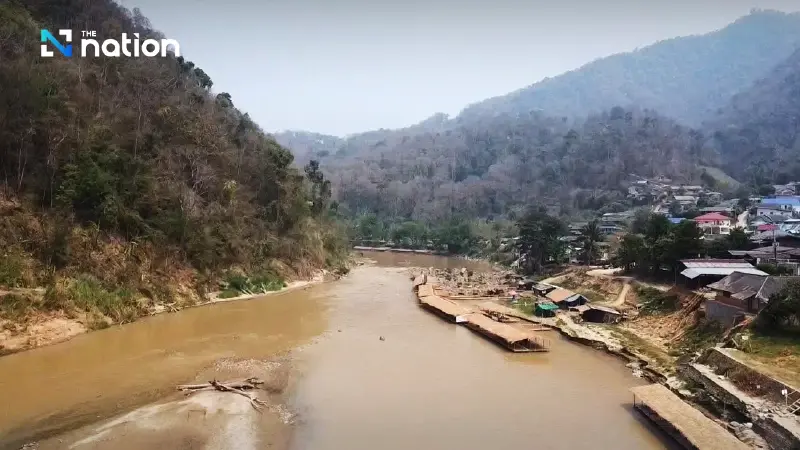


Heavy metal contamination leaves thousands without clean water as campaigners demand urgent state funding and fresh water alternatives
- Civil society groups and health experts are urging the government to declare the heavy metal contamination of the Kok River a national agenda to address a transboundary pollution crisis.
- The pollution has created a severe socio-economic crisis for northern communities, causing incomes from river-based livelihoods to collapse while forcing families to pay high costs for safe water.
- High concentrations of heavy metals like arsenic and mercury pose a significant long-term health threat through bioaccumulation, yet affected residents have not received any official health screenings.
- The call for national action is driven by a failing state response, with bureaucratic red tape crippling comprehensive water testing and an inability to trace the pollution's source.
Heavy metal contamination leaves thousands without clean water as campaigners demand urgent state funding and fresh water alternatives.
Civil society networks and public health experts are piling pressure on the government to declare the heavy metal contamination of the Kok River a national agenda.
The transboundary pollution crisis has devastated local economies, left indigenous river communities without safe drinking water, and triggered severe health fears over toxic bioaccumulation.
The alarm was raised following an investigation by Sujanya Sunthonphoncharoen, the health and wellness editor at Thansettakij.
Citing findings from Songpon Tulata, director of the Northern Public Policy Office at the National Health Commission Office (NHCO), the report highlighted a critical failure in public data coordination during the peak of the contamination crisis across the Kok, Ruak, and Mekong basins.

To combat this data deficit, the NHCO collaborated with Chiang Mai University’s Faculty of Public Health to execute a Rapid Health Impact Assessment (Rapid HIA).
Surveying 424 residents across Chiang Mai and Chiang Rai provinces, the study exposed a catastrophic socio-economic reality for the region’s vulnerable farming communities.

Families pushed to the brink by water costs
The assessment revealed that while the vast majority of residents survive on fewer than 5,000 Baht a month, an overwhelming 91 per cent had noticed physical abnormalities in the river water.
Approximately 70 per cent have been forced to fundamentally alter their daily habits—suspending all river activities and relying entirely on boiling, filtering, or purchasing bottled water.
This ecological disaster has delivered a double blow to household finances:
Income Collapse: Some 63 per cent of households have seen their monthly earnings drop by an average of 1,200 to 1,300 Baht due to the complete halt of local tourism and traditional river-based livelihoods.
Surging Expenditures: Conversely, families are facing a punishing additional cost of 2,600 Baht per month just to procure safe, clean water for basic utility and consumption.
Alarmingly, despite environmental checkpoints repeatedly showing that heavy metal concentrations exceed safe limits, not a single person surveyed had ever been provided with an official health screening.

Red tape cripples local water testing
Academics have warned that the state's existing defensive mechanisms are failing. Dr Suebsakun Kidnukorn, an international development lecturer at Mae Fah Luang University, compared the daily consumption of the river's micro-contaminants to smoking.
He cautioned that even if official reports claim toxins remain within "permissible limits", the continuous bioaccumulation poses an insidious, long-term threat to human tissue.

The crisis has been exacerbated by administrative blunders. Local waterworks authorities conventionally dispatch raw water samples to a specialised laboratory in Bangkok for comprehensive screening.
However, internal bureaucratic procurement bottlenecks have frozen this testing pipeline.
Instead, technicians have been forced to rely on basic field test kits that check for just three types of heavy metals, down from the standard seven. Furthermore, state agencies have been unable to trace or identify the definitive industrial or transboundary sources of the contaminants found in local soil and flora.

A silent killer on a ten-year timeline
For those living on the riverbank, the changing face of the water is an existential threat. Parathakorn Karnrew, the village chief of Mae Yao subdistrict, described the Kok River as a former lifeline turned "silent killer".
"It might not claim lives instantly, but the full impact will manifest over the next five to ten years," Parathakorn warned. "Local residents have two choices: stay silent and accept our fate, or stand up alongside academic and civil networks to breathe life back into this river."
Acknowledging that international diplomacy and legislative shifts could take a decade to yield results, Parathakorn urged the government to immediately fund infrastructure to divert water from two pristine local upstream sources—Huay Mae Sai and Song Khwae Phatthana—to sustain his village in the interim.
The urgency is underscored by severe environmental anomalies witnessed over the last two years. Somkiat Khuanchiangsa, president of the Living River Association, noted that following the catastrophic mega-floods, the Kok River never regained its natural clarity.
Furthermore, fish populations downriver have begun developing severe blister-like lesions and nodules. Laboratory dissections of these mutations have confirmed high accumulations of arsenic and mercury—a grim ecological indicator that the toxic plume is actively migrating further into the broader Mekong River system.
