
Thailand Eyes Middle East Expansion Through Halal Economy Infrastructure Pact with Bahrain


Kingdom positions itself as a regional hub via a Songkhla industrial development and logistics ties, Krungthep Turakij reports
- Thailand is partnering with Bahrain to establish a strategic logistics gateway into the Middle East's expanding halal market.
- The collaboration will utilize Bahrain's "Sea to Air Logistics Hub," which can efficiently transfer cargo from deep-sea ports to international airports in under two hours.
- Thailand is developing its Chana Industrial Estate in Songkhla province as a major regional halal manufacturing hub to supply goods for this new trade route.
- As part of the pact, Bahrain will provide technical support for Thai agriculture and livestock breeding to ensure products meet the quality standards for export to the Middle East.
Kingdom positions itself as a regional hub via a Songkhla industrial development and logistics ties, Krungthep Turakij reports.
Thailand is aggressively accelerating its infrastructure and trade strategies to capture a dominant share of the rapidly expanding global halal market. By forming strategic logistics and agricultural partnerships with Bahrain, the Thai government aims to establish a definitive gateway into the lucrative Middle East consumer base.
According to data compiled by Krungthep Turakij, the global halal economy is experiencing an unprecedented boom despite widespread macroeconomic uncertainties.
Research from Islamic economic institute Salaam Gateway estimated the global halal market at $2.35 trillion, with food and beverage products accounting for a staggering 58.7 per cent split, valued at $1.38 trillion.
The remaining market share consists of fashion (13.2 per cent), media and recreation (11.5 per cent), tourism (8.9 per cent), pharmaceuticals (4.5 per cent), and cosmetics (3.2 per cent). By 2027, the total sector is projected to hit $3.10 trillion, fuelled by an 11 per cent annual surge in halal food demand alone.
Intermodal logistics and a southern industrial hub
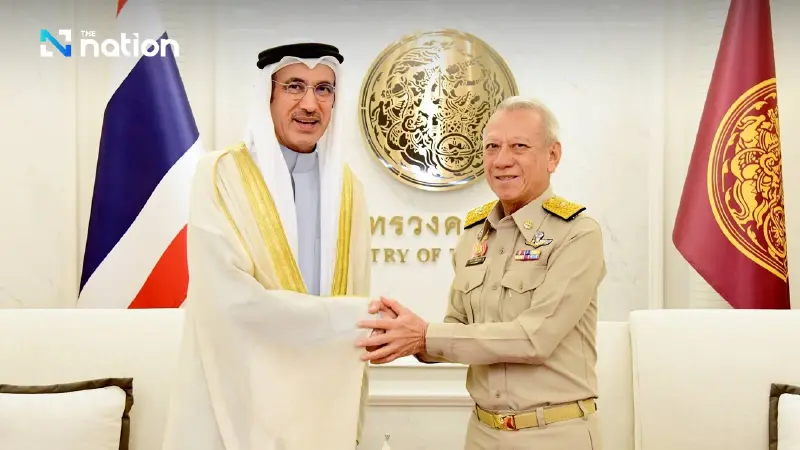
To secure a front-runner position in this booming industry, Deputy Prime Minister and Minister of Transport Phiphat Ratchakitprakarn hosted H.E. Khalil Yaqoob Al Khayat, the Ambassador of Bahrain to Thailand, to celebrate nearly 50 years of bilateral relations and map out integrated logistics networks.
During the diplomatic session, Bahrain pitched its "Sea to Air Logistics Hub" blueprint. The proposal leverages Bahrain's advanced domestic infrastructure, which can seamlessly transition cargo from deep-sea ports to international airport runways in under two hours. The Thai Ministry of Transport has accepted the framework for further development.
Concurrently, Thai officials pushed forward the Chana Industrial Estate Development Project in Songkhla Province as a cornerstone of its domestic economic agenda.
The government intends to develop this zone into a major regional halal manufacturing hub, aimed at stimulating employment, specialised careers, and long-term income across the five southern border provinces.
The Bahraini ambassador expressed strong support for the project, pledging technical consultations regarding crop cultivation and optimised livestock breeding. This technology transfer is designed to enable local Muslim producers to yield premium-grade raw materials that feed directly into the industrial estate for onwards export to the Middle East.
Targeted hospitality and medical tourism pipelines
The Ministry of Transport is also rolling out socio-cultural infrastructure upgrades to accommodate regional travel preferences. Plans are underway to install dedicated, gender-segregated prayer cabins on long-distance southern line trains, allowing Muslim passengers to perform their daily prayers seamlessly whilst travelling.
This initiative complements broader efforts discussed during a separate meeting between the Bahraini Ambassador and Deputy Prime Minister and Minister of Interior Anutin Charnvirakul. The two leaders agreed to build on bilateral strengths in trade, mutual investments, food security, and specialized medical tourism.
According to Krungthep Turakij, Thailand remains a premium destination for Bahraini citizens seeking advanced medical care, with arrivals reaching over 30,000.
Bahraini officials noted that because their island nation is positioned adjacent to Saudi Arabia and other major Gulf Cooperation Council (GCC) markets, it stands ready to act as a primary entry point for Thai goods seeking deep market penetration across the Middle East.
