From scam hubs to slave mines — SHRF exposes border horror
THURSDAY, MAY 21, 2026
Play
SHRF alleges trafficked scam-centre workers in Myanmar were sold into Chinese rare earth mines near Thailand under armed protection
A major report released by the Shan Human Rights Foundation (SHRF) has alleged systematic links between Chinese-run online scam operations in eastern Shan State and rare earth mining businesses near the Thai border, with trafficked workers reportedly forced into slave-like labour under the protection of armed groups and corrupt officials.
The report, published on May 19, centres on the testimony of a 25-year-old survivor identified under the pseudonym “Ko Tet”, who said he was trafficked from an online scam compound in Tachileik to a rare earth mining site near Mong Yawn, less than eight kilometres from Thailand’s border along the Kok River basin.
According to SHRF, the case highlights not only the growing scale of transnational trafficking networks operating in Myanmar’s border regions, but also mounting environmental risks that could eventually affect communities in northern Thailand.
From scam compounds to forced labour camps
Tachileik, opposite Mae Sai district in Chiang Rai province, has become one of Southeast Asia’s major centres for online scam operations in recent years, particularly after the “Operation 1027” crackdown in northern Shan State forced many Chinese scam syndicates to relocate southwards.
SHRF said many of these operations were hidden inside casino complexes and large hotels, locally referred to as “online foreign jobs”.
One location highlighted in the report was Yong Nee Oo Resort, an extensive compound allegedly controlled by the United Wa State Army (UWSA). The site, previously linked to corruption and narcotics activity, has reportedly been transformed into a heavily guarded hub housing at least five Chinese scam companies.
Ko Tet said he had initially accepted an accounting job there in 2025 after being promised high earnings. However, he alleged that workers’ treatment depended entirely on the whims of Chinese supervisors.
He claimed he and a colleague were later accused of mishandling financial transfers and concealing information. When they denied the accusations, they were allegedly ordered to repay 43,000 yuan or continue working without pay. Refusal, he said, carried the threat of being handed over to authorities and forcibly conscripted into military service.
The report further alleged that when rumours spread in April 2026 that police planned to raid the Yong Nee Oo compound, company managers instead arranged for indebted workers to be transferred elsewhere as a form of “debt sale”.
Ko Tet said he and two others were driven overnight under armed escort through police checkpoints without inspection.
According to his testimony, the convoy was waved through after the escort greeted officers at a major checkpoint west of Tachileik. SHRF alleged the escort was later identified as a sergeant linked to Myanmar’s anti-trafficking task force, raising serious allegations of official corruption and state complicity in trafficking networks.
Chinese rare earth mines accused of using slave labour
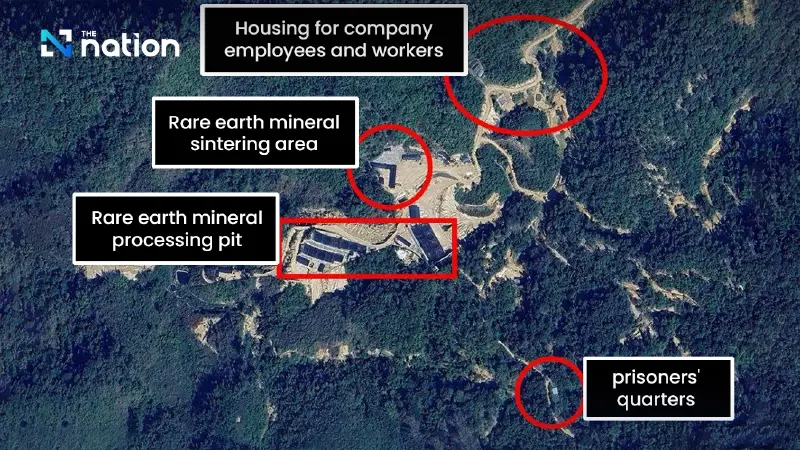
The report alleged the victims were eventually taken to rare earth mining operations in Mong Yawn, south of Mong Sat, where a Chinese state-linked mining company was operating extraction sites.
Instead of office work, Ko Tet said he was confined in prison-like accommodation where workers were chained to wooden posts at night.
SHRF described the working conditions as extremely dangerous and inhumane.
Workers were allegedly forced to dig soil, carry chemical containers and transport processed minerals under constant surveillance. The mining process reportedly involved strong acids and toxic chemicals, while labourers were given only basic surgical masks for protection.
The report also detailed alleged physical punishment for escape attempts. One worker identified as “Jai Muang” was reportedly beaten by Wa soldiers and tied to a tree overnight after trying to flee.
Food supplies were described as severely inadequate, with workers allegedly surviving on little more than rice water, steamed buns and boiled vegetables.
Environmental fears near Thailand
SHRF warned that the mining sites were located along the Kok River, a major waterway flowing from Shan State into Chiang Rai province in Thailand.
The organisation alleged that mining activities were proceeding without proper environmental safeguards, potentially allowing hazardous chemicals to contaminate the river system and threaten downstream ecosystems and public health on both sides of the border.
The report said the mines were protected by around 50 Wa soldiers, effectively creating heavily militarised zones beyond meaningful international oversight.
SHRF further alleged that periodic raids by Myanmar authorities were often little more than opportunities for bribery collection from Chinese managers, with payments reportedly ranging from 50,000 to 100,000 baht per worker.
Calls for international action
The organisation argued that the crisis reflected broader political instability inside Myanmar and called for long-term democratic reforms and stronger local control over natural resources.
SHRF urged regional governments, particularly within ASEAN, to treat mining pollution and human trafficking as interconnected regional security issues rather than isolated domestic problems.
The group also called on companies involved in rare earth supply chains to strengthen due diligence and ensure minerals were not sourced from conflict zones linked to forced labour.
The report warned that many of the rare earth minerals used in modern technologies, including smartphones and electric vehicles, may come at the cost of exploitation and human suffering hidden within Myanmar’s borderlands.
Ko Tet reportedly escaped in June 2025, although the fate of several former co-workers remains unclear.
The report cited one colleague, “Ko Myo”, as still missing, while another worker, “Jai Muang”, was allegedly rescued by relatives before later being detained again in China.
SHRF said the case represented only a fraction of a much wider humanitarian crisis unfolding quietly across Shan State.