
Stargazers invited to watch Moon meet Beehive Cluster from 10pm
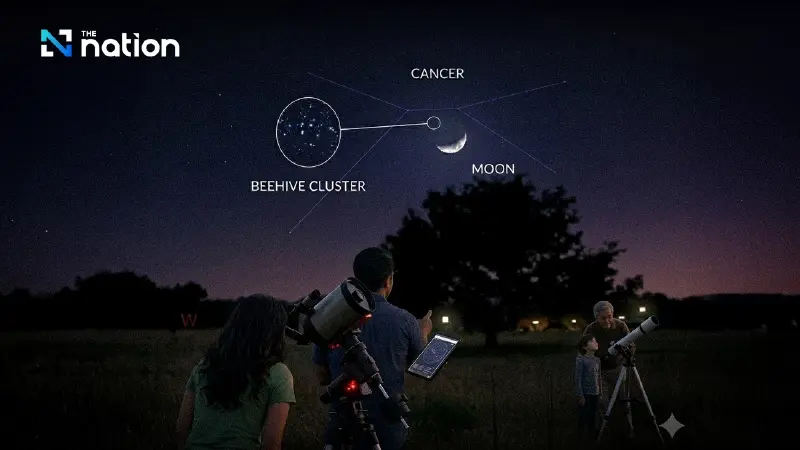


NARIT says the Moon will cross the Beehive Cluster in the western sky from 10pm to 11.20pm on May 21, with the phenomenon best viewed from dark areas.
Stargazers in Thailand will have a chance to observe the Moon passing across the Beehive Cluster on Thursday night (May 21), with the phenomenon visible in the western sky from around 10pm to 11.20pm.
According to the National Astronomical Research Institute of Thailand (NARIT), the Moon will appear to pass in front of the Beehive Cluster, one of the best-known open star clusters in the night sky.
NARIT advised those hoping to watch the event to choose a dark location away from city lights, as the Beehive Cluster is relatively faint. The view is expected to be much clearer and more impressive through binoculars or a small telescope.
What is the Beehive Cluster?
The Beehive Cluster, also known as Praesepe, is an open star cluster in the constellation Cancer. Its Latin name is often translated as “manger”, “crib” or “enclosure”.
It is among the closest open star clusters to Earth and contains a large number of stars, with about 1,000 identified members. Under dark skies, it can appear to the naked eye as a small misty or nebula-like patch.
The cluster has been known since ancient times. The classical astronomer Ptolemy described it as a nebula-like mass within Cancer, while Galileo later made it one of the early celestial objects he studied through a telescope.

Astronomers have also noted similarities between the Beehive Cluster and the Hyades Cluster, including their age and motion, suggesting they may share a similar origin. Both clusters contain red giants and white dwarfs, which represent later stages of stellar evolution, as well as many main-sequence stars.
The Beehive Cluster spans about 1.5 degrees across the sky, making it suitable for viewing through binoculars or a small low-magnification telescope. Regulus, Castor and Pollux can also be used as guide stars to help locate the cluster.
