
Two comets may be visible to the naked eye this April: NARIT
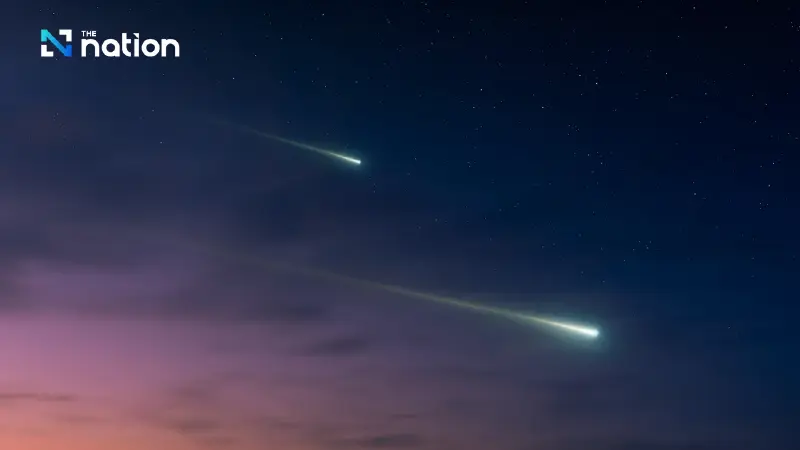


NARIT says Thai skywatchers may have a chance to spot two comets in April — C/2026 A1 (MAPS) and C/2025 R3 (PanSTARRS).
The National Astronomical Research Institute of Thailand (NARIT) said that people in Thailand may get the chance to see two comets in April: C/2026 A1 (MAPS) and C/2025 R3 (PanSTARRS). The two are expected to reach peak brightness in early April and after Songkran, respectively, and both may become bright enough to be seen with the naked eye.
C/2026 A1 (MAPS)
Comet MAPS belongs to the Kreutz sungrazer group, meaning it will pass very close to the Sun and may become bright enough to be visible without a telescope. It is expected to make its closest approach to the Sun on April 4, 2026, and its closest approach to Earth on April 6, 2026, at a distance of 143.7 million kilometres.
Its peak brightness is forecast at magnitude -4, making it potentially visible to the naked eye and roughly as bright as Comet Tsuchinshan-ATLAS in 2024.
However, it remains uncertain whether the comet will survive the Sun’s intense radiation as it passes so close. If it does, it could become a striking object in the evening sky from April 4 onwards. If not, it may break apart and fade into space.
The best time to observe Comet MAPS is therefore from April 4 onwards in the early evening, looking towards the west. April 6 is expected to be especially favourable, as that is when the comet will be closest to Earth and will already have passed its closest point to the Sun, while also appearing farther from the Sun in the sky, making it easier to spot.
Real-time information on C/2026 A1 (MAPS) is available here.
C/2025 R3 (PanSTARRS)
Comet PanSTARRS is believed to have originated in the Oort Cloud, the outermost shell of the Solar System filled with icy bodies. It is expected to make its closest approach to the Sun on April 19, 2026, and its closest approach to Earth on April 26, 2026, at a distance of 73.2 million kilometres.
Its peak brightness is forecast at around magnitude 4, meaning it may be visible to the naked eye in areas free from light pollution. It is expected to be similar in brightness to Comet Lemmon in 2025.
The best time to observe Comet PanSTARRS will be from April 18 to 23 in the early morning, looking east. April 19 is expected to be a particularly good date, because although it will be at its closest point to the Sun, it will still appear at a fairly wide angle from it in the sky.
However, when the comet is closest to Earth, it will not be visible because it will rise and set with the Sun. Skywatchers may get another chance to see it from April 28 onwards in the early evening, looking west.
Real-time information on C/2025 R3 (PanSTARRS) is available here.
