
NARIT: 10 must-see sky events in 2026
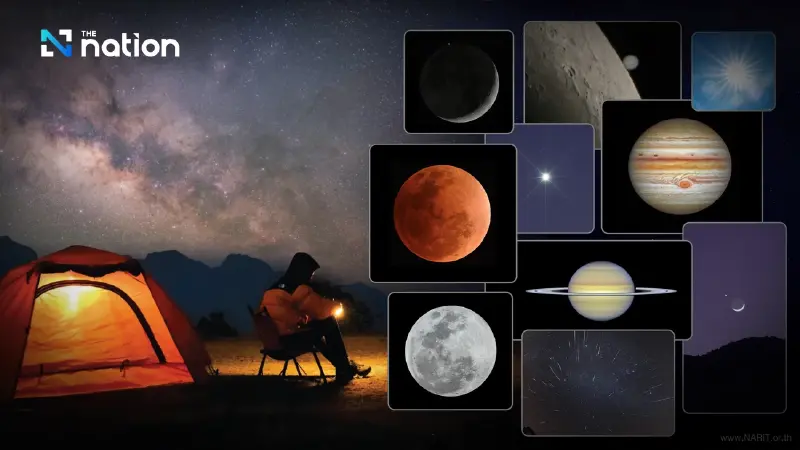


NARIT lists 10 astronomy highlights for 2026, including a total lunar eclipse on March 3, major meteor showers, and a super full moon on December 24
Thailand’s National Astronomical Research Institute (NARIT) has published a list of 10 astronomy phenomena to watch in 2026, featuring a total lunar eclipse, major meteor showers, the Sun passing directly overhead in Thailand, and the year’s closest and farthest full moons.
The 10 highlights are:

1) Jupiter closest to Earth of the year — January 10, 2026
Jupiter reaches opposition, placing it opposite the Sun in the sky and at its closest distance to Earth for the year, about 633 million kilometres away. It can be observed all night. With a telescope of 30x magnification or more, observers can see the Galilean moons and Jupiter’s cloud bands. At 100x or more, the Great Red Spot — a giant storm larger than Earth by about 1.3 times — can be seen clearly. This occurs roughly every 13 months.

2) Total lunar eclipse — March 3, 2026 (Makha Bucha Day)
The eclipse runs roughly 3.44pm–9.23pm Thailand time. In Thailand, the Moon becomes visible above the eastern horizon at around 6.23pm (Bangkok time), during the total eclipse phase, when the full Moon appears brick red until about 7.02pm. A partial eclipse follows until the event ends around 9.23pm. Visible to the naked eye nationwide.

3) Farthest and closest full moons of the year
Micro Full Moon / “Micro Blue Moon” — May 31, 2026 (Visakha Bucha Day): the year’s farthest full Moon, and the second full Moon of the month (a Blue Moon), making it a “micro blue moon”, appearing slightly smaller than usual.
Super Full Moon — December 24, 2026 (Christmas Eve): the year’s closest full Moon, appearing slightly larger than usual.

4) The Moon occults Venus — September 14, 2026
From about 7.28pm–8.34pm (Bangkok time), the Moon moves in front of Venus in the western sky after sunset. In Thailand, the Moon sets at around 8.24pm, so observers will not see the full event, but can still watch the key first part if skies are clear.

5) Venus at its brightest — twice in 2026
September 22, 2026: brightest in the evening western sky
November 27, 2026: brightest in the morning eastern sky
Through a telescope, Venus appears as a crescent, similar to the Moon.

6) Saturn closest to Earth of the year — October 4, 2026
Saturn reaches opposition, coming closest to Earth at about 1,261 million kilometres. It can be observed all night. This occurs about every 378 days.

7) The Moon occults Jupiter — early morning November 3, 2026
The Moon passes in front of Jupiter. In Thailand, it is visible to the naked eye only in the South and some islands in Trat, while other areas will see Jupiter near the Moon through the night.

8) Meteor showers to watch (minimal moonlight interference)
Lyrids: April 22–23 (about 18 per hour)
Perseids: August 12–13 (about 100 per hour)
Orionids: October 21–22 (about 20 per hour)
Southern Taurids: November 5–6 (about 10 per hour)
Northern Taurids: November 12–13 (about 5 per hour)
Leonids: November 17–18 (about 15 per hour)
Geminids: December 14–15 (about 150 per hour)
Viewing depends on weather. For best results, choose a dark location away from city lights and watch with the naked eye.

9) Moon–planet pairings and planet gatherings
Notable dates include April 16 (Moon near Mercury, Mars and Saturn), April 19–23 (Mercury, Mars and Saturn gathering), June 10 (Venus near Jupiter), and multiple Moon–planet alignments through November and December, including Mars near Jupiter and Regulus.

10) The Sun directly overhead in Thailand — twice each year
Thailand experiences two annual periods when the Sun passes near the zenith.
First period (April–May): Bangkok on April 27, 2026, ending in the North in May.
Second period (July–September): Bangkok on August 16, 2026, ending in the South in September.
At zenith time, shadows fall directly beneath objects, appearing almost “shadowless”.
NARIT said people can follow these events on the listed dates and times, or track updates via its official channels. www.facebook.com/NARITpage https://www.narit.or.th/th/10-astronomical-phenomena-in-2026
