
NASA launches Thai liquid crystal research to space for the first time
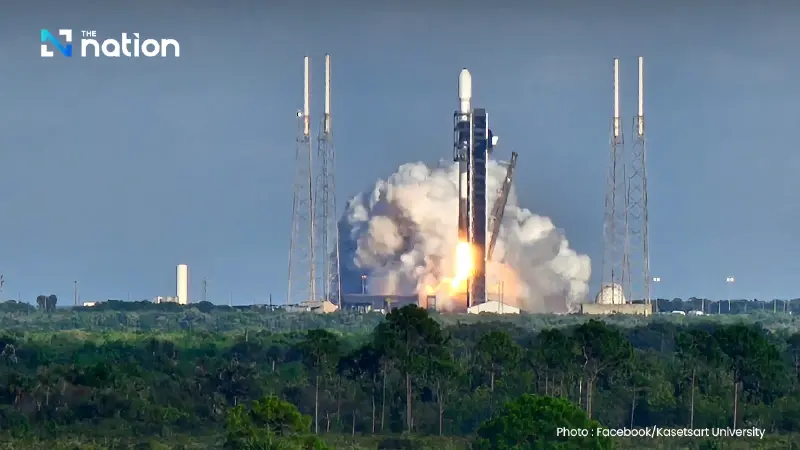


The National Aeronautics and Space Administration (NASA) has welcomed Thai scientific research into orbit for the first time, with a project on liquid crystals developed by Kasetsart University successfully launched to the International Space Station (ISS).
At 5.11am on Monday (September 15), SpaceX’s Falcon 9 rocket lifted off from Cape Canaveral, Florida, carrying the Cygnus spacecraft (NG-23 mission) on a resupply run to the ISS. On board was the Thailand Liquid Crystals in Space (TLC) experiment — marking the first time Thai research has joined a NASA space mission.
The TLC project explores liquid crystal behaviour in microgravity and was developed by a team of researchers at Kasetsart University. Its inclusion in NASA’s Commercial Resupply Service (CRS) mission underscores Thailand’s growing presence in global space science.
A Thai delegation led by Acting President of Kasetsart University Damrong Sripraram attended the launch, alongside officials from the Thailand Science Research and Innovation (TSRI), the Program Management Unit for Human Resources & Institutional Development, Research and Innovation (PMU-B), and the Geo-Informatics and Space Technology Development Agency (GISTDA).
Robyn Gatens, Director of the ISS at NASA, and Robert Hampton, Director of Payload Operations at the US ISS National Lab, congratulated the Thai research team and praised their achievement as a significant step forward for international scientific collaboration.

Six years of perseverance culminate in pride on the world stage
Natthapon Chattham, from the Department of Physics at Kasetsart University and head of the TLC project, shared her emotions at the historic moment:
“During the pre-launch briefing, NASA formally welcomed the team from Thailand. At that moment, I felt deeply moved that more than six years of effort had finally led to recognition by one of the world’s leading space agencies, allowing Team Thailand to become part of the ISS experiment programme.”
“When the Falcon 9 rocket lifted off, it was truly overwhelming. It symbolised that both I and my team had overcome the many challenges and struggles, and that Thailand has now been recognised on the international stage.”

Inside the TLC mission and technology
The TLC project will run for three months aboard the ISS, with a total of 144 experimental hours carried out by NASA astronauts under instructions from the Thai research team. The Thai scientists will be stationed at two ground control centres in the United States — Houston, Texas, and Boulder, Colorado.
At the heart of the project is a carefully engineered payload comprising two main components:
- Control Module — Weighing 15.7 kilograms, this module acts as the system’s support unit. It regulates the supply of electricity (up to 120 watts), water, and air to the second module. It will be integrated with the existing KERMIT microscope aboard the ISS.
- Image Module — Weighing 4.0 kilograms, this module creates liquid crystal films on specially designed experimental plates, enabling researchers to observe and record changes in the crystals in microgravity.
The entire experiment will be monitored in real time through the ISS network, with high-resolution video data stored on a 6-terabyte SSD hard drive.
Once the mission is complete, the TLC payload and all collected data will return to Earth aboard SpaceX-33 in January 2026. The materials will then be sent to Thailand for in-depth analysis by the research team and students, opening the door to new knowledge and inspiring future generations of Thai scientists.
