
NASA discovers ‘Sapphire Canyon’ rock on Mars, hinting at ancient life
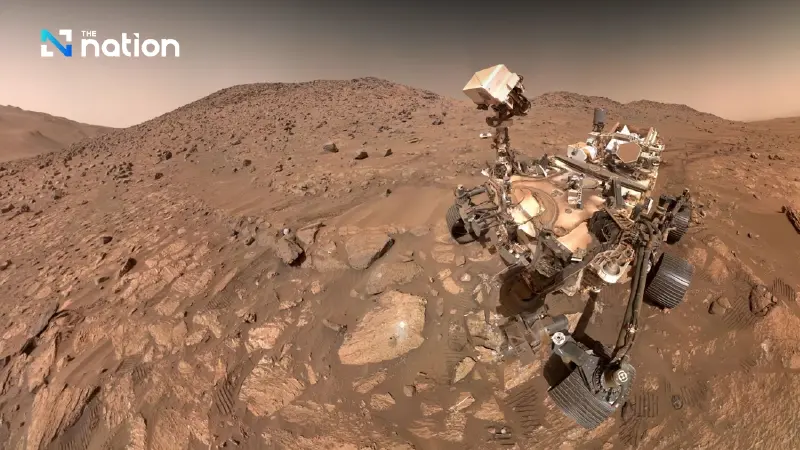


NASA has announced the discovery of a Martian rock sample that may preserve traces of ancient life, describing it as the clearest evidence yet of possible biosignatures on the Red Planet.
The rock, named Sapphire Canyon, was collected in July 2024 by the Perseverance rover in Jezero Crater, a site believed to have once been an ancient lake. Scientists revealed that the rock contains minerals such as vivianite and greigite, both typically linked with microbial activity in sediments on Earth.
Researchers also detected organic compounds with structures resembling biological residues, arranged in patterns unlikely to be formed by ordinary geochemical processes.

This is the most confident I have felt in over 20 years of working on Mars missions that we may be looking at a potential biosignature, said Joel Hurowitz, a planetary scientist at Stony Brook University and lead author of the study.
He noted that microbes on Earth often form these minerals as metabolic by-products in wetland or lake environments.
Still, the evidence remains inconclusive. Non-biological chemical reactions could also have created the minerals, prompting Hurowitz to admit he would only bet a modest sum that the rock holds proof of past life.

Janice Bishop, a senior scientist at the SETI Institute, described the finding as exciting, saying it reinforces the view that Mars once had conditions favourable for life. However, she cautioned that abiotic explanations remain highly plausible.
The rock displays distinctive “poppy seed” and “leopard spot” textures where the minerals are concentrated—patterns strikingly similar to microbial sediments found on Earth.
Despite the tantalising clues, the final answer may take years. NASA’s Mars Sample Return mission, originally designed to bring rock samples back to Earth, has been delayed due to ballooning costs exceeding US$11 billion. The US government has even proposed cancelling the mission altogether.
Until samples like Sapphire Canyon and Cheyava Falls can be examined with advanced instruments on Earth, the mystery of Martian life is likely to remain unresolved. The final answer may have to wait until the samples can be analysed on Earth with more advanced technology.
