
Thammasat tops world for peace and justice as Thai universities gain THE 2026 recognition



Thammasat University has been ranked No.1 globally for Peace, Justice and Strong Institutions in THE Sustainability Impact Ratings 2026, while 21 Thai universities earned places in the Times Higher Education World University Rankings 2026.
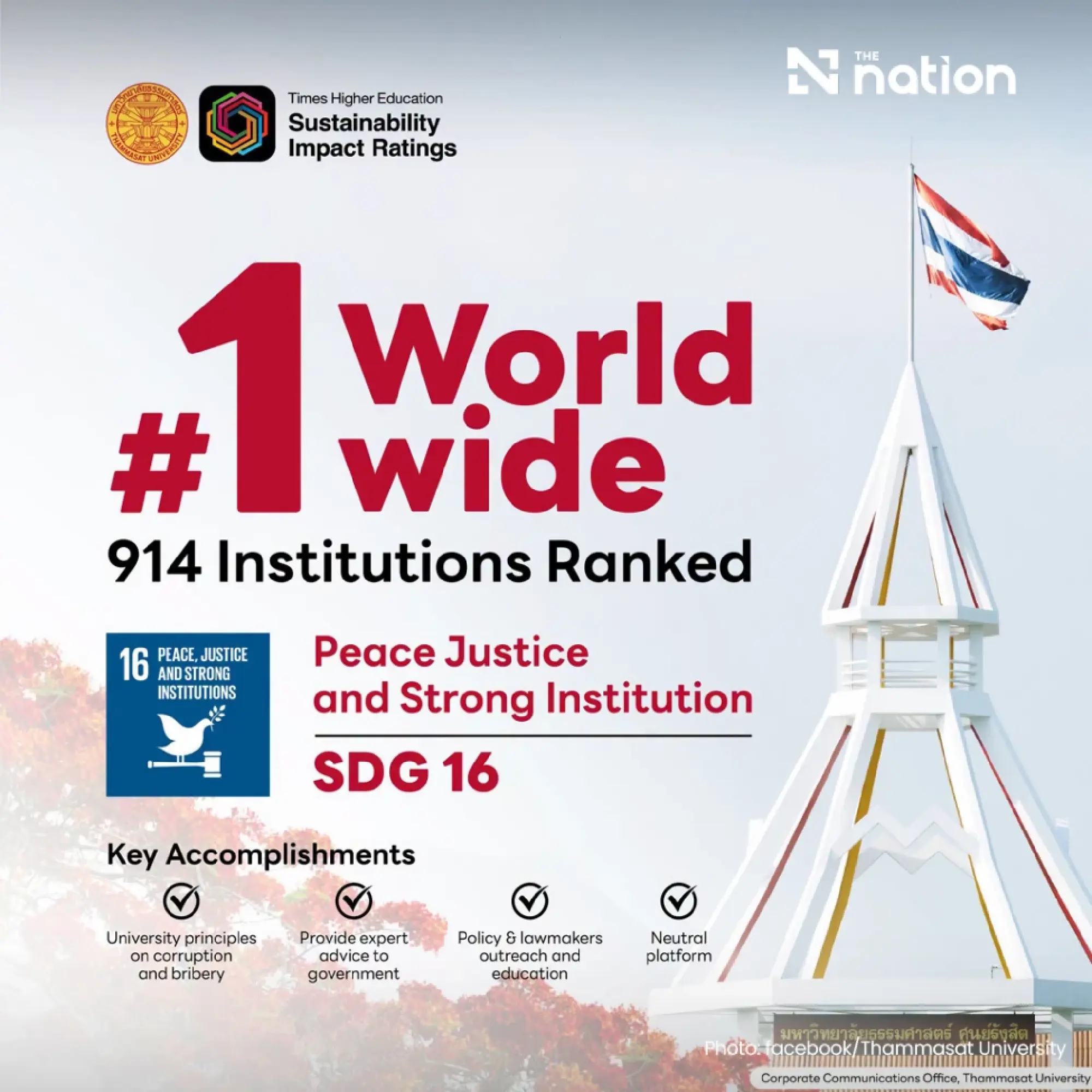
Thammasat University has emerged as Thailand’s standout institution for social impact after being ranked No.1 in the world for SDG 16: Peace, Justice and Strong Institutions in the Times Higher Education Sustainability Impact Ratings 2026.
The achievement gives Thailand a global leadership position in one of the most politically and socially significant categories of the rankings, which assess how universities contribute to inclusive societies, access to justice, transparent governance and strong institutions.
According to Times Higher Education, the SDG 16 table surveyed 914 universities from 103 countries and territories, with Thammasat named the world’s top university in the category. THE said universities ranked in SDG 16 are assessed on their work in advancing inclusive societies, justice, transparent institutions, anti-discrimination efforts, violence prevention and contributions to legal and governance frameworks.

Thammasat’s founding identity matches SDG 16 strength
The result is particularly significant because it aligns closely with Thammasat’s institutional identity.
THE describes Thammasat as Thailand’s second-oldest university, established in 1934, and notes its roots in democracy, social justice and public service. The university was originally founded as the University of Moral and Political Sciences after the 1932 revolution to educate citizens on democratic principles.
That historical profile gives the SDG 16 ranking added weight. Rather than being a narrow sustainability achievement, it reinforces Thammasat’s long-standing image as a university associated with law, politics, public administration, civic engagement and social responsibility.
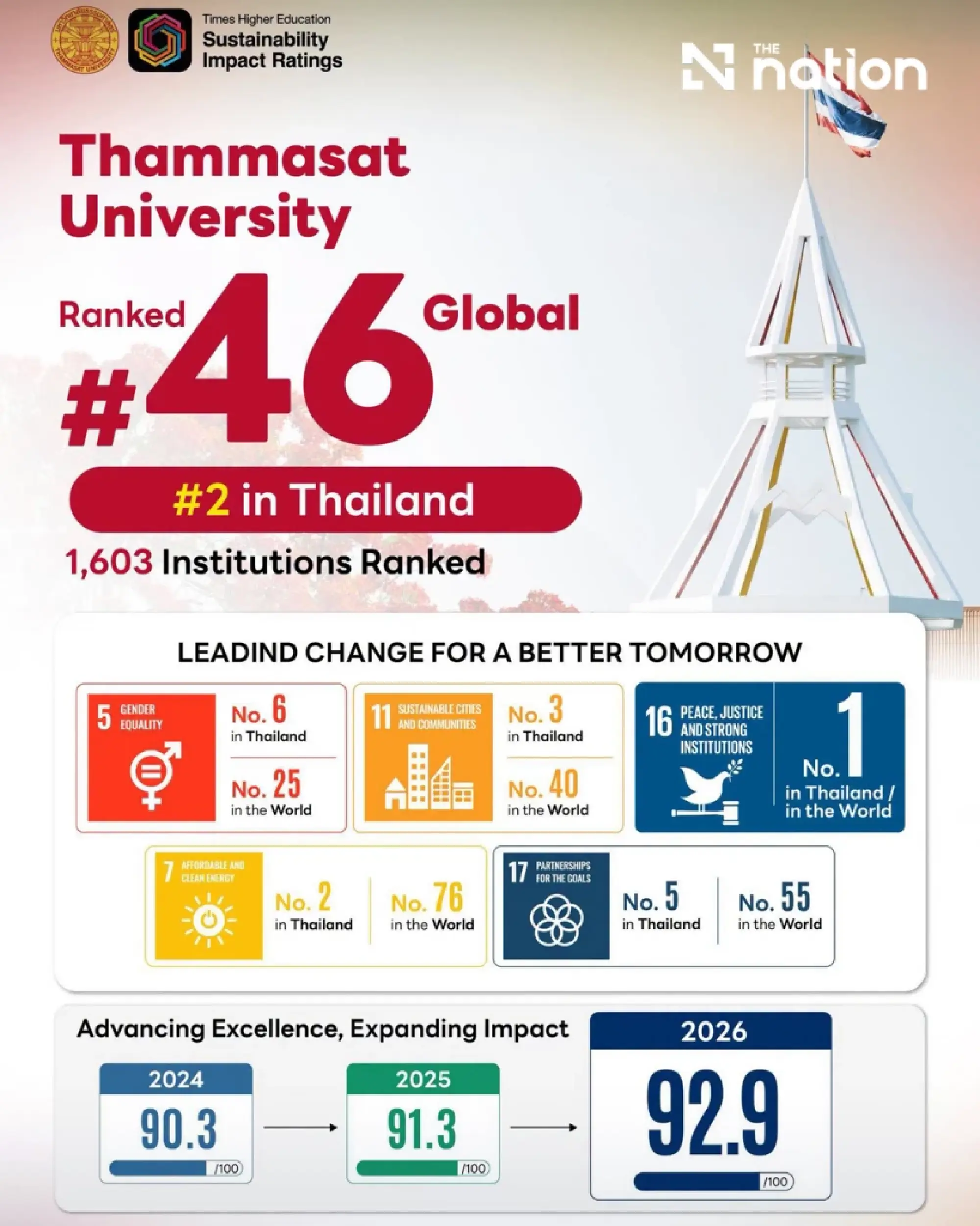
In the overall THE Sustainability Impact Ratings 2026, Thammasat was ranked 46th globally, while its strongest individual results included 1st for SDG 16, 25th for Gender Equality, 40th for Sustainable Cities and Communities, 76th for Affordable and Clean Energy, and joint 55th for Partnerships for the Goals.

Thailand’s broader SDG performance also stands out
Thailand’s performance in THE’s sustainability rankings was not limited to Thammasat.
The 2026 Sustainability Impact Ratings covered 1,646 universities from 116 countries and territories, assessing institutions across 17 individual SDG tables and one overall ranking. Thailand was among the most represented systems, with 69 universities ranked in the overall Sustainability Impact Ratings 2026. Chulalongkorn University was Thailand’s top-ranked institution overall, placed 19th globally.
Thailand also secured another global No.1 position, with Mahidol University ranked top in the world for SDG 3: Good Health and Well-being, according to THE’s list of top-ranked universities for each SDG.
These results show that Thai universities are gaining recognition not only through traditional academic rankings, but also through impact-based performance in health, governance, equality, sustainability and community engagement.
21 Thai universities ranked in THE World University Rankings 2026
In the broader Times Higher Education World University Rankings 2026, Thai universities also maintained a visible presence.
THE said the 2026 World University Rankings included 2,191 institutions from 115 countries and territories. The global table evaluates research-intensive universities across core missions including teaching, research, knowledge transfer and international outlook.
Among Thai institutions, 21 universities were globally ranked out of 31 Thai submissions, according to data reported by Suranaree University of Technology from the THE WUR 2026 results. The Thai entries were distributed across ranking bands, with one university in the 501–600 band, one in 601–800, one in 801–1,000, two in 1,001–1,200, six in 1,201–1,500, and ten in the 1,501+ band.
Chulalongkorn leads Thailand in overall WUR ranking
Chulalongkorn University remained Thailand’s highest-ranked university in the THE World University Rankings 2026, placed in the 501–600 global band.
Mahidol University followed in the 601–800 band, while King Mongkut’s University of Technology Thonburi was ranked in the 801–1,000 band.
Chiang Mai University and Mae Fah Luang University were placed in the 1,001–1,200 band, while Thammasat University was ranked in the 1,201–1,500 band, alongside Khon Kaen University, Prince of Songkla University, Suranaree University of Technology, Walailak University and King Mongkut’s University of Technology North Bangkok.
The rankings highlight the different strengths of Thai higher education: Chulalongkorn’s broad academic profile, Mahidol’s health and life-science leadership, KMUTT’s technology and industry links, and Thammasat’s social-science, law, governance and civic-impact identity.
THE 2026 methodology rewards research quality and global impact
The World University Rankings 2026 are based on five core pillars: Teaching, Research Environment, Research Quality, International Outlook and Industry. THE uses 18 performance indicators, with Research Quality carrying the largest weighting at 30%, followed by Teaching at 29.5% and Research Environment at 29%. International Outlook accounts for 7.5%, while Industry accounts for 4%.
This structure means Thai universities are being assessed not only on domestic reputation or teaching scale, but also on research output, citation performance, international collaboration, industry links and the ability to transfer knowledge into wider social and economic use.
For Thai institutions, the data suggests a mixed but encouraging picture. Several universities recorded relatively strong scores in Industry, reflecting their ability to connect research with practical application. However, the wider challenge remains raising research environment and research quality scores to compete with leading universities in East Asia, Europe and North America.
Impact rankings give Thai universities a second route to global visibility
The most important message from the 2026 results is that global university recognition is no longer measured only by traditional research rankings.
THE’s Sustainability Impact Ratings focus on how universities contribute to the United Nations Sustainable Development Goals. THE said the rankings encourage institutions to consider what universities are “good for”, not only what they are “good at”, and require evidence of real initiatives and outcomes.
This creates an opening for Thai universities to build global reputation through areas where they have strong social, community and policy roles.
Thammasat’s No.1 position in SDG 16 is the clearest example. While the university is not Thailand’s highest-ranked institution in the overall WUR table, it has achieved a global leadership position in peace, justice and institutional development — an area closely tied to its founding mission and public-service tradition.
Thai higher education gains a stronger international profile
The combined results from THE’s World University Rankings 2026 and Sustainability Impact Ratings 2026 show that Thai universities are becoming more visible in two different ways.
The first is through traditional academic performance, where Chulalongkorn, Mahidol and KMUTT continue to lead Thailand in the global WUR table.
The second is through impact-based performance, where Thai universities have achieved global recognition in areas such as health and governance.
For Thammasat, the SDG 16 result is more than a ranking milestone. It strengthens the university’s international profile as an institution associated with democracy, justice, public service and strong institutions.
For Thailand, the wider picture is that the country’s universities are increasingly competing not only as teaching and research institutions, but also as civic actors contributing to social development, public policy and sustainable growth.
Source: Times Higher Education
