
Shipping attacks deepen Iran war impasse; Hormuz remains closed
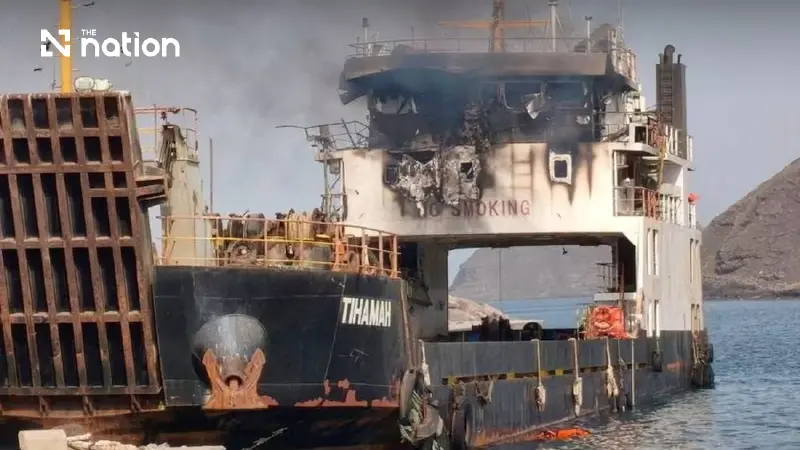


Fresh attacks on shipping in the Gulf of Oman and Bab el-Mandeb have dimmed peace hopes, while Iran vows to keep the Strait of Hormuz closed.
Fresh attacks on commercial shipping near two of the world’s most important maritime chokepoints have further weakened hopes of a swift end to the Iran war, with Tehran insisting that the Strait of Hormuz will remain closed until Washington accepts its conditions.
The United States and Yemen’s Iran-aligned Houthi movement reported separate operations against vessels on Tuesday — one in the Gulf of Oman, which leads to the Strait of Hormuz, and another in the Bab el-Mandeb Strait at the entrance to the Red Sea. Both routes are critical to global oil supplies and international trade.
Oil prices rose and global shares fell amid renewed doubts over a near-term settlement. Brent crude futures gained 1.4% to settle at US$88.91 per barrel, while US crude rose 1.3% to US$83.20 per barrel.

Six killed around Bab el-Mandeb
Four crew members were killed in a suspected Houthi attack on the small Egyptian-owned cargo vessel Tihamah in the Bab el-Mandeb Strait, according to Yemen’s Transport Ministry.
Yemen’s Coast Guard said two Yemeni rescuers from an anti-Houthi military group were also killed. If confirmed, the deaths aboard the Tihamah would be the first fatalities caused by Houthi attacks on shipping since the Iran war began.
The Houthi-controlled Saba news agency separately claimed that the group had attacked a Saudi ship carrying military equipment through the strait. It did not identify the vessel, and Saudi authorities did not immediately respond to the report.
The Houthis said last month that they would impose a naval blockade on Saudi Arabia in the Red Sea.
US helicopter disables Panama-flagged vessel
In a separate incident, the US military said a US Navy MH-60 helicopter fired two Hellfire missiles to disable the steering system of a Panama-flagged cargo vessel.
US Central Command said the ship had ignored repeated instructions to stop breaching Washington’s naval blockade of Iranian ports. Maritime sources told Reuters that the vessel was struck off Pakistan while sailing towards the Gulf of Oman.
The separate attacks came despite repeated statements by US President Donald Trump that an agreement to end the conflict could be close.
Iran sets conditions for reopening Hormuz
Iran’s senior security official Mohsen Rezaei said the Strait of Hormuz would remain closed until the United States changed its position and accepted Tehran’s conditions for ending the war.
Iran’s demands include the release of its frozen overseas assets and an end to conflicts across the region, including those in Lebanon and Gaza.
His comments followed a new demand from Trump that Iran pay compensation for people killed during five decades of wars, attacks and protests.
Trump has alternated between threats of military escalation and claims that a peace agreement is imminent. In an interview released on Monday, he suggested Washington could allow Iran’s economy to weaken further or launch significantly heavier attacks.
Rezaei’s statement offered the strongest indication so far that the Strait of Hormuz would not reopen to normal shipping soon. Before the war, the waterway carried about one-fifth of global oil and liquefied natural gas flows.
Washington did not immediately respond to Iran’s latest conditions.
Iran signals readiness for wider operations
Thousands of people have been killed since the United States and Israel launched attacks on Iran on February 28.
Iran has retaliated against US assets and infrastructure in several countries, including Oman, Jordan, Kuwait, Israel, the United Arab Emirates and Saudi Arabia.
Raising the prospect of further escalation, Mohammad Reza Naqdi, an adviser to the commander of Iran’s Revolutionary Guards, said the force was developing the capability to carry out operations on enemy territory when ordered.
The latest military activity, harder rhetoric from both sides and Tehran’s refusal to reopen Hormuz suggest that efforts to end the war remain at an impasse, despite earlier expectations of progress.
Source: Reuters
