
Krungthai and DCCE to Study Financing for SMEs in Thailand's Just Transition
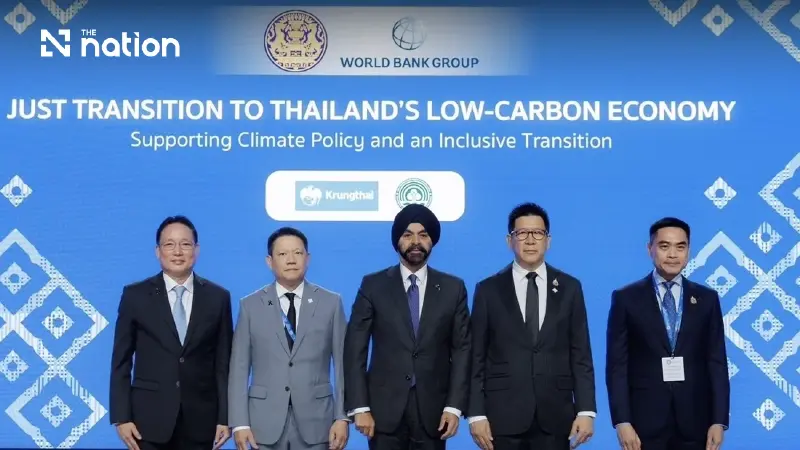


The partnership will study financial and carbon market tools to help smaller firms invest, adapt to new standards and share in green growth
- Krungthai Bank and the Department of Climate Change and Environment (DCCE) are collaborating to study a "just transition" to a low-carbon economy for Thailand's small and medium-sized enterprises (SMEs).
- The study will focus on developing financial and carbon market mechanisms to help SMEs invest in green technology, adapt to new standards, and reduce emissions.
- The partnership aims to ensure that SMEs can remain competitive and that the benefits of the green economy, such as new jobs and growth, are shared inclusively and equitably.
The partnership will study financial and carbon market tools to help smaller firms invest, adapt to new standards and share in green growth.
Krungthai Bank and the Department of Climate Change and Environment (DCCE) have announced a collaboration to study and implement a "just transition" for Thai businesses, particularly small and medium-sized enterprises (SMEs).
It is the third announcement in a series by Krungthai at the 2026 IMF–World Bank Group Annual Meetings. The first covered the I-SPARK industrial decarbonisation initiative with PTT, and the second a carbon credit market with the Stock Exchange of Thailand.
The collaboration was unveiled at the event "Low Carbon Cities and Energy Security – Building System at Scale: Mobilising Private Capital, Creating Jobs". It aims to connect climate policy with mechanisms that help businesses cut greenhouse gas emissions while advancing economic and social development.
The work will focus on financial and carbon market mechanisms that could help SMEs invest in technology and adapt to emerging standards. The partners say this would strengthen their competitiveness and ensure the opportunities of the low-carbon economy are broadly shared.
Policy, finance and skills
Phirun Saiyasitpanich, Director-General of the DCCE, said a just transition requires coordination across climate policy, financial mechanisms and capacity building among stakeholders. The DCCE is working closely with Krungthai to study and develop policy frameworks, measures and support mechanisms.
These would help businesses, industries and workers prepare for the shift while accounting for the possible economic and social effects of emissions-reduction measures. They would also promote opportunities and ease access to appropriate financing.
He said the effort is in line with the just transition approach in Thailand's Nationally Determined Contribution (NDC 3.0). The shift to a low-carbon economy contributes to the country's climate goals, he said, and offers significant opportunities to promote green jobs, improve workforce skills, strengthen business competitiveness and foster sustainable growth.
The emphasis, he said, is on stakeholder participation, support for those who may be adversely affected, and sharing the benefits "inclusively and equitably".
"The collaboration represents another step in extending the dialogues at the IMF–World Bank Annual Meetings into practical action, laying the foundation for Thailand's just transition," Phirun said.
He said it seeks to ensure that industrial upgrading and green job creation generate opportunities for businesses of all sizes, making the low-carbon economy "a pathway to growth in which all sectors can participate and benefit".
A burden and an opportunity for SMEs
Payong Srivanich, Chief Executive Officer of Krungthai, said the transition brings both opportunities and challenges for business, particularly SMEs. They must prepare for new standards through financing, technology and human capital, he said, while the effects on workers and communities must also be considered.
For that reason, Krungthai is working with the DCCE to study suitable financial and carbon market mechanisms. These would support affected businesses and industries in investing to improve production processes and resource efficiency and in maintaining competitiveness while taking economic and social factors into account.
"As we transition to a green economy, we must ensure that no one is left behind," Payong said.
Krungthai, he said, will use its financial expertise to connect climate goals with opportunities for SMEs so that the transition strengthens businesses, creates opportunities for workers and delivers benefits to communities.
"This will enable all sectors to grow together and drive Thailand's next growth engines."
Taken together, the three announcements show Krungthai pursuing one theme at the meetings. I-SPARK targets large-scale industrial investment in Map Ta Phut–Rayong.
The carbon credit market, built on the World Bank-backed LCC Project, would turn emissions cuts into income. The just transition study looks at how smaller firms, workers and communities can take part.
All three are presented as efforts to put the dialogue at the IMF–World Bank Annual Meetings into practice.
