
Thailand and World Bank Launch Low-Carbon Push to Turn Climate Policy into Bankable Projects
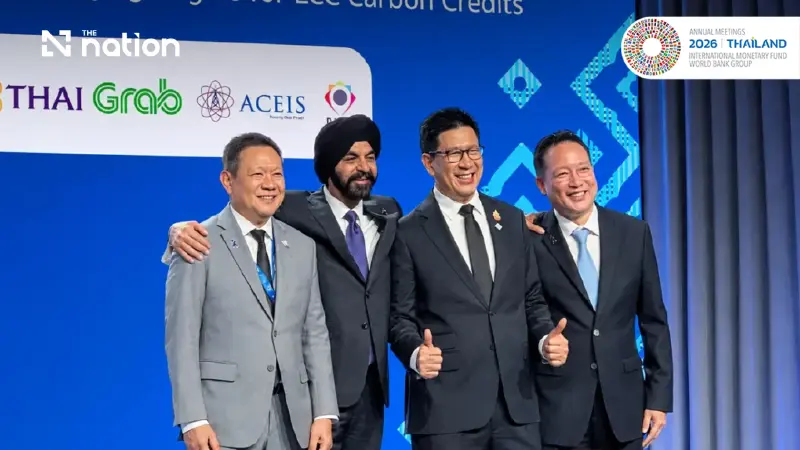


A $200 million loan, a carbon-credit market, and a Rayong industrial platform aim to cut energy costs, draw in private capital, and create jobs, officials say
- Thailand's Ministry of Finance and the World Bank have launched a partnership to finance low-carbon initiatives and attract private investment into bankable green projects.
- The plan is anchored by a $200 million World Bank loan to EXIM Thailand, intended to fund energy service companies investing in clean energy and energy efficiency.
- A central goal is to establish a high-integrity carbon-credit market, with Krung Thai Bank and the Stock Exchange of Thailand developing mechanisms to verify, trade, and price carbon credits.
- The partnership also includes creating a low-carbon industrial platform in Rayong to mobilize private capital for bio-based and circular industries through blended-finance models.
A $200 million loan, a carbon-credit market, and a Rayong industrial platform aim to cut energy costs, draw in private capital, and create jobs, officials say.
Thailand’s Ministry of Finance and the World Bank Group have unveiled a suite of initiatives designed to finance clean energy, build a credible carbon market, and crowd in private investment, as the 2026 IMF-World Bank Annual Meetings drew to a close in Bangkok.
Deputy Prime Minister and Finance Minister Ekniti Nitithanprapas and World Bank Group President Ajay Banga announced the measures on Saturday (October 17) under the theme "Low Carbon Cities and Energy Security: Building Systems at Scale, Mobilising Private Capital, Creating Jobs".
The LCC Project: A $200m Foundation
At the heart of the plan is the Low Carbon Cities and Carbon Market Development Project (LCC).
The initiative aims to facilitate transparent, verifiable carbon-credit transactions aligned with international standards, supporting Thailand's commitments under the Paris Agreement and its national net-zero targets.
To kick-start the project, the World Bank is providing a $200 million loan to the Export-Import Bank of Thailand (EXIM Thailand), backed by a sovereign guarantee from the Ministry of Finance.
The funds will enable energy service companies (ESCOs) to invest in clean energy and energy efficiency across public-sector assets, preparing both public and private sectors for evolving market standards.
Ekniti also highlighted a $2.4 million World Bank grant under the Partnership for Market Implementation, alongside contributions from Krung Thai Bank (KTB), to establish the framework for a just transition.

Building a High-Integrity Carbon Market
KTB will play a central role in aggregating, verifying, and monetising greenhouse gas emission reductions to connect credits with domestic and international buyers.
The strategy spans three main pillars of cooperation:
• Business Transition: KTB and the Department of Climate Change and Environment (DCCE) will develop financial tools to help small and medium-sized enterprises (SMEs) transition to low-carbon technologies while supporting affected workers.
• Carbon-Credit Market: KTB will aggregate credits, while the Stock Exchange of Thailand (SET) establishes a transparent auction and price-discovery mechanism. Prospective buyers including Grab, ACEIS Electric and Power, DriverAI, and Thai Airways have expressed interest. All credits must complete formal validation and verification prior to sale.
• Industrial Investment: PTT, KTB, and the DCCE will create blended-finance mechanisms for the I-SPARK low-carbon industrial platform in the Map Ta Phut–Rayong area, aiming to mobilise private capital for speciality, bio-based, and circular industries.

Results Over Pledges
Ekniti stressed that development finance must be measured by outcomes rather than capital raised. Over time, he noted, robust carbon markets and accessible green financing should reduce Thailand's reliance on government subsidies and tax incentives.
He acknowledged that the government must deliver clear regulatory frameworks and bankable projects to accelerate scale.
"Success should be measured by whether we can bring down energy costs, make industry more competitive, and create better jobs. That should be the legacy of the Annual Meetings 2026," Ekniti said, requesting further guarantee support from the World Bank and the International Finance Corporation (IFC).

Banga: Trust is the 'Centre Point'
Commending Thailand for its exceptional hospitality throughout the summit, Banga emphasised that the success of the carbon framework hinges entirely on credibility.
"Without trust and credibility, nothing would happen," Banga noted, pointing to the partnership between the SET, the Securities and Exchange Commission, and KTB as the "secret sauce" that will attract private investors.
Banga outlined three key advantages of the initiative:
1. Cost Savings: Energy efficiency reduces utility bills for businesses, cities, and households, freeing up public funds for schools, roads, and services while creating local maintenance jobs.
2. Private Capital Integration: Government budgets alone cannot fund modern infrastructure. "There is not enough public money to do these kinds of things," Banga said, stressing that private capital is essential to scale impact.
3. Market Continuity: A thriving commercial ecosystem ensures businesses continue investing in urban sustainability without permanent reliance on public funding.
According to government officials, the initiatives align with a broader strategy to use finance as a tool for economic restructuring. By addressing market constraints and establishing reliable financial data, the public sector aims to de-risk green investments for institutional capital.
