
Central Bankers Urge 'Collaboration' as AI Reshapes Inflation, Jobs and Financial Stability
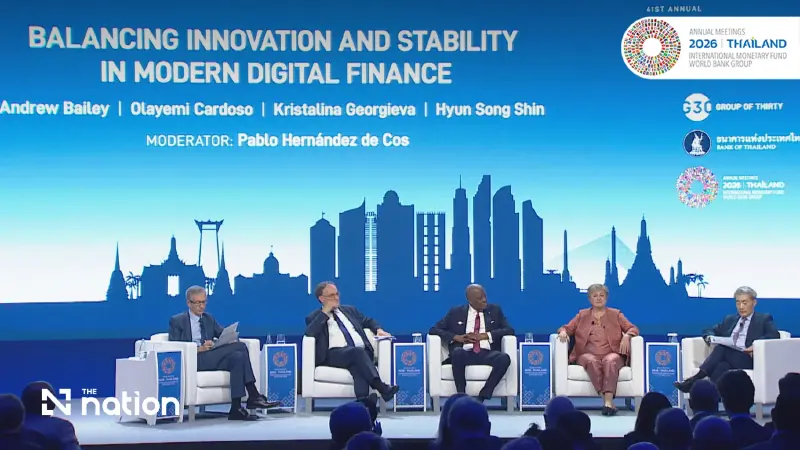


G30 panel in Bangkok calls for stronger model testing, classic financial safeguards and early anti-fraud design as AI raises systemic risks
- Top central bankers and IMF officials are urging for urgent collaboration between governments and developers to establish effective guardrails for AI in the global financial system.
- AI is identified as a significant risk to financial stability, with potential threats including sudden market corrections, heightened cyber risks, and unpredictable herd behavior amplified by algorithms.
- The technology is currently viewed as inflationary due to a demand shock and wealth effect, while its long-term impact on jobs and income inequality, especially in emerging economies, is a major concern.
- Key recommendations include stronger AI model testing, applying traditional financial safeguards like capital requirements, embedding anti-fraud controls into new systems, and demanding transparency from developers.
G30 panel in Bangkok calls for stronger model testing, classic financial safeguards and early anti-fraud design as AI raises systemic risks.
Stronger testing of AI models, traditional financial safeguards, built-in anti-fraud controls, and tighter cooperation between governments and developers formed the core demands of four of the world’s top policymakers in Bangkok on Saturday (October 17).
Speaking at the Group of Thirty (G30) 41st Annual International Banking Seminar—hosted by the Bank of Thailand as part of the 2026 IMF and World Bank Annual Meetings—Bank of England Governor Andrew Bailey, Central Bank of Nigeria Governor Olayemi Cardoso, IMF Managing Director Kristalina Georgieva, and Bank of Korea Governor Hyun Song Shin agreed that AI is already reshaping global finance and that the window to establish effective guardrails is closing rapidly.
The panel was moderated by Pablo Hernández de Cos, General Manager of the Bank for International Settlements (BIS).

Core Consensus: Test, Protect, and Cooperate
The panel reached clear agreement across five key priorities:
• Rigorous Model Testing: Bailey stated that the foundation for oversight is "stronger model testing standards", applied both before and after commercial release as models continuously evolve.
He noted that evaluating open-weight models presents greater challenges than testing frontier systems such as Anthropic's Mythos, pointing to the UK's AI Safety Institute as a model for public-private collaboration.
• Classic Safeguards: Shin argued that traditional financial tools—capital requirements, leverage limits, collateral, and straightforward rules—remain the most effective defence against market panic, preventing financial firms from becoming simultaneous forced sellers.
• Embedded Anti-Fraud Controls: Bailey urged that new payment infrastructure and tokenised deposits must have fraud protection engineered into their architecture from inception rather than "bolting things on later."
Cardoso echoed the sentiment, stressing the need to act early "so that the horse doesn't bolt away".
• Arming the Defence: "These models arm the offence. We've got to arm the defence as well," Bailey warned.
• Direct Developer Engagement: Georgieva observed that creating a centralised "world cybersecurity organisation" would be too slow, given that private-sector innovation outpaces bureaucratic frameworks.
While AI developers must have a seat at the table, she stressed that governments should demand total transparency rather than passively accepting industry self-regulation.
She called on the IMF, the Financial Stability Board (FSB), and the BIS to present joint recommendations by the upcoming spring meetings.

When asked for a final takeaway, both Bailey and Cardoso offered a single word: collaboration.
Demand Effects and Systemic Fragilities
Bailey, who also chairs the FSB, noted that general-purpose technologies have historically expanded economic potential and that AI combined with robotics could drive the next productivity leap.
However, he cautioned policymakers to distinguish between demand and supply effects in both scale and timing. Demand effects, he noted, are arriving first through asset markets, particularly in the United States.
He outlined four primary vulnerabilities that could disrupt stability:
1. Market Corrections: Sudden price drops if investors reassess AI's short-term productivity gains.
2. Lagged Benefits: Slower-than-anticipated returns, echoing past technological revolutions that took decades to show up in macroeconomic data.
3. Corporate Churn: High failure rates among highly valued AI firms ("remember Netscape").
4. Fragile Public Trust: The risk that debt-funded valuations collapse if public confidence wanes.
On broader financial stability, Bailey warned that frontier AI has elevated cyber risk to the top of policy concerns. He revealed that the FSB and UK authorities first grasped the scale of the threat in April, adding that Anthropic's Mythos model "is old technology now."
He also highlighted legal ambiguities, noting that while AI can act as an "economic agent", it cannot be held legally responsible for its actions.

Short-Term Inflation and Policy Uncertainty
Georgieva argued that AI is currently exerting an inflationary pressure on the global economy through a positive demand shock.
AI-related goods now account for over 10 per cent of international trade, while rising stock valuations create a wealth effect that boosts consumer spending alongside existing pressures from energy, food, and defence costs.
Looking further ahead, she noted that economists remain divided: one camp expects ongoing price pressures driven by energy demand and wealth effects, while another foresees deflation as automation slashes operational costs.
The IMF has not taken a definitive stance.
"We have many more questions than we have answers," she cautioned, advising delegates, "Do not fall for the guys that pretend they have the answers."
She also drew attention to the neglected issue of fiscal and monetary coordination, questioning how tax bases will adapt as labour structures shift.
US data suggests net employment remains positive, but structural shifts are widening income gaps between highly paid, AI-augmented workers and lower-paid service roles as routine jobs contract.
Georgieva identified three major financial stability threats: an abrupt pull-back in AI investment that triggers a broader downturn while the economy is "standing on one leg"; cyber risks "on steroids"; and catastrophic events involving autonomous, rogue AI agents.
Describing her own perspective, she remarked: "Love it, hate it, fear it, it's here." Responding to a question regarding AI entities creating their own financial products, she warned, "If we do not work on guardrails now, we may wake up to something that is not guardrailable anymore."
She compared the required global mobilisation to the preparations for Y2K, warning that current efforts fall well short of that benchmark.

Emerging Markets and Strategic Choice
Cardoso emphasised that AI presents emerging economies with a choice between economic convergence or widening divergence, urging developing nations to formulate explicit AI strategies.
His primary concern centers on employment: with roughly 60 per cent of Africa's population under the age of 25, more workers will enter the African job market by 2035 than in the rest of the world combined.
AI that enhances productivity without creating jobs, he warned, poses severe socio-economic risks. He added that central bank credibility will increasingly hinge on data integrity, requiring localised economic models.
On the positive side, AI could accelerate monetary policy transmission in developing nations with underdeveloped banking channels.
Recalling foreign-exchange pressures on the Nigerian naira three years ago driven by virtual assets, Cardoso stressed that technical solutions cannot replace sound fundamentals: "Emerging markets must put their macroeconomic house in order."

Market Dynamics and Cross-Border Payments
Shin described AI's internal mechanics as a "black box" but noted that finance has long managed opaque risks, framing the future as "humans plus AI versus other humans plus AI".
While market participants may use diverse AI models, Shin warned that financial incentives can override algorithmic diversity. During market stress, leveraged institutions are forced to sell simultaneously regardless of their underlying models.
He compared this herd behaviour to London’s Millennium Bridge, which swayed on opening day because pedestrians unconsciously synchronised their steps in response to the structure's movement.
"In finance, the price is the bridge," he noted.
Turning to international payments, Shin described cross-border transfers as "the land that time forgot" due to severe friction and network fragmentation.
To address this, the Bank of Korea is testing "B-Int'l Wire"—an international extension of its large-value payment system that enables foreign banks to hold won accounts and settle transactions directly in central bank money.
Scheduled to launch in January, Shin stressed that success depends less on underlying technology than on regulatory modernisation.

Concluding the session, Hernández de Cos previewed an upcoming BIS survey of households across more than 20 countries, which reveals that while people are optimistic about AI's potential to boost growth, anxiety over job security remains high—particularly among younger and less-educated demographics.
Addressing audience questions on wholesale digital currencies and stablecoins, Bailey highlighted the BIS-led Project Agorá as one of the most promising initiatives for cross-border settlement, while reiterating that private stablecoins must meet the same strict regulatory standards as commercial bank deposits if they are to function as genuine money.
