
Ekniti positions Thailand to guide nations through global risks
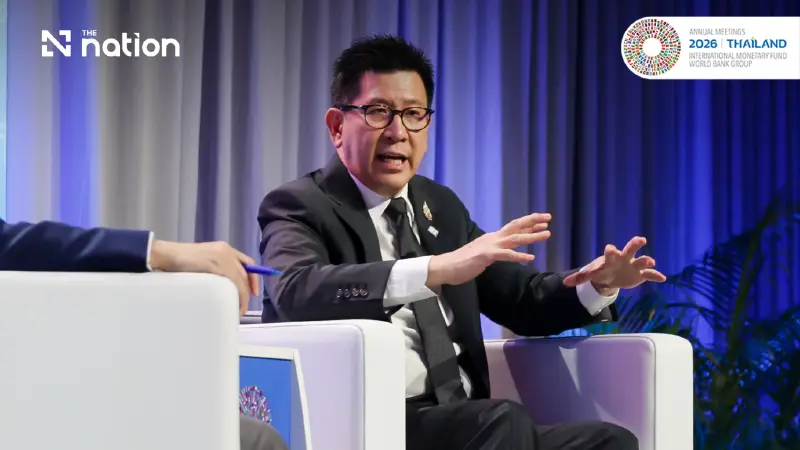


At the 2026 IMF–World Bank meetings in Bangkok, Ekniti Nitithanprapas casts Thailand as a trusted connector to guide countries through global risks.
- At the IMF–World Bank Group Annual Meetings, Thailand's finance minister positioned the nation as a "trusted connector" to help guide 191 countries through global economic challenges.
- This vision was presented through the "Bangkok Dialogue Notes", which emphasise building trusted connections and practical cooperation to tackle risks like geopolitical fragmentation, AI, and climate change.
- The initiative promotes people-centred resilience and ensuring international investment delivers tangible benefits to local communities, with strategic priorities including digital trust and climate transition.
Deputy Prime Minister and Finance Minister Ekniti Nitithanprapas has positioned Thailand as a leader ready to help steer 191 countries through turbulent global economic waters alongside the International Monetary Fund (IMF) and World Bank Group.
Drawing on the image of the Royal Barge Suphannahong, Ekniti compared Thailand’s role to that of the figure at the front who sets the direction as the crew rows in unison through rough water. He argued that countries needed the same sense of purpose to confront economic uncertainty together.
“Thailand would like to show ourselves as a trusted connector, so we can connect everyone—191 countries together—to be on the same boat for one week,” he said, emphasising the importance of sharing ideas, responsibilities and a common goal of improving people’s lives.
Ekniti outlined the vision on Saturday (October 17) as Thailand unveiled the Bangkok Dialogue Notes, a collection of reflections from the 2026 IMF–World Bank Group Annual Meetings, taking place at the Queen Sirikit National Convention Center from October 12 to 18.
More than 19,000 people had registered, the highest total in the event’s history, according to the host country’s statement. Ekniti identified three achievements: international recognition for Thailand’s hosting capabilities, a role in shaping the global economic agenda and a stronger position as a trusted connector.

Global challenges demand trusted connections
He warned that geopolitical and geoeconomic fragmentation, artificial intelligence (AI), higher energy prices and living costs, rising borrowing costs and climate disruption were testing economies worldwide. Technological advances and international investment could create new opportunities, but their benefits were becoming increasingly uneven, particularly for smaller businesses and vulnerable communities.
“True resilience comes not from isolation, but from trusted connections that help societies withstand challenges and create opportunities for people,” Ekniti emphasised.
The Bangkok Dialogue Notes are not negotiated international agreements or formal policy recommendations. Instead, they draw together reflections from exchanges among policymakers, international institutions, businesses and thought leaders, with an emphasis on turning discussions into practical cooperation.
Five key themes underpin the Bangkok Dialogue Notes:
- People-centred resilience: Equip individuals and businesses with lifelong learning, employment opportunities and social protection, while involving communities in shaping their futures.
- Stronger domestic trust: Ensure international trade, investment and cooperation deliver tangible benefits to local businesses and communities.
- Lasting local capabilities: Measure the success of global investment and technology partnerships by the skills, knowledge and stronger domestic businesses they help develop.
- Practical international cooperation: Strengthen regional partnerships to address shared challenges and rebuild confidence in multilateral cooperation.
- Trusted global connections: Encourage middle powers such as Thailand to bridge countries and regions, supported by international financial institutions and multilateral development banks.
“If you cannot build trust locally, you cannot connect globally,” Ekniti stressed, warning that investment would encounter resistance if local communities were excluded from its benefits.

Digital trust, investment and climate action
Thailand’s Host Country Programme identifies four strategic priorities for translating these principles into action:
- Trusted digital futures: Promote practical, affordable AI applications, including Thailand’s Nok Krasip initiative, which helps street vendors analyse sales, manage costs and improve access to formal finance. Strengthen digital public infrastructure and cross-border efforts to combat financial scams through initiatives such as Connect the Dots and the Bangkok Blueprint for Fraud-Resilient Financial Services.
- Trade, investment and geoeconomic fragmentation: Diversify supply chains and expand trade and investment links while strengthening domestic capabilities. Thailand aims to build on its growing role in AI-related industries, including photonics, power semiconductors, sensors and printed circuit boards, while helping local businesses benefit from foreign investment.
- Climate transition and adaptation: Accelerate the shift towards cleaner energy, strengthen electricity grids and improve access to climate finance, particularly for communities and businesses most exposed to environmental risks.
- Demographic change and longevity: Adapt education, healthcare, employment, savings and social protection systems to ageing populations, ensuring that longer lives bring greater economic opportunities and security.
“Attracting capital investment is good, but you have to turn capital into capabilities,” Ekniti argued, emphasising the need to equip Thai workers and businesses with the skills and resources to participate in global supply chains.
Regional cooperation and Thailand’s growth plans
As an example of practical regional cooperation, Ekniti highlighted plans to advance the ASEAN Power Grid. Hydropower from Laos could be transmitted through Thailand and Malaysia to Singapore, potentially extending to Indonesia, under a multi-year approach that would continue across successive ASEAN chairmanships.
He also urged ASEAN members to establish shared targets for regional trade, investment and digital integration, noting that intra-regional trade accounted for only about 22% of the bloc’s total.
On economic policy, Ekniti urged governments to respond to higher energy costs with targeted support for vulnerable groups rather than broad subsidies, while maintaining fiscal discipline.
He attributed Thailand’s relatively modest rise in government bond yields to fiscal discipline and early fiscal consolidation, arguing that these measures had strengthened market confidence amid rising borrowing costs internationally.
At home, he outlined three goals agreed with the private sector: raising Thailand’s potential economic growth rate to more than 3%, increasing investment from around 22% to 30% of gross domestic product, and securing a place among the top 20 in an international competitiveness index.
The finance minister also described efforts to strengthen ties with European counterparts, explore Islamic finance partnerships and sustain dialogue with global investors through the World Economic Forum’s “Road from Bangkok to Davos” initiative.

Putting people at the centre
The host country’s programme took global discussions beyond conference rooms through dialogues, thematic pavilions, youth activities and exhibitions highlighting Thai communities. The Royal Pavilion presented the development principles and Sufficiency Economy Philosophy of the late King Bhumibol Adulyadej the Great.
Ekniti singled out IMF Managing Director Kristalina Georgieva’s reference to the late King’s teachings at the plenary session as a particularly meaningful moment, linking the principle of patient, people-centred development to the week’s discussions.
He argued that the value of Thailand’s international engagement would ultimately depend on stronger local economies, with investment in human capital, digital systems and energy infrastructure needed to prepare the country for future growth.
“At the end of the day, no matter what we do, we must go back to the people, go back to local communities, understand them and empower them to become resilient and ready for Thailand’s next phase of growth.”
