
Yodchanan outlines AI skills goal for 20m Thais in push to turn learners into job creators
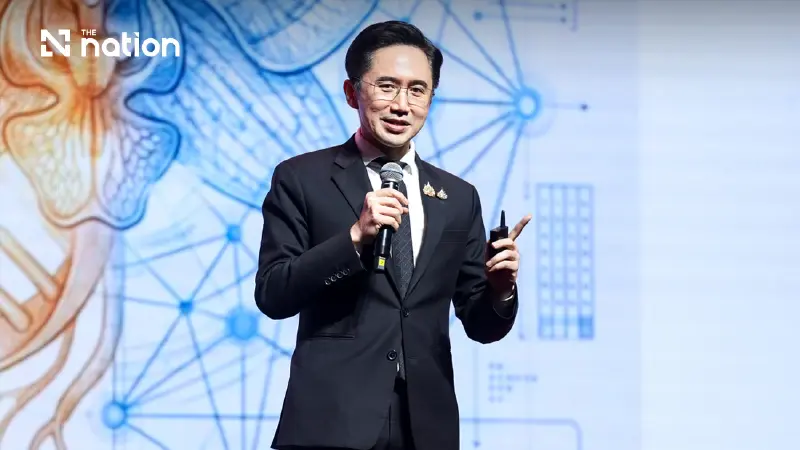


Yodchanan links education reform and AI literacy for 20 million people to new growth in advanced industry, healthcare and specialised food.
- Thailand's deputy prime minister has outlined a plan to provide artificial intelligence (AI) literacy training to 20 million people.
- The initiative's primary goal is to reform the education system to equip learners to become job creators who can build new businesses and industries, rather than just fill existing jobs.
- The AI literacy program will have four development levels, ranging from "Foundation" to "Frontier Master," to support this progression.
- This strategy is part of a larger push for Thailand to develop its own technologies, reduce reliance on imports, and take locally created products to global markets.
Yodchanan Wongsawat, deputy prime minister and minister of higher education, science, research and innovation, outlined plans on 11 November 2026 to build artificial intelligence literacy among 20 million people in Thailand, linking education reform and scientific investment to new sources of economic growth.
Speaking at Thansettakij’s “Innovation Power Up: Developing People, Creating Innovation” keynote event, Yodchanan called for Thailand to develop its own technologies, prepare people to create jobs and take locally developed products into global markets.
Education reform to develop job creators
Yodchanan argued that education must move beyond preparing graduates for existing vacancies and equip them to build new businesses and industries. Universities needed to break down the divisions between subjects such as physics, chemistry and biology, using artificial intelligence (AI) to connect knowledge across disciplines.
The gap between people who use AI and those who do not was widening dramatically, Yodchanan observed, describing a K-shaped divide becoming almost vertical. Children and other members of the public who could develop and use AI effectively might accomplish tasks beyond some doctoral graduates, he argued, making foresight essential alongside knowledge acquired through formal education.
The ministry’s “AI for Thai Discovery” initiative aims to support new discoveries through Thailand’s own foundation models. Yodchanan argued that competing internationally, including with Silicon Valley, required Thailand to develop capabilities beyond importing ready-made models.

Yodchanan acknowledged that industry criticism of universities for producing graduates with unsuitable skills was partly justified. However, universities also had to prepare people for industries that did not yet exist, because nobody could guarantee that established sectors would survive another five or 10 years.
Thailand needed an environment that encouraged invention and helped people adapt to change, Yodchanan added. The Thailand Future Skill Map would connect work experience with recognised skills that could count towards degrees, support efforts to prevent students dropping out and allow people from different professions to retrain or change fields.
The ministry’s AI literacy goal covers 20 million people, with four development levels: Foundation, Industry Ready, Technology Creator and Frontier Master. Yodchanan identified the National Science and Technology Development Agency’s Skill Bridge mechanism as a means of supporting this progression.
Scientific expertise and research infrastructure
Yodchanan stressed that factories alone could not secure technological competitiveness. Countries with strong semiconductor and biotechnology industries also had physicists, biologists and Nobel laureates with deep expertise in fundamental science.
Thailand should develop advanced mathematical and algorithmic skills before investing in data centres and a 3-gigaelectronvolt (GeV) synchrotron, Yodchanan argued. He linked the synchrotron project to an ambition to place Thailand among the world’s top 10.

Yodchanan identified physical AI, programmable biology and organoids as priorities for advanced research, arguing that organoids could shorten drug-testing times to 1.5–2 years. Other areas included precision medicine, sequencing to develop specialised foods, and the “AI 4M” project to design new materials from agricultural produce.
Higher research and development budgets and investment in world-class scientific equipment were also necessary, Yodchanan argued, to give Thailand its own sources of growth and the confidence to compete internationally.
Thailand’s space plans include developing 18 Thai satellites to give local start-ups practical opportunities to build technology. Yodchanan also highlighted the study of small modular reactors as a potential contribution to energy security.
Three initiatives to support new industries
Yodchanan outlined three initiatives intended to translate scientific capabilities into economic activity: Siam Silica, Siam Medica and Siam Terra.
Siam Silica focuses on high-value industries, including photonics and advanced semiconductor packaging. Siam Medica covers high-value services, medical devices and herbal products, while Siam Terra aims to turn agricultural crops into specialised foods.
The ministry is also promoting Made in Thailand initiatives with the Federation of Thai Industries and the Thai Chamber of Commerce. Yodchanan described domestic use of Thai innovations as a foundation for subsequent expansion into international markets.
University research would play a central role in this approach. The ministry is working with the Stock Exchange of Thailand on establishing funds and promoting university holding companies and consortia, giving businesses greater confidence in accessing university technologies and innovations.

Global markets to make innovation more affordable
Yodchanan argued that Thai innovations needed international customers to achieve sufficient scale. Citing a domestic population of roughly 60 million, he maintained that relying on local purchasing power alone would leave consumers paying higher prices.
The “Go Global” strategy would expand markets for Thai products, helping people at home gain access to quality goods at lower prices. Yodchanan also called for investment in curricula that met international standards to support this ambition.
“Thailand’s next golden age will no longer be defined by what we import. We need to become creators and contributors,” Yodchanan said.
“If Thailand starts sharing knowledge with others and becomes a contributor, others will give back to us,” Yodchanan added.
“If we can stand on our own feet and rely on ourselves, I will have no fear, whoever I negotiate with,” Yodchanan concluded.

