
How Thailand, the US, Japan and China regulate civilian firearms
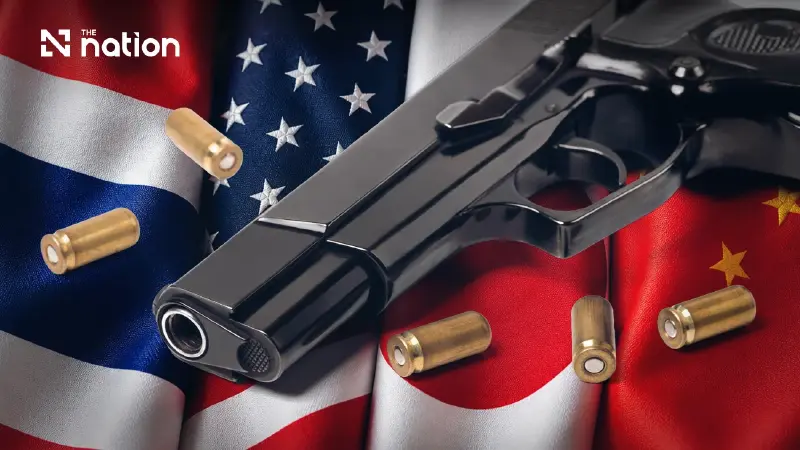


Gun laws in Thailand, the US, Japan and China differ widely on who may buy, own and carry firearms, and the penalties for breaking the rules.
- Thailand allows civilian gun ownership but requires a multi-step licensing process for purchasing and possessing firearms, with a separate, currently suspended permit needed to carry them in public.
- The United States constitutionally protects the individual right to bear arms, with federal background checks for purchases from licensed dealers, but specific regulations vary widely between states.
- Japan prohibits civilian firearm possession in principle, with very narrow exceptions for specific hunting and sporting guns that require official permission.
- China enforces strict state control, generally forbidding private citizens from owning firearms, with limited exceptions for approved organizations like shooting ranges and hunting grounds.
Recent gun violence in Thailand has brought firearm controls back into the public spotlight, particularly after the shooting at Debsirin Nonthaburi School on August 7, 2026.
The gunman was a 14-year-old boy. Nine people died in total, including victims at the family home and the school, as well as the gunman, while many others were injured. The handgun used in the attack was legally registered to the boy’s grandfather.
The attack has raised questions not only about school safety, but also about how effectively Thailand controls the purchase, ownership, storage and accessibility of firearms.
Internationally, approaches to gun control vary sharply. The US Constitution protects an individual right to keep and bear arms, while Japan and China impose much tighter restrictions on civilian possession, with limited exceptions.
Thailand: gun ownership is legal, but licences are required
Thailand’s main firearms legislation is the Firearms, Ammunition, Explosives, Fireworks and Imitation Firearms Act, BE 2490 (1947). It allows civilians to possess and use firearms, but only with permission from the authorities.
Under the normal licensing system, a person seeking to buy a firearm must first obtain a Por 3 purchase permit. After buying the weapon, the owner must apply for a Por 4 licence to possess and use the firearm. Registrars consider factors including the applicant’s qualifications, conduct, occupation, residence and reasons for seeking a firearm.
However, a Por 4 licence does not automatically allow a firearm owner to carry the weapon in public. Thai law treats possession and use separately from carrying. Section 8 bis restricts carrying firearms in towns, villages or on public roads without the relevant permission.
The issuance of Por 12 permits to carry firearms has been temporarily suspended since February 2026. Following the school shooting, the government also introduced several additional gun-control measures.
Penalties depend on the offence. Unauthorised firearm possession under Section 7 is punishable under Section 72 by one to 10 years in prison and a fine of 2,000–20,000 baht. Carrying a firearm in breach of Section 8 bis is a separate offence with different penalties, meaning a single penalty cannot be applied to every firearms violation.
United States: constitutional protection, but rules vary by state
The United States takes a markedly different approach. The Second Amendment protects the right to keep and bear arms, and US Supreme Court rulings have interpreted this as an individual right to possess firearms for lawful purposes, including self-defence. The court has also recognised that the right to bear arms for self-defence extends beyond the home.
That does not mean firearm purchases are entirely unrestricted. When a gun is bought from a federally licensed firearms dealer, the dealer generally submits the buyer’s details for a check through the National Instant Criminal Background Check System (NICS) to determine whether the person is legally prohibited from receiving a firearm.
State laws can differ substantially. California, for example, generally requires firearm purchases and transfers to go through a licensed dealer and imposes a 10-day waiting period before a firearm can be released. The state also restricts assault weapons and large-capacity magazines.
Texas, by contrast, has more permissive carry rules. People who meet the legal requirements may carry handguns in many public places without first obtaining a state carry licence, although restrictions still apply to prohibited individuals and certain locations.

Japan: possession is banned in principle, with narrow exceptions
Japan takes a far more restrictive approach. Its principal legislation, commonly referred to as the Act for Controlling the Possession of Firearms or Swords and Other Such Weapons, dates from 1958.
The basic rule is that civilian firearm possession is prohibited unless a specific exception applies. Limited categories of hunting guns and air guns may be legally possessed with permission from a prefectural public safety commission, including for approved hunting and sporting purposes.
Japan has also tightened its laws in response to newer types of weapons. Amendments enacted in 2024 strengthened firearm controls and introduced penalties for publicly inciting or soliciting illegal firearm possession. They also brought dangerous electromagnetic guns, or coilguns, under the prohibition on possession.
China: civilian firearm ownership is tightly restricted
China also maintains strict firearm controls. The Law of the People’s Republic of China on Control of Guns establishes strict state control and prohibits the unlawful possession, manufacture or modification, sale, transport, leasing or lending of firearms.
The law does not provide a broad right for ordinary citizens to buy or possess firearms. Limited civilian-use exceptions apply to approved shooting sports organisations and ranges, hunting grounds and wildlife protection organisations.
Strict controls, however, do not eliminate illegal firearms entirely. Chinese courts continue to handle cases involving unlawful manufacture, sale, transport and possession, including cases involving air guns and weapons that can be modified.
These cases show that restricting legal access can sharply narrow the lawful civilian firearms market without completely eliminating illicit weapons.
Source: Spring News
