
Former BRN member describes recruitment and secret networks
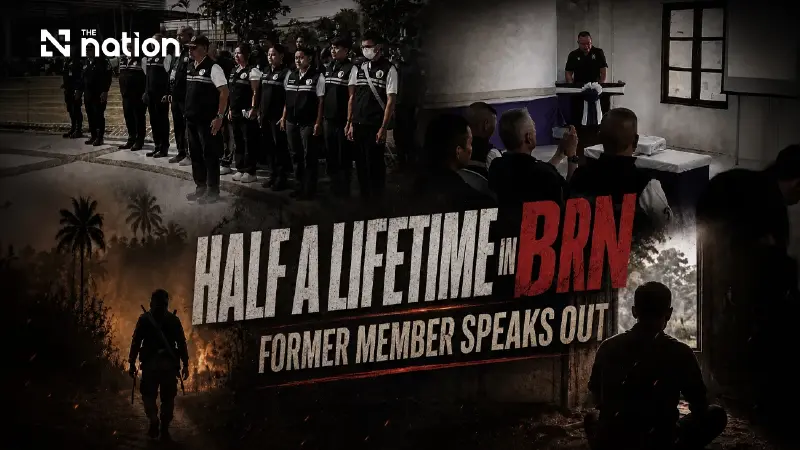


A former BRN member describes youth recruitment, alleged clandestine networks and the challenges facing state-led reintegration efforts.
- A former member alleges that BRN initially sought "Grade A" recruits with strong academic records and ideological potential, but later broadened its recruitment to include people from more varied backgrounds.
- The source describes BRN as a clandestine organization with secret networks that extend beyond armed operations into politics, religion, and community-level mobilization.
- According to the account, this structure of separate networks for different tasks allows the movement to remain active and influential by disseminating ideas even when no violent incidents are occurring.
- He explained that members are drawn to the movement by a combination of ideology, political objectives, and deeply held beliefs, viewing their participation as a struggle rather than solely through the lens of violence.
An unnamed former member of the Barisan Revolusi Nasional (BRN) has described how young people are drawn into the movement and alleged that its clandestine networks extend beyond armed operations into politics, religion and community-level mobilisation.
His account, presented by Nation TV’s investigative programme, offers the perspective of someone who spent much of his life inside the movement before eventually leaving.
The testimony represents the former member’s personal experience and assessment.
The interview comes 22 years after the current phase of violence in Thailand’s Deep South erupted in 2004, with security operations continuing alongside efforts to prevent recruitment and revive the peace process.
From an inquisitive student to a BRN recruit
The former member said he did not come through a religious-school system but attended an ordinary school. He believed his independent nature and habit of questioning what happened around him made him attractive to recruiters.
He described an earlier period in which the movement deliberately sought capable young people with strong academic records and ideological potential. Such recruits were regarded as “Grade A” candidates who could carry the movement forward.
Recruitment subsequently became broader, he claimed, with new members entering from more varied backgrounds and for different reasons rather than being selected solely for academic ability or an established political outlook.

After joining BRN while in his twenties, he gradually developed views that differed from those of others in the movement. According to his account, a senior figure asked him to remain until he was about 40, suggesting that age and experience might change his perspective.
He nevertheless eventually decided to leave.
The former member explained that people inside the movement did not necessarily view their participation solely through the lens of violence. Instead, they understood it as a struggle shaped by ideology, political objectives and deeply held beliefs.
This combination of political grievances, identity, history and ideology, he suggested, was among the factors making the southern conflict difficult to resolve through security measures alone.
Alleged networks extend beyond armed operations
The former member portrayed BRN as a clandestine organisation divided into smaller structures with responsibility for particular geographical areas.
According to his account, its activities were not limited to armed or security-related operations. He alleged that separate networks supported political work, religious engagement and the recruitment or mobilisation of supporters within communities.
He argued that such a structure allowed the movement to remain active even when no violent incident was taking place. Its influence, he claimed, could also operate through the dissemination of ideas and the cultivation of support, particularly among younger people.
These descriptions remain allegations from a former member and should not be treated as an independently established account of BRN’s present-day organisation.
Former members seek to protect the next generation
The investigation also examined why some former members decided to abandon a cause to which they had devoted years of their lives.
Several reportedly felt that they had sacrificed their time, prospects and family life, only to be left to face the consequences alone when difficulties arose.
Some are now parents who use their experiences to discourage their children from following the same path. Although they cannot undo their past decisions, they believe they can help prevent another generation from experiencing similar losses.
Their departure does not necessarily mean they have abandoned every belief they once held. Instead, the investigation suggested, some have redirected their priorities from serving an organisation towards protecting their families and preventing further violence.
Reintegration raises questions of peace and justice
The state’s “Bring People Home” initiative is intended to provide a route for people wishing to leave insurgent movements and return to civilian life.
The process described in the report includes reporting to the authorities, screening, rehabilitation and eventual reintegration into families and communities.
Supporters regard such an avenue as a potentially important peacebuilding tool because it gives people an alternative to remaining within a violent movement.
However, victims and relatives of those killed or injured may question how accountability and redress are addressed when former members return to their communities. Critics also fear that reintegration could be perceived as favouring people associated with violence while those affected continue to live with their losses.
Coordination Centre 5 under the Internal Security Operations Command (ISOC) is among the agencies monitoring the situation and coordinating security-related work in the southern border provinces.
The challenge for the authorities therefore extends beyond preventing attacks. It also involves disrupting recruitment, creating credible routes away from violence and ensuring that reintegration does not come at the expense of justice or the rights of victims.
Source: NationTV
