
Bangkok orders 10-year audit of suspected pink-card fraud
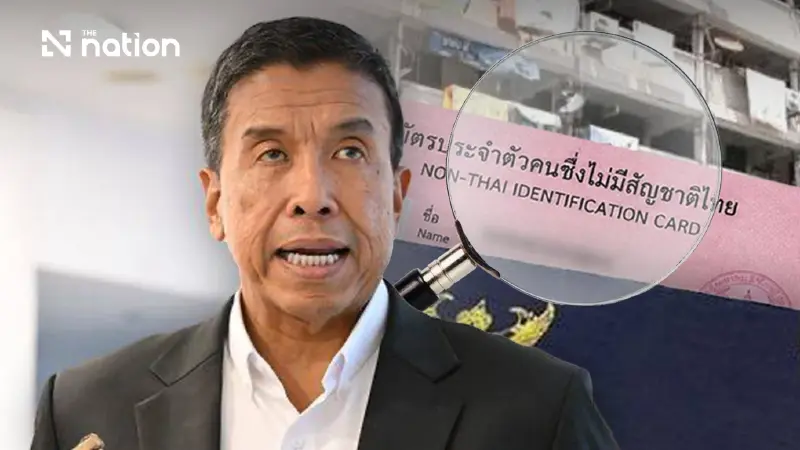


Bangkok is reviewing a decade of household registrations across all 50 districts following suspected pink-card irregularities in Din Daeng
- Bangkok's governor has ordered all 50 district offices to audit 10 years of household registration records to investigate suspected fraud involving identification cards (pink cards) for non-Thai nationals.
- The investigation focuses on schemes where individuals were improperly added to household registries, allegedly using methods like exploiting abandoned birth certificates or creating fabricated family relationships.
- The city-wide audit was prompted by the discovery of significant irregularities in the Din Daeng district, where one small property had over 40 registered residents, leading to the suspension of four officials.
- Authorities are collaborating with police to investigate financial links between brokers and government employees, and plan to reform procedures to prevent future fraud.
Bangkok Governor Chadchart Sittipunt has ordered all 50 district offices to examine 10 years of household-registration records following suspected irregularities involving identification cards for people without Thai nationality, commonly known as pink cards.
The review will cover records dating from 2017 and examine whether non-Thai nationals were improperly transferred into household registrations to obtain documentation supporting pink-card applications.
Every district office was instructed to submit a preliminary report by Friday (August 21).
Suspected methods under investigation
Chadchart explained that the suspected schemes exploited weaknesses in the civil-registration system to assume or misuse another person’s registration status.
One alleged method involved birth certificates belonging to children of foreign nationals who were born in Thailand but subsequently returned to their parents’ home countries.
The certificates remained in Thailand and were allegedly used to transfer other people into household registrations under the children’s identities.
Other cases allegedly involved moving names from the central household register into ordinary household registrations or using fabricated child-parent relationships, sometimes described as “phantom child” and “phantom father” arrangements.
These matters remain under investigation, and the available information does not establish wrongdoing by every person whose registration will be reviewed.
Din Daeng records trigger wider inquiry
The suspected irregularities were first detected clearly in Din Daeng district.
One property measuring only about 40 square metres was found to have between 40 and 45 people listed in its household registration, according to Chadchart.
A review of Din Daeng registrations from 2024 subsequently identified more than 2,000 apparently unusual address transfers.
Four BMA administrative employees linked to the matter have been temporarily removed from service pending disciplinary inquiries. The administrative action does not constitute a finding of guilt, while separate police proceedings remain under way.
The latest action included the temporary removal of a fourth Din Daeng employee as authorities widened the pink-card investigation.
Police asked to examine financial links
Chadchart said the BMA would coordinate with police on a deeper investigation into possible financial connections between brokers and government employees.
The BMA cannot independently compel people outside the administration to provide information or examine their financial transactions.
Police assistance is therefore required to trace money flows and determine whether payments were made between suspected brokers and officials.
An investigation committee will be established to examine the records and the conduct of people involved.
Chadchart maintained that the inquiry would follow the evidence even if it led to senior executives or officials who had already retired. Any action would depend on the findings and applicable law.
Estimated number remains unconfirmed
Chadchart cautioned that an estimate of approximately 3,000 questionable registrations had not yet been confirmed.
The cases may be distributed among several properties rather than concentrated at a single address, he explained.
For the initial screening, the BMA will identify homes with at least 15 registered residents. The threshold may subsequently be lowered to allow wider random checks of individual properties.
The review is intended to determine whether unusually large household registrations have legitimate explanations or warrant a more detailed investigation.
Approval powers and staffing to be reviewed
The BMA is also preparing measures to close procedural loopholes and prevent approval authority from being concentrated in one employee.
District directors and section heads will be required to share responsibility for registration approvals, strengthening oversight and reducing dependence on individual officers.
Officials working in sensitive registration positions may also be rotated periodically to reduce the risk of entrenched relationships, abuse of authority or corruption.
Chadchart added that the BMA’s existing anti-corruption policies would be expanded to place greater emphasis on administrative affairs and civil registration.
The working procedures will be reviewed to improve transparency while ensuring that legitimate applicants are not unfairly affected by the investigation.
