
Nepal foreman rescued after nine days in flooded tunnel says he stayed behind to help colleagues escape
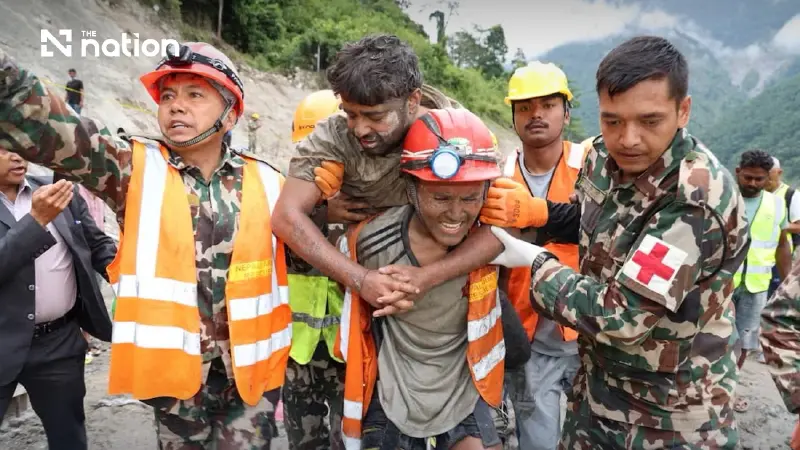


Sanjay Sah and Kabir Maharjan survived nine days in a Nepal hydropower tunnel, while searches continue for hundreds believed trapped
- A Nepali foreman, Sanjay Sah, was trapped for nine days in a flooded hydropower tunnel because he stayed behind to help his colleagues escape.
- Sah said he felt it was his responsibility to save everyone and that it was not right for him to run away from the disaster.
- He successfully warned other workers to flee but was unable to escape himself before a torrent of ice, rock, and mud blocked his exit.
- After nine days, Sah and another worker were the first to be rescued from the affected hydropower projects.
A Nepali foreman rescued after nine days inside a flood-hit hydropower tunnel said he became trapped while helping colleagues escape, having stayed behind because he felt responsible for their lives.
Sanjay Sah, 30, and mechanical supervisor Kabir Maharjan were brought out of the Upper Trishuli 3A Hydropower Station tunnel on Friday (September 4). They were the first workers rescued from the affected hydropower projects following the August 26 glacier collapse that devastated the Trishuli River valley.
Speaking to army officials from a stretcher with an oxygen mask over his face, Sah said the tunnel’s control room might have held 40 to 45 people when the disaster struck, far more than its usual four to six occupants.
“My responsibility was to save everyone's lives. When there was such a big accident, it was not right for me to run away,” he said in footage shared by Nepali authorities.

Warning colleagues left no time to escape
Sah, a mechanical foreman, said he urged others to flee as soon as he learned of the disaster upstream. By the time he tried to leave himself, he could no longer get out.
A torrent of ice, rocks, mud and debris had swept through the valley containing the power station after the glacier collapsed on the river’s upper reaches.
During nine days in darkness, Sah recited mantras, or prayer verses, to sustain his hope. He maintained contact with three or four other workers somewhere inside the tunnel and said more people could still be trapped deeper in the mountain.
Army footage showed him being carried out on a worker’s back, his face covered in mud. Doctors checked his vital signs and fitted an oxygen mask inside a rescue tent. He was later carried to a helicopter evacuation from an army base in Nuwakot.
Maharjan was lifted through an opening in the ground as onlookers cheered, then placed on a stretcher.
Both men were taken to an army hospital in Kathmandu, where they remained in intensive care. A hospital source told Reuters their vital signs were stable. An aide to the energy minister said Maharjan could not move his hands or legs, while Sah’s injuries were not considered critical.
Amir Maharjan, Kabir’s brother, said he had been told to go to the hospital but had not yet received official confirmation that his brother had been rescued.
“I have been hearing from the news that my brother has been found. The entire family is very happy,” Amir said.

Hundreds feared trapped at six projects
Officials and rescue workers believe at least 900 people were trapped in tunnels connected to six hydropower projects along the Trishuli River. Although a small group escaped from another tunnel within hours of the disaster, Sah and Maharjan were the first workers brought out by rescuers.
The army said searches were continuing around Upper Trishuli 3A, where a body was also recovered. Two more bodies were found in a tunnel at Langtang Hydropower Station on Friday.
Nepal’s army and police were directing operations with assistance from experts from India, South Korea and China. Specialists also guided rescuers through a WhatsApp group, alongside efforts using helicopters and heavy machinery.
Australian disaster response specialists left for Nepal on Friday to help search for survivors. Australia’s government expressed “serious concerns” about the welfare of 36 missing citizens.
The floods destroyed houses, streets and schools in settlements near the border with China’s Tibet, displacing thousands of people.
Later figures released on Friday put Nepal’s death toll at at least 1,294, with more than 5,053 people missing, according to the disaster management authority. The missing included 583 foreign nationals, many of them pilgrims and trekkers.
China raised the death toll in Tibet to 31, with 531 others missing, state news agency Xinhua reported. Across Nepal and Tibet, more than 1,300 people had died and over 5,600 remained unaccounted for.

Losses reach billions as relief needs mount
Nepal lost property, housing and infrastructure worth at least 387.5 billion Nepalese rupees, or US$2.56 billion, Dharma Raj Upreti, chief of the National Disaster Risk Reduction and Management Authority, said on Friday.
Around 20,000 homes will need rebuilding in flood-affected areas, Upreti has said, including at least 7,500 that were destroyed.
Commercial insurance losses could exceed US$132.3 million, according to a senior official at one of Nepal’s leading insurers, with hydropower projects expected to account for most claims.
Eleven Nepali hydropower projects lie within the affected region, and access roads and above-ground infrastructure have been washed away at many sites.
The United Nations and humanitarian partners launched a US$49.6 million emergency appeal on Friday to provide life-saving relief to more than 84,000 people affected by the floods.
Elsewhere in Nepal, authorities urged people to remain on high alert after a landslide blocked the Chaulani River in Appi Himal rural municipality, about 450 kilometres from the district worst hit by the disaster.
