
Thailand warns on Sept 21 of 0.5–1.5m water rise below Chao Phraya Dam
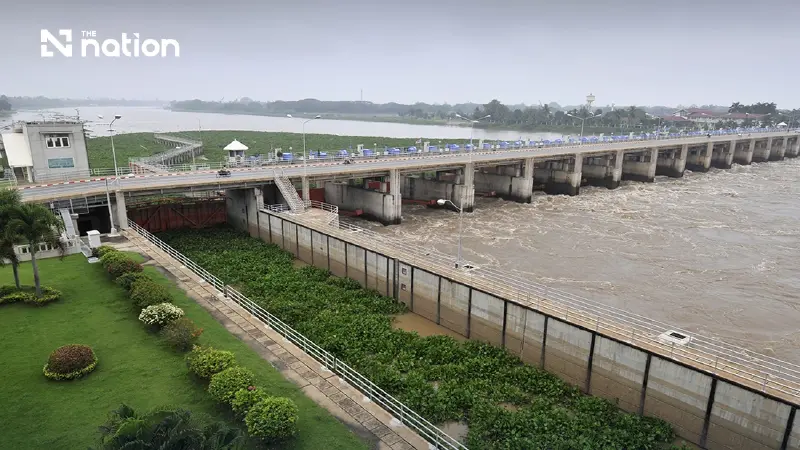


Thailand plans higher Chao Phraya Dam releases after heavy rain, putting low-lying areas outside Ayutthaya’s flood embankments at risk.
- Thailand's Royal Irrigation Department is increasing water releases from the Chao Phraya Dam, which is expected to raise downstream river levels by 0.5 to 1.5 meters.
- The measure is a response to heavy rainfall in northern Thailand that has significantly increased the volume of water flowing into the river system.
- Low-lying areas outside flood embankments in six Ayutthaya districts are expected to be among the first affected, and residents in 11 provinces have been warned to move belongings to higher ground.
Thailand’s Royal Irrigation Department warned on September 21, 2026, that downstream river levels could rise by 0.50–1.50 metres as it prepares to increase releases through Chao Phraya Dam in Chai Nat. Director-general Wittaya Kaewmee said low-lying areas outside flood embankments in Ayutthaya would be among the first affected.
Releases through Chao Phraya Dam will be raised gradually from approximately 990 cubic metres per second to between 1,000 and 1,300 cubic metres per second, Wittaya said. The adjustment is intended to manage upstream levels and accommodate rising flows from northern Thailand following heavy rain.
Six Ayutthaya districts face rising water outside flood embankments
The Royal Irrigation Department identified low-lying areas outside flood embankments along the Noi and Chao Phraya rivers in six Ayutthaya districts as among the first expected to be affected:
- Sena.
- Phak Hai.
- Bang Ban.
- Phra Nakhon Si Ayutthaya.
- Bang Pa-in.
- Bang Sai.
Wittaya said communities and economic areas inside flood embankments had not been affected at the time of the briefing. The forecast increase of 0.50–1.50 metres refers to downstream river levels, with the warning focused on vulnerable land outside the barriers.
The Royal Irrigation Department has sent warning letters to governors in 11 Chao Phraya basin provinces, asking provincial administrations and local authorities to prepare and notify vulnerable communities. Riverside residents and people in low-lying areas have been urged to move belongings higher and monitor official announcements closely.
Northern rainfall increases pressure on Chao Phraya flows

Rainfall exceeded 100 millimetres in Phrae, Chiang Rai, Kamphaeng Phet and Sukhothai during September 19–20, following a week of heavy to very heavy rain in several parts of Thailand, according to the department’s assessment. The latest readings also recorded 146 millimetres in Kamphaeng Phet and 136 millimetres in Phitsanulok.
Water from the rainfall has continued to enter natural waterways through seepage and run-off. At 6am Thailand time on September 21, the C.2 station in Nakhon Sawan recorded approximately 1,377 cubic metres per second flowing through the Chao Phraya River, with the volume still increasing, the Royal Irrigation Department said.
The Royal Irrigation Department is using irrigation networks on both banks of the Chao Phraya to divert water into canals. Wittaya said the diversions would spread the flow and reduce the volume passing downstream through Chao Phraya Dam as much as possible.
Four reservoirs placed under special monitoring
The Royal Irrigation Department has placed four reservoirs under special monitoring because of high water levels:
- Kiu Lom Dam in Lampang.
- Pa Sak Jolasid Dam in Lop Buri.
- Khun Dan Prakan Chon Dam in Nakhon Nayok.
- Kaeng Krachan Dam in Phetchaburi.
Across Thailand, large and medium-sized reservoirs held approximately 55 billion cubic metres of water, or 73% of their combined capacity, in the department’s September 21 assessment. More than 20 billion cubic metres of storage remained available.
The four main reservoirs serving the Chao Phraya basin — Bhumibol, Sirikit, Khwae Noi Bamrung Dan and Pa Sak Jolasid — held approximately 16 billion cubic metres, equivalent to 68% of their combined capacity. The department put their remaining storage space at about 7 billion cubic metres.
The Royal Irrigation Department is coordinating releases with the Electricity Generating Authority of Thailand and the Office of the National Water Resources. Wittaya said the planning must protect dams and irrigation structures, reduce downstream flooding and retain sufficient supplies for the approaching dry season.
Irrigation department readies 5,732 units for flood response
The Royal Irrigation Department has prepared 5,732 units of machinery and equipment nationwide for flood assistance, including:
- Water pumps.
- Water-propelling machines.
- Water tankers.
- Other support machinery.
Irrigation personnel are being stationed at vulnerable locations to provide round-the-clock assistance and respond to urgent problems. Wittaya said 647 units of machinery and equipment had already been deployed to disaster-affected areas in more than 55 provinces since the start of the rainy season on May 1, 2026.
Southern irrigation projects have also been instructed to intensify monitoring because continuing heavy to very heavy rain and further rainfall accumulation could trigger flash floods, fast-flowing run-off and flooding in low-lying areas. The Royal Irrigation Department has ordered immediate public warnings whenever signs of risk emerge.
Wittaya issued the instructions following an urgent September 21 review at the Smart Water Operation Center (SWOC) at the Royal Irrigation Department in Samsen, Bangkok. The meeting was linked by video conference to all 17 regional irrigation offices.
Agencies participating in the SWOC review included the Thai Meteorological Department, the Department of Disaster Prevention and Mitigation, the Department of Water Resources, the Bangkok Metropolitan Administration’s Department of Drainage and Sewerage, and the Hydro-Informatics Institute (Public Organization).
Wittaya instructed irrigation projects to anticipate changing conditions by analysing real-time monitoring-station readings, accumulated rainfall, river flows, storage in large and medium-sized reservoirs, and weather forecast models together. Releases and storage plans should be adapted to each area, particularly in the strategically important Chao Phraya basin, to limit damage to homes and farmland.
“Water management at the end of the rainy season must address two priorities at the same time: speeding up drainage to reduce the impact of flooding on people, and managing storage so that reservoirs retain as much water as possible to secure supplies for domestic use, drinking water and agriculture during the approaching dry season,” Wittaya said.
The Royal Irrigation Department said it would promptly notify provinces and relevant agencies if water conditions changed or further adjustments to releases became necessary, allowing updated warnings to reach riverside and low-lying communities as quickly as possible.
