
Bangkok readies drainage network as heavy rain warning begins
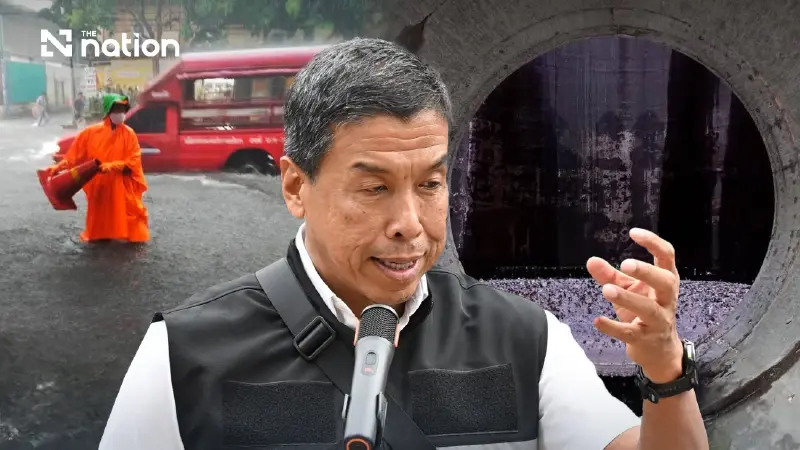


Governor Chadchart Sittipunt says the city is lowering canal levels and monitoring upstream flows, with pumps, floodgates and staff ready for heavy rain.
- Bangkok's city administration is preparing its water management systems in response to a meteorological department warning for heavy to very heavy rain.
- Preparations include clearing rubbish from drains, lowering water levels in the city's 1,980 canals, and readying pumping stations, floodgates, and water retention areas.
- The city is managing two water sources: local rainfall and upstream flow from the Chao Phraya River, for which flood barriers and riverside pumping stations are being monitored.
Bangkok Governor Chadchart Sittipunt said on Wednesday (September 23, 2026) that the Bangkok Metropolitan Administration (BMA) had made preparations under its plan after the Thai Meteorological Department warned of heavy to very heavy rain from September 23 to 27, 2026.
The city was closely monitoring rainfall and water levels to manage water and drain it as quickly as possible.
“The BMA has surveyed and monitored flood-prone areas since last week, particularly places that have flooded before, including Sena Nikhom, Sena Nikhom 1 Road, Phahon Yothin 84 Road, Inthra 5 Road and areas along Lat Phrao Canal where water has previously overflowed,” the governor said.
Chadchart said effective drainage was crucial, particularly keeping rubbish from blocking drain inlets and grates.
He had instructed district office cleaning staff to keep checking and clearing rubbish so it would not obstruct drainage during heavy rain.

“Water management has to be divided into two parts: rain that falls in Bangkok and water coming from upstream along the Chao Phraya River. For rain in Bangkok, we have the usual pumping and drainage systems. For upstream water, we must check the flood barriers, floodgates, pumping stations and other equipment along the Chao Phraya River,” the governor said.
The current upstream flow was about 1,500 cubic metres per second, still at a manageable level.
The BMA would nevertheless monitor riverside communities closely and continue coordinating with the Royal Irrigation Department and other relevant agencies.
“If more water is released through the Chao Phraya Dam, we will have to monitor it closely, because managing Bangkok’s water requires us to consider both river levels and rainfall in the city,” the governor said.

Drainage systems and staff prepared to respond
Chadchart said the Department of Drainage and Sewerage was preparing space for rainwater before rainfall by regulating and lowering water levels in Bangkok’s 1,980 canals, which have a combined length of 2,745 kilometres.
It had also readied 38 monkey cheek retention areas and Water Bank sites with a combined capacity of 13.71 million cubic metres.
The drainage system comprises 207 pumping stations, 371 pump wells, 244 floodgates, 5 drainage tunnels and 6,854 kilometres of drainage pipes.
The city had also prepared equipment and personnel for operations, including additional pumps, 12 mobile-unit vehicles, 46 water-propelling machines and 24 Bangkok Emergency Service Team (BEST) units.
It had readied 2 weather radar stations and a telemetry system to support monitoring and water management in the field.
Along the Chao Phraya River, the BMA had readied 96 pumping stations and was monitoring flood defences along 88 kilometres.
It was also ready to attend to 51 gaps in the defences and pier openings spanning a combined 2.7 kilometres, with sandbags prepared and personnel stationed at vulnerable points ready to respond.
‘Rain bombs’ assessed day by day as weather changes
Addressing talk of “rain bombs”, Chadchart said rainfall patterns and severity depended on each day’s weather and wind direction.
It was therefore impossible to say in advance that the same pattern of heavy rain would occur in every area.
“Rain bombs have to be assessed day by day, because the nature of the rain depends on the weather and wind direction each day.
We cannot say in advance that the same thing will happen in every area.
The BMA therefore has to monitor both weekly and daily weather forecasts and adjust its work to suit the situation,” the governor said.
Chadchart also urged the public not to be complacent, to follow warnings from government agencies and to allow extra time for journeys during heavy rain, especially on routes where water has previously accumulated.
Residents can check water conditions and BMA alerts on the Department of Drainage and Sewerage website and report incidents through Bangkok’s 1555 hotline, LINE: @Traffyfondue, the Bangkok Flood Prevention Center Facebook page or by calling 0 2248 5115.

