
Recycled-Bottle Blankets Enter 27th Winter as Thai State Leans on Corporate Relief
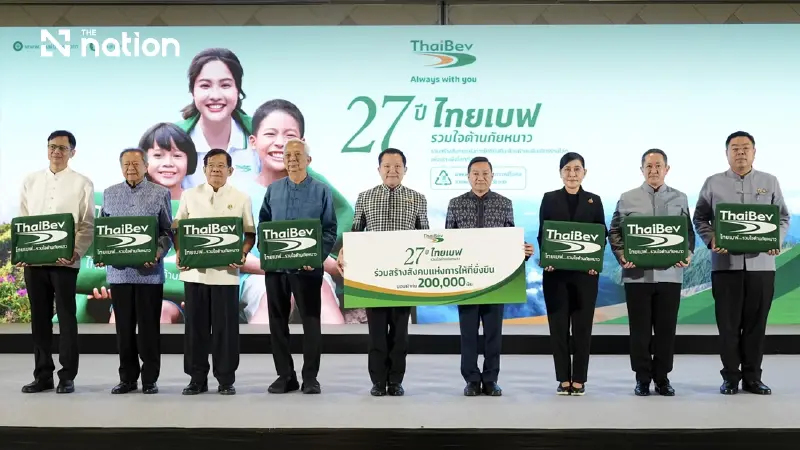


Thai Beverage hands over 200,000 rPET blankets to the Interior Ministry, combining seasonal relief with circular economy claims that lack third-party verification
- For the 27th consecutive year, Thai Beverage is donating 200,000 winter blankets to the Thai government, highlighting the state's reliance on corporate philanthropy for seasonal relief.
- The blankets are marketed as part of a circular economy initiative, with the company claiming they are made from recycled plastic bottles (rPET), with each blanket using 38 bottles.
- The company's sustainability claims, including the recycled content and the number of bottles processed, are self-reported and lack independent, third-party verification.
- A Thai Interior Ministry official confirmed that corporate partnerships are essential for delivering material aid to remote areas, as state budgets may not fully cover these needs.
Thai Beverage hands over 200,000 rPET blankets to the Interior Ministry, combining seasonal relief with circular economy claims that lack third-party verification.
Thailand’s Interior Ministry accepted a donation of 200,000 fleece blankets from Thai Beverage on Saturday, marking the 27th year of one of the country’s longest-running corporate winter relief initiatives.
The handover signals the seasonal rollout of the ThaiBev caravan, which will deliver cold-weather aid to vulnerable communities across 15 northern and north-eastern provinces.
However, as the beverage giant increasingly frames the project around circular economy metrics, the scheme underscores both the state’s reliance on corporate philanthropy and the absence of independent verification for self-reported corporate sustainability claims.
Presided over by Interior Permanent Secretary Unsit Sampuntharat and ThaiBev Chief Executive Thapana Sirivadhanabhakdi, the handover initiates distribution through the ministry’s Department of Disaster Prevention and Mitigation.
The relief caravan is scheduled to target high-altitude and rural districts across Mukdahan, Sakon Nakhon, Nakhon Phanom, Bueng Kan, Nong Khai, Udon Thani, Nong Bua Lam Phu, Loei, Phetchabun, Phitsanulok, Sukhothai, Tak, Phrae, Phayao, and Nan.
Initiated in 2000 by ThaiBev founders Charoen Sirivadhanabhakdi and Khunying Wanna Sirivadhanabhakdi, the project has distributed approximately 5.4 million blankets over nearly three decades.

In 2020, ThaiBev pivoted the initiative to align with its corporate sustainability strategy, converting production to recycled polyethylene terephthalate under a collect-back and recycle scheme operated by subsidiary Thai Beverage Recycle.
According to company figures, each blanket uses the equivalent of 38 plastic bottles. This year's run of 200,000 blankets diverts 7.6 million bottles from waste streams, bringing total cumulative totals since 2020 to 1.4 million recycled blankets and over 53 million bottles processed.
Speaking on behalf of the board, Thapana linked the annual drive to broader climate volatility, citing extreme temperature fluctuations and natural disasters that disrupt rural livelihoods.
He noted that the blanket caravan is increasingly integrated with secondary programmes spanning public health, local economic development, and disaster relief.

However, the event also highlighted the structural division of labour between the Thai state and major corporate conglomerates. Unsit acknowledged that while the Interior Ministry possesses the administrative reach to access remote villages, corporate partnerships remain essential for delivering material assistance that state budgets may not fully cover.
Praising the transition to recycled fabric, Unsit framed corporate intervention as a vital buffer against both physical hardship and rural anxiety, citing regional surveys where community wellbeing directly correlated with the expectation of external relief during seasonal crises.

