
Sufficiency and Collaboration: One Bangkok Forum Defines Urban Resilience
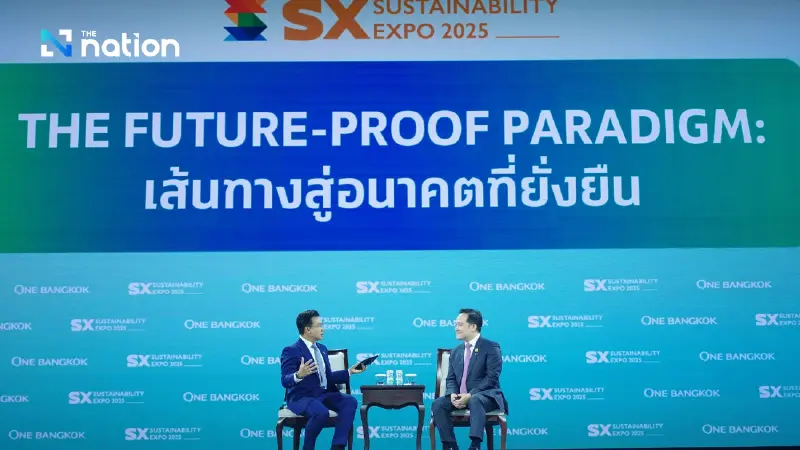


Real estate developers including One Bangok and governments unite to transform Bangkok into a sustainable metropolis, proving green investment delivers both community wellbeing and long-term returns
- The forum defined urban resilience through the principle of "sufficiency," which prioritizes long-term value from management and purposeful use (the "70%") over the initial physical construction (the "30%").
- Achieving urban resilience requires extensive collaboration between four key sectors: government, the private sector, civil society/academia, and citizens.
- A central theme was the need to shift from a reactive, problem-solving mindset to one of proactively designing a desired future, challenging economic models that discount long-term benefits.
- The One Bangkok project serves as a practical example, dedicating nearly half its land to green spaces and using advanced systems to demonstrate that sustainability is a form of long-term investment and risk mitigation.
As climate change accelerates and urban populations surge, the question facing metropolitan areas worldwide is no longer whether to pursue sustainability, but how to embed it into the very fabric of city life.
At the Sustainability Expo 2025 (SX2025), leading voices in urban development gathered to outline a compelling vision: sustainable cities aren't merely about reducing carbon emissions—they're about creating thriving ecosystems where economic prosperity, social wellbeing, and environmental stewardship converge.
Experts and developers, including Frasers Property Group CEO Panote Sirivadhanabhakdi, shared their insights at a special forum, "PLANET SHIFT 2025: Navigating the Crisis towards The City of the Future," held on October 3rd.
Hosted by One Bangkok, the forum aimed to demonstrate that the organization's vision extends far beyond iconic architecture to meticulously crafting meaningful spaces and impactful programs that profoundly benefit wider society.

A Paradigm Shift: From Problem-Solving to Future Design
Dr Youssef Nassef, Director of Adaptation Division at the United Nations Framework Convention on Climate Change (UNFCCC), delivered a keynote address, "Shaping the Future of Resilience," that challenged conventional thinking about climate resilience.
Rather than viewing adaptation as a reactive measure, he argued for a fundamental shift in mindset.
"We have to move away from a problem-slash-solution mentality to a mentality of creative design of the future," Dr Nassef explained. "Begin with the end in mind and ask yourself what kind of Bangkok we want to live in in the coming 10 years or 20 years."
This forward-looking approach acknowledges that climate adaptation affects everything from water management to public health, infrastructure to heritage preservation.
Unlike emissions mitigation—which has clear numerical targets—adaptation requires holistic thinking across multiple sectors simultaneously.
Dr Nassef highlighted a critical challenge facing sustainable development: temporal discounting. Economic models typically prioritise immediate costs and benefits over future ones, creating a structural bias against long-term thinking.
"This is very incompatible with thinking about the long term, very incompatible with the problem of climate change and how we can address it, and very incompatible with intergenerational equity," he noted.
The solution? Integrating indigenous wisdom, frontier technologies, and innovative financial instruments whilst maintaining focus on the youth—the primary stakeholders in any future we design today.

The 30-70 Rule: Redefining Real Estate Success
Panote Sirivadhanabhakdi, Group Chief Executive Officer of Frasers Property Limited, the developer of One Bangkok outlined a provocative framework for sustainable development that challenges the construction industry's traditional priorities.
"What we see as concrete, as steel, as beautiful decoration—this is only approximately 30% of the life cycle," Panote explained during his special dialogue, "The Future-Proof Paradigm.". "The other 70% is how we manage it, how we use the space for its benefits, and how we maintain it to survive and grow alongside changing circumstances and reasons."
This "30-70 rule" represents a fundamental reconception of what real estate development means. The physical infrastructure—however architecturally impressive—is merely the foundation.
The remaining 70% comprises space management, community programming, and adaptive maintenance that respond to evolving urban needs.
Frasers Property interprets "sufficiency" not as austerity but as achieving optimal balance between quality and purpose.
"Sufficiency means adequacy that comes with reasonable purpose," Panote stated. "In the end, this will create immunity, and sustainability is about closing risks. Sustainability isn't necessarily about spending without return."
This philosophy has guided FPT's approach to sustainable investment across multiple dimensions:
Green Investment as Risk Mitigation: Rather than viewing sustainability expenditures as costs without immediate returns, Frasers Property recognises that green projects reduce long-term operational risks whilst creating "stickiness"—customer loyalty that translates into sustainable returns over time.
Global Standards: Frasers Property became the first developer in Thailand to achieve LEED Platinum certification for commercial buildings and continues developing projects to world-class environmental standards, including residential and office buildings at One Bangkok.
Learning from Global Best Practices: Frasers Property actively studies and adapts urban development models from cities like Singapore, Australia, Europe, and China. Singapore's experience is particularly instructive—the city-state invested heavily in long-term infrastructure planning 50 years ago, creating an "underground city" that now demonstrates the crucial need for urban resilience and adaptability.

Collaboration: The Currency of Sustainable Cities
A recurring theme throughout the SX Expo discussions was that sustainable urban transformation cannot be achieved by any single sector working in isolation.
The Bangkok Metropolitan Administration (BMA), represented by Pronphrom Vikitsreth, Adviser to the Governor and Chief Sustainability Officer, outlined the city's two-pronged environmental strategy: enhancing what's already good (such as expanding green spaces) and reducing problematic elements (waste, air pollution, PM2.5).
Bangkok's commitment to accessible green space manifests in the "15-minute park" concept—ensuring every resident can reach a park within 15 minutes or 800 metres on foot. Beyond creating parks, BMA is pioneering waste management through circular economy principles, such as converting food waste into fertiliser.
"Everyone must work together, whether it's the general public, large organisations, shop owners, building owners, or various stakeholders," Pronphrom emphasised. "Different people working together will significantly reduce waste."
However, Pronphrom acknowledged that government cannot achieve these goals alone, requiring collaboration across four essential sectors:
1. Government (BMA): Policy-setting and regulation
2. Private Sector: Active participation in sustainability initiatives, including "sharing city" concepts like opening green spaces to the public
3. Civil Society/Academia: Proposing new policies and innovations, such as waste collection systems that incentivise sorting
4.Citizens: Adopting sustainable lifestyles
The Financial Lever: Green Loans and Carbon Reduction
Dr Jirawat Panpiemras, Vice President at Bangkok Bank, highlighted the financial sector's pivotal role in accelerating sustainable urban development.
Green loans—financing specifically designated for environmentally beneficial projects—are becoming increasingly sophisticated tools for channelling capital towards energy efficiency improvements, electric vehicle adoption, and waste management systems.
The banking sector's approach to green financing delivers multiple benefits:
Risk Reduction: Green projects typically demonstrate superior operational management, reducing loan default risks.
Customer Attraction: Sustainable buildings appeal to environmentally conscious tenants willing to pay premium rents.
Carbon Reduction (Scope 3): When clients reduce their carbon footprints, it simultaneously decreases the bank's indirect emissions, creating aligned incentives.
"A city that truly achieves sufficiency must be one where benefits are distributed and people's happiness is widespread," Dr Jirawat noted, linking financial sustainability with inclusive urban growth.

One Bangkok: A Living Laboratory for Urban Flourishing
As a participant at SX Expo 2025, One Bangkok—the largest holistically integrated district in central Bangkok—exemplifies how these principles translate into practice.
Developed jointly by TCC Assets (Thailand) and Frasers Property Holdings (Thailand), the project has evolved beyond architectural ambition into what its leadership describes as "a thriving ecosystem" focused on urban flourishing.
Urasate Navanugraha, Chief Investment Officer of One Bangkok, outlined how the project embodies "sufficiency" principles through strategic green investments:
Efficient Land Use: Despite occupying highly valuable central Bangkok real estate, almost half of the total land area is dedicated to green and open spaces
Infrastructure for the Environment: The project promotes public transportation usage whilst reducing congestion through seamless connectivity. Innovative systems include a district cooling network that reduces energy consumption by 15% over conventional approaches.
Water Management: A 100% water recycling system conserves approximately 3 million cubic metres annually—equivalent to 1,000 Olympic-sized swimming pools.
Market Leadership: One Bangkok is the first and only project in Thailand to achieve LEED Core and Shell Development Platinum certification, establishing new benchmarks for sustainable development.
"The key principle we uphold is developing with balance, then taking responsibility whether for society, economy, or the environment," Urasate explained. "We don't see this as higher upfront costs, but rather as unavoidable costs that we're simply bringing forward."
Beyond physical infrastructure, One Bangkok has implemented extensive community programming:
- Workplace wellness initiatives including yoga, running clubs, and HIIT training for office workers
- One Bangkok Football Camp partnering with ThaiBev Football Academy to support youth development in six neighbouring communities
- The Art Loop, a 2-kilometre public art promenade featuring world-class installations
- The Wireless House One Bangkok, preserving Thailand's first radio telegraph station as a cultural exhibition space that has attracted nearly 100,000 visitors

The Path Forward: From Liveable to Flourishing
Bangkok's ranking as 98th globally in the Economist Intelligence Unit's liveability index—below other leading Asian tourism destinations—underscores the urgency of urban transformation. Yet the vision articulated at SX Expo 2025 extends beyond merely improving rankings.
The government recognises that incentivising private-sector sustainability requires sophisticated policy tools.
These include tax benefits for green investments, Floor Area Ratio (FAR) incentives for sustainable design, and Transferable Development Rights that make green investment financially advantageous.
Financial institutions can offer preferential interest rates or higher loan amounts for certified green projects.
Most fundamentally, the shift towards sufficiency doesn't demand choosing between economic growth and environmental responsibility.
As Panote emphasised: "We view sufficiency as adequacy that comes with reasonable purpose. In the end, this will create immunity, and sustainability is about closing risks—not sustainability as spending without return."
The challenge and opportunity facing Bangkok—and metropolitan areas globally—is creating cities where prosperity, wellbeing, and environmental stewardship reinforce rather than contradict one another.
As Dr Nassef concluded: "Remember, the future does not happen to us. We have it to the future."
Through collaborative frameworks bringing together government, private developers, financial institutions, and citizens, Bangkok is demonstrating that the sustainable city of tomorrow isn't a distant aspiration—it's a blueprint being built today, one thoughtful investment, one community programme, and one shared commitment at a time.
