
Thailand warns four provinces to prepare for rising Mae Klong waters
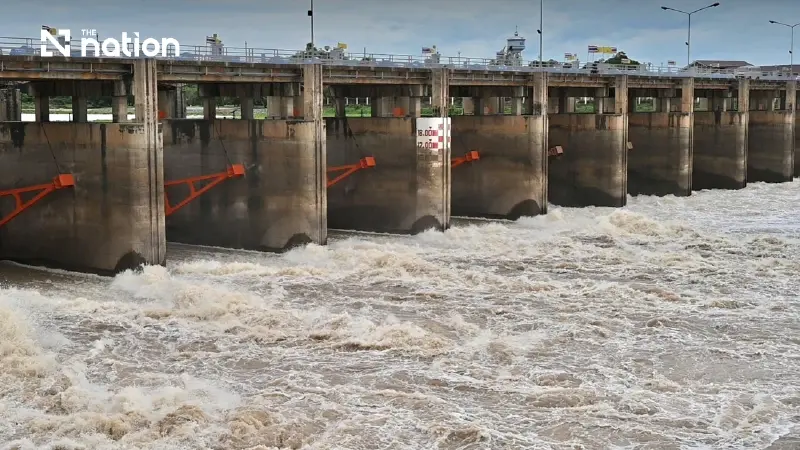


Mae Klong Dam releases are expected to exceed 1,200 cubic metres per second, while Chao Phraya Dam begins cutting discharges as upstream flows decline.
- Thailand's Royal Irrigation Department has warned four provinces, Kanchanaburi, Ratchaburi, Samut Songkhram, and Samut Sakhon, to prepare for rising water levels in the Mae Klong basin.
- The warning is due to a forecast of heavy rain and a monsoon trough, which are expected to increase water inflows into the Mae Klong Dam.
- To manage the increased volume, the Mae Klong Dam will increase its water releases to a rate expected to exceed 1,200 cubic metres per second.
- Residents and businesses in low-lying areas are advised to move valuables to higher ground and monitor official updates on the water situation.
The Royal Irrigation Department has warned residents and businesses in four Mae Klong basin provinces, Kanchanaburi, Ratchaburi, Samut Songkhram and Samut Sakhon, to remain alert and monitor water conditions closely as heavy rain is expected to increase inflows into Mae Klong Dam.
In the Chao Phraya basin, declining upstream flows prompted the department to begin reducing releases from Chao Phraya Dam on Wednesday (October 7, 2026) to balance water management across the system.
Heavy rain forecast prompts Mae Klong basin warning
The Royal Irrigation Department’s Mae Klong basin warning follows a Thai Meteorological Department forecast of thundershowers, gusty winds, hail and isolated heavy to very heavy rain in upper Thailand for October 6–7.
Rainfall is also expected to continue increasing during October 8–13.
The monsoon trough and heavy rain are expected to send substantial flows from the Khwae Noi and Khwae Yai rivers into the Mae Klong River.
The Royal Irrigation Department therefore needs to increase releases from Mae Klong Dam to accommodate the expected inflows.
Discharges from Mae Klong Dam are expected to exceed 1,200 cubic metres per second, according to the Royal Irrigation Department.
The department plans to adjust releases to reflect actual rainfall and runoff in the area.
The Royal Irrigation Department urged residents, business operators, shopkeepers and farmers along the Mae Klong River, particularly in low-lying areas of Kanchanaburi, Ratchaburi, Samut Songkhram and Samut Sakhon, to prepare in advance.
The Royal Irrigation Department urged people in the Mae Klong basin to move belongings, electrical equipment and valuables to higher ground as soon as possible, inspect flood embankments and follow official updates closely to reduce the impact of potentially rising water levels.
Chao Phraya inflows decline as upstream conditions ease
The Royal Irrigation Department’s close monitoring indicates a continuing downward trend in flows from the upper Chao Phraya basin, bringing a gradual reduction in water entering the Chao Phraya River at Nakhon Sawan.
Water flow data for 6am on October 7 showed the following readings:
- P.17 station, Ping River: 484 cubic metres per second, with flows declining.
- N.67 station, Nan River: 998 cubic metres per second, with flows declining.
- C.2 station, Chao Phraya River in Mueang district, Nakhon Sawan: total flow down to 1,915 cubic metres per second.
- Ct.19 station, Sakae Krang River in Uthai Thani: 52 cubic metres per second.
A significant decline in water flowing towards Chao Phraya Dam prompted the Royal Irrigation Department to adjust downstream water management to reflect current rainfall and runoff.
Chao Phraya Dam starts reducing releases
The Royal Irrigation Department had held releases from Chao Phraya Dam at 2,500 cubic metres per second, with the upstream water level at 16.38 metres above mean sea level.
Falling inflows prompted the department to start reducing releases on October 7 under the following plan:
- Phased reductions: Cuts began at 8am, reducing the discharge rate by about 20 cubic metres per second each hour.
- Target discharge: The plan was to reduce Chao Phraya Dam releases to 2,400 cubic metres per second at 1pm and maintain that rate continuously as appropriate for water conditions.
- Irrigation intake: Combined water intake into the eastern and western irrigation systems was also reduced to 487 cubic metres per second, compared with 564 cubic metres per second on October 6.
The simultaneous reductions in Chao Phraya Dam releases and irrigation canal intake are intended to balance water management and prevent impacts on farmland and downstream communities.
Royal Irrigation Department keeps dam release plans flexible
The Royal Irrigation Department continues to closely monitor and assess rainfall and runoff from upstream areas and remains ready to adjust its dam release plans according to actual daily weather and water conditions.
People in at-risk areas of the Mae Klong basin in Kanchanaburi, Ratchaburi, Samut Songkhram and Samut Sakhon, and in the Chao Phraya basin, can closely follow warnings, water situation reports and real-time water-level information through the Royal Irrigation Department’s official channels or local government agencies to prepare promptly for changing conditions.
