
Thailand Slips to 80th in Global Rule of Law Index Amid Corruption Concerns



New WJP report shows Thailand falling three places in global rankings, with sharp declines in anti-corruption efforts and law enforcement
- Thailand's ranking in the World Justice Project's Rule of Law Index has fallen three places to 80th out of 143 countries.
- The decline is primarily attributed to worsening scores in anti-corruption measures and law enforcement.
- The country's score for "Absence of Corruption" fell below the global average and has contracted by 5.6% over the last five years.
- Experts noted that a strong rule of law is crucial for economic prosperity and investor confidence, which are vital for Thailand's development goals.
New WJP report shows Thailand falling three places in global rankings, with sharp declines in anti-corruption efforts and law enforcement.
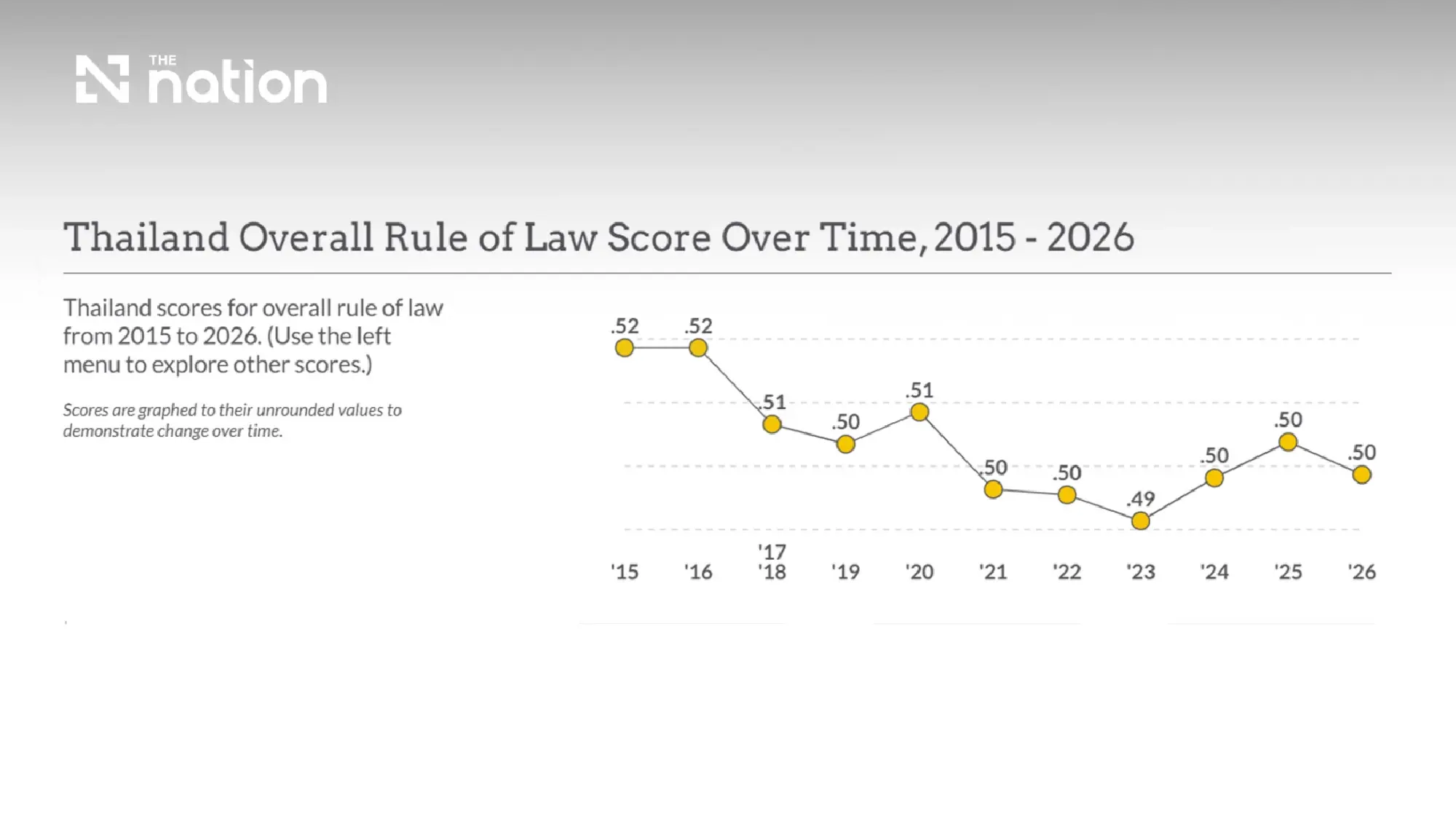
Thailand has fallen three places to rank 80th out of 143 countries in the World Justice Project (WJP) Rule of Law Index 2026, driven by declining scores in anti-corruption measures and law enforcement.
According to the report published on 24 October 2026, Thailand achieved an overall score of 0.50 out of 1.00. Within the East Asia and Pacific region, Thailand ranks 10th out of 15 countries and 24th out of 44 upper-middle-income nations globally.
The results highlight ongoing challenges in enforcing checks and balances on state power, protecting fundamental rights, and ensuring access to justice.
Performance across key metrics
Thailand scored above the global average in only one of the eight factors assessed—Order and Security—while falling below average in the remaining seven:
Constraints on Government Powers: 0.47 (Global average: 0.53)
Absence of Corruption: 0.44 (Global average: 0.51)
Open Government: 0.48 (Global average: 0.52)
Fundamental Rights: 0.49 (Global average: 0.55)
Order and Security: 0.75 (Global average: 0.72)
Regulatory Enforcement: 0.44 (Global average: 0.54)
Civil Justice: 0.50 (Global average: 0.54)
Criminal Justice: 0.42 (Global average: 0.47)
Compared to 2025, Thailand saw direct score reductions in both the Absence of Corruption (down from 0.45) and Regulatory Enforcement (down from 0.45).
Over a five-year period (2021–2026), the absence of corruption metric contracted by 5.6 per cent, whilst regulatory enforcement dropped by 4.0 per cent.

Governance and civil liberties
The country report noted specific declines in freedom of expression, freedom of assembly, civic participation, and judicial constraints on executive power.
Thailand is among 86 per cent of nations globally that have experienced a deterioration in at least one mechanism designed to prevent authoritarianism over the past five years.
Additionally, Thailand failed to make progress in the affordability, accessibility, and non-discriminatory nature of civil justice—areas where more than half of surveyed countries improved globally.
The WJP noted that executive overreach and political interference continue to weaken civil and criminal justice systems worldwide, whilst restrictions on civic space hinder public oversight.

Economic implications
Dr Phiset Sa-ardyen, executive director of the Thailand Institute of Justice (TIJ), stated that the index provides crucial empirical data to guide legal and institutional reform.
"The goal is to enable laws and institutions to deliver justice and build public trust through concrete, evidence-based approaches," Dr Phiset said.
He emphasised that a strong rule of law directly correlates with economic prosperity, price stability, and sovereign creditworthiness.
Clear rules, equal enforcement, and accessible dispute resolution are vital for investor confidence and Foreign Direct Investment (FDI), particularly as Thailand pursues goals under its 13th National Economic and Social Development Plan and targets OECD membership by 2028.
"Elevating the rule of law is an investment in the nation’s foundation—protecting rights, fostering fair economic opportunities, and supporting sustainable development," Dr Phiset added.

Global context
Globally, rule of law scores declined in 62 per cent of assessed countries this year, marking the ninth consecutive year in which more nations regressed than improved. Denmark, Norway, and Finland topped the global rankings.
In the East Asia and Pacific region, New Zealand ranked 1st (7th globally), followed by Australia and Singapore. The Philippines, Myanmar, and Cambodia occupied the bottom three regional spots.
