
Industry Ministry to inspect 1,500 waste factories from November 2
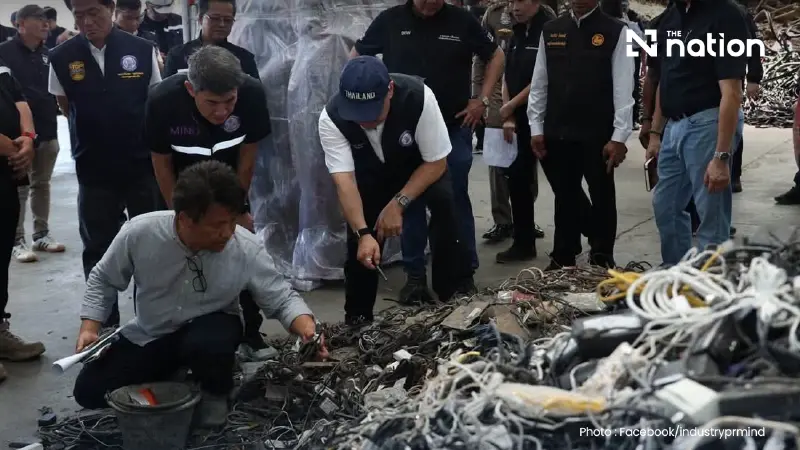


The Industry Ministry plans to deploy 50 teams across five provinces amid concern over industrial-waste leaks exposed by flooding in Prachin Buri.
- Starting November 2, Thailand's Industry Ministry will deploy 50 teams to inspect about 1,500 waste-handling and recycling factories across five high-risk provinces.
- The inspections are a response to repeated complaints and a recent incident in Prachin Buri where industrial waste leaked from a flooded landfill, contaminating local waterways.
- Factory operators found to be non-compliant with required standards will face legal action as part of a broader goal to eliminate illegal factories by 2027.
- The probe will extend beyond physical inspections to scrutinize company ownership structures, financial transactions, and the status of foreign shareholders to uncover illegal activities.
Thailand plans to deploy 50 teams to inspect about 1,500 waste-handling and recycling factories across five high-risk provinces from November 2, Industry Minister Varawut Silpa-archa said on October 27. Operators that fail to meet required standards will face legal action.
Varawut said inspections would cover Chon Buri, Rayong, Chachoengsao, Samut Prakan and Prachin Buri. The five provinces account for about 1,500 of Thailand’s 3,049 category 105 and 106 factories, which handle waste sorting, disposal and recycling.
Flooding exposes Prachin Buri waste leaks
The Department of Industrial Works said in an October 5 statement that preliminary inspections found industrial-waste leachate and other contaminants flowing from a flooded landfill and waste-treatment site in Hua Wa subdistrict, Si Maha Phot district, Prachin Buri. A rainbow-coloured, oil-like sheen had spread across surrounding floodwater.

The Department of Disease Control reported on October 2 that the sheen extended more than a kilometre along waterways, with farmland and communities along the route potentially affected.
The Pollution Control Department reported on October 14 that a water sample collected on October 1, about 65 metres from a leaking landfill embankment, contained 114,860 milligrams per litre of petroleum hydrocarbons. Samples taken 435 and 850 metres away contained less than 3 milligrams per litre. The department planned sediment sampling after floodwater receded to assess the extent of contamination and guide management of the affected area.
The Department of Industrial Works said it had ordered the Hua Wa facility to halt all operations and stop receiving waste pending corrective work. Emergency containment measures included oil booms, absorbent pads and sandbag barriers.

The Department of Disease Control said on October 27 it had opened an emergency operations centre for the Prachin Buri incident and planned at least two years of health monitoring for residents at risk. Of 613 people screened, 116 reported symptoms, mainly rashes and blisters, which the department said could result from prolonged contact with floodwater.
The Department of Disease Control also advised residents to avoid consuming aquatic animals or agricultural produce from potentially contaminated areas until authorities confirmed their safety.
Responding to an October 26 complaint about chemicals in water in Khok Pip subdistrict, Si Mahosot district, Prachin Buri, Varawut said he had not yet received a report on that specific case.
Illegal factories expected to start closing by year-end
Varawut said he expected illegal factories to begin closing before the end of 2026 and would seek to eliminate such operations from Thailand during 2027. Many factories operated properly, Varawut said, although a substantial number were breaking the law.

Varawut said he had asked the ministry’s permanent secretary over the preceding months to organise 50 teams comprising provincial industry officials and staff from across the country. The inspections starting on November 2 would cover every relevant factory in the five target provinces, with teams coordinating with local administrative organisations, the Ministry of Natural Resources and Environment and the Ministry of Interior.
Varawut said complaints had arisen repeatedly in several provinces, particularly Prachin Buri, Rayong and Chachoengsao, prompting inspections and enforcement. A ministry LINE group established in early October linked senior officials, relevant agencies and provincial industry offices nationwide so complaints could be logged and officials dispatched to investigate.
Varawut urged residents to stay alert to activities carried out by people from outside their communities and report concerns through the Industry Ministry’s 1564 hotline. Officials would be sent to investigate.
Varawut said the prime minister had stressed the need for action at the previous week’s Cabinet meeting and during their other meetings. Further instructions from the Prime Minister’s Office were expected that week.
Shareholding and financial links under scrutiny
Varawut said investigations were extending to company ownership structures, including the discovery of one Thai individual listed as a shareholder in nearly 18 companies with foreign-language names. “We are investigating why this person’s name appears in so many companies and whether there are any connections,” Varawut said.
Varawut said banks had been asked to trace financial transactions to establish whether nominee arrangements were involved, particularly in cases involving serious offences such as dumping industrial waste or electrical cables.
For companies with foreign shareholders, Varawut called for checks with the Immigration Bureau on their travel status and monitoring to prevent departure if they were considered potential suspects.
Waste shipments face checks on declarations and destinations
Following the Customs Department’s discovery of containers carrying illegally imported electronic waste and hazardous waste, Varawut said officials needed to verify whether the intended receiving factories held Department of Industrial Works licences.
Varawut said checks were also needed to establish whether waste sent to licensed factories matched the declared quantities and volumes. In some cases, the facilities supposedly designated to destroy electronic waste did not exist.
Varawut thanked Customs for inspecting containers before they left port, saying interception could limit the damage. Allowing waste shipments out of the port was like releasing a genie from a bottle, Varawut said, because bringing them back under control would be difficult.
Asked whether suspending electronic-waste imports would affect Thailand’s recycling industry, Varawut said a suspension was unlikely at this stage and that the issue needed to be discussed first. Varawut emphasised coordinated checks to prevent false declarations, establish what materials were entering the country and verify whether they had been declared.
The Department of Foreign Trade has separately reaffirmed that electronic-waste imports are prohibited. An official government update on October 22 said the ban remained in force while lawful imports of high-quality scrap metal were still permitted.
