
Why countries urge emergency food supplies and what Thais should prepare
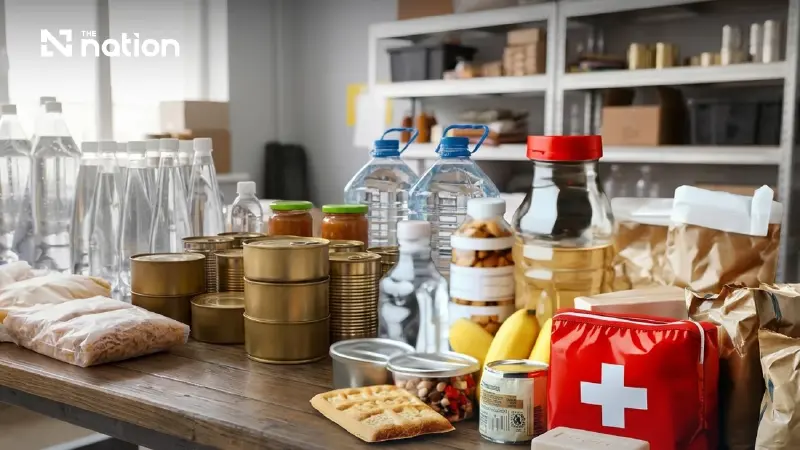


Countries recommend keeping 3–7 days of emergency supplies for disasters and outages, while Thailand expands catastrophe insurance for 30 million homes.
- Several countries, including the UK, Japan, and Sweden, are urging citizens to stock 3-7 days of essential supplies as a standard disaster preparedness policy, not as a warning of imminent war, to ensure self-sufficiency during disruptions from events like extreme weather, earthquakes, or infrastructure failures.
- While other nations focus on household stockpiling, Thailand's government has prioritized a different approach to disaster management, recently increasing the budget for a national disaster-insurance scheme to provide financial protection.
- Despite the lack of an official government campaign, it is recommended that Thai households prepare a basic 72-hour emergency kit with non-perishable food, water, medicine, and equipment like torches and power banks as a routine precaution against local risks such as floods and power cuts.
- The international push for preparedness is part of a broader strategy, consistent with UN frameworks, to build resilience and reduce disaster risks before they occur, emphasizing that individual preparation should also include evacuation plans.
A growing number of countries are encouraging households to keep at least three to seven days of food, drinking water and other essential supplies, prompting questions in Thailand over whether the advice signals an approaching war or major global crisis.
The recommendations have attracted widespread attention on social media, with some users interpreting them as warnings of an imminent emergency.
However, the measures largely form part of national disaster-preparedness policies designed to help households cope with temporary disruptions to electricity, water, communications, transport and other essential services.
While some governments explicitly include war and cyberattacks among the risks they are preparing for, the announcements do not in themselves indicate that a major conflict or disaster is about to occur.
Countries promote emergency supplies for different risks
The UK government launched its Be Ready campaign on October 22, encouraging households to keep enough non-perishable food, bottled water and other essentials to manage independently for at least three days.
The campaign forms part of a three-year initiative to improve public preparedness for emergencies that could disrupt essential services, including severe storms, flooding, extreme weather and threats to critical infrastructure.
The British government also highlighted research showing that only 13% of respondents felt prepared for an emergency that could cut them off from essential services.
Japan has long recommended that households maintain at least three days of emergency supplies, preferably enough for a week.
On October 27, Japanese media reported that the country's disaster management minister planned to issue a nationwide preparedness appeal on November 2, encouraging people to stock food, water and emergency toilet supplies.
The appeal is intended to strengthen readiness for major earthquakes and other disasters that could damage roads, transport networks and utilities, potentially delaying government assistance.
The United States has similarly promoted emergency preparedness for years through Ready.gov, an initiative of the Federal Emergency Management Agency (FEMA).
Its recommendations include maintaining at least three days of food, drinking water, medicines and essential equipment, alongside household emergency plans.
In Northern Europe, Sweden advises households to prepare to manage independently for at least seven days.
Its updated 2024 booklet, In Case of Crisis or War, provides guidance on dealing with armed conflict, power cuts, extreme weather, cyberattacks and other emergencies.
Finland, meanwhile, promotes a 72-hour preparedness recommendation, encouraging households to keep enough essential supplies to cope with temporary disruptions before outside assistance becomes available.
Although the approaches differ, they share a central principle: during a major emergency, public authorities may not be able to reach every household immediately, making basic self-sufficiency an important part of disaster preparedness.
UN urges investment in prevention rather than recovery alone
The emphasis on preparing before disasters occur is consistent with the Sendai Framework for Disaster Risk Reduction 2015–2030, adopted under the United Nations.
The framework identifies four priorities: understanding disaster risks, strengthening disaster-risk governance, investing in resilience, and improving preparedness for effective emergency response and recovery.
It encourages governments to reduce risks and potential losses before disasters occur instead of relying primarily on assistance and reconstruction afterwards.
The economic case for prevention is substantial.
According to the Global Assessment Report 2025 from the United Nations Office for Disaster Risk Reduction (UNDRR), every US$1 invested in disaster resilience can generate up to US$15 in avoided future losses.
The report estimates that the global economic cost of disasters exceeds US$2.3 trillion annually when indirect economic effects, cascading losses and environmental damage are taken into account.
These findings underline the importance of disaster preparedness not only for public safety and quality of life but also for national budgets and long-term economic stability.

Thailand increases disaster-insurance budget to THB16.55bn
Thailand is also moving towards a more proactive approach to disaster-risk management, although its recent policies have focused more on financial protection than household emergency stockpiling.
The government is implementing a national disaster-insurance scheme intended to shift part of the financial burden from post-disaster relief towards advance risk management through insurance.
On October 27, the Cabinet approved an increase in the budget ceiling for purchasing disaster insurance for the public from THB15.5 billion to THB16.55 billion, an additional THB1.05 billion.
The increase does not expand the number of households covered or their existing insurance entitlements.
Instead, it addresses a shortfall after the original calculation of residential insurance premiums omitted 7% value-added tax, leaving the previously approved budget insufficient.
The programme, overseen primarily by the Department of Disaster Prevention and Mitigation (DDPM), aims to cover approximately 30 million homes against floods, windstorms and earthquakes.
Under the insurance conditions, compensation for residential damage is capped at THB100,000 per household per covered disaster, while death benefits are set at THB2 million per person.
The government announced that coverage would take effect from October 1, 2026, although the residential insurance premium payments required an adjustment to the budget framework.
The programme reflects Thailand's efforts to reduce uncertainty over disaster-related public expenditure and enable affected households to receive financial assistance more quickly.
Should Thai households stock emergency food and water?
Unlike countries that have established public campaigns promoting three- or seven-day emergency supplies, Thailand has not introduced a similarly comprehensive national household-stockpiling campaign.
Nevertheless, households in Thailand face risks that could make emergency supplies useful, including floods, storms, power cuts, interruptions to water supplies and disruptions to transport or access to shops.
Cyberattacks affecting essential infrastructure could also interfere with services that people rely on in everyday life.
Preparing a basic emergency kit therefore does not have to be viewed as a response to an approaching war or crisis.
Instead, households can adopt internationally recognised preparedness practices as a routine precaution.
Based on FEMA guidance, a basic emergency kit should contain enough essentials for at least 72 hours.
- Food and drinking water: Keep drinking water, ready-to-eat meals, tinned food and other non-perishable products that do not require refrigeration or electricity for preparation.
- Medicines and hygiene: Prepare essential medication, a first-aid kit, personal hygiene products and supplies for children, older people and household members with particular medical needs.
- Emergency equipment: Keep torches, spare batteries, charged power banks and a battery-powered or hand-cranked radio for receiving information during power or communications outages.
- Important documents and emergency plans: Store copies of essential documents, emergency contact numbers and a household evacuation plan in an accessible location.
Preparedness does not require households to purchase large quantities of food or other supplies at once.
The UK's Be Ready guidance recommends starting by checking what is already available at home, gradually adding missing essentials during normal shopping and regularly checking expiry dates.
This approach allows households to build emergency supplies according to their needs and financial circumstances without unnecessary expenditure or panic buying.
Emergency supplies must be accompanied by evacuation plans
Keeping emergency supplies at home does not mean that remaining inside is always the safest option.
In situations involving flash floods, landslides, structural damage or other immediate threats, residents may need to evacuate promptly in accordance with official warnings.
Emergency supplies should therefore form part of a broader household preparedness plan that includes evacuation routes, access to reliable information and arrangements for family members who may need additional assistance.
Individual preparedness must also be supported by effective government measures, including early-warning systems, local risk assessments, evacuation planning and assistance for vulnerable groups.
Low-income households, older people and people with disabilities may face particular difficulties in preparing supplies independently, making community and government support especially important.
Ultimately, the growing emphasis on emergency preparedness internationally is not a reason for panic.
For Thailand, the lesson is that disaster readiness should begin before an emergency occurs, with households, communities and government agencies sharing responsibility for reducing risks.
Keeping a modest supply of essential items at home is one practical way to improve resilience, giving families greater ability to manage during the first critical days of a disaster while awaiting assistance.
