
Queen Sirikit’s crematorium design follows ancient royal tradition
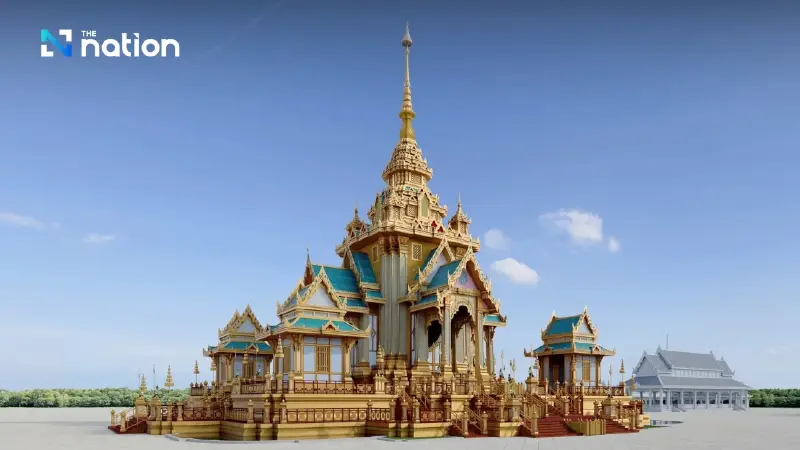


The roof’s seven tiers match those of the Maha Prasat throne halls in the Grand Palace. The gable arches echo the crown and necklace the Queen Mother wore.
- The crematorium's design is based on ancient royal customs, taking the form of a spired palace with a seven-tiered roof modeled after the Grand Palace's throne halls.
- Traditional symbols of the highest royal rank are used, such as the Nine-Tiered Great White Umbrella of State at the summit.
- The design incorporates religious symbolism, including a Brahma-shaped finial to represent the Queen Mother's passage to the next realm and her role as "Mother of the Land."
- Personal elements are woven into the traditional design, such as the Queen Mother's cypher, the use of light blue for her Friday birthday, and motifs inspired by her name and jewelry.
The Fine Arts Department followed ancient royal custom in designing the Royal Crematorium and its ceremonial fittings for the royal cremation of Her Majesty Queen Sirikit The Queen Mother.
Beauty of form was also central to the design, which reflects the Queen Mother’s conduct and the compassion she showed the Thai people.
The spire takes the form of a stylised crown modelled on royal headdresses.
The roof rises in seven tiers, its eaves arranged one above the other as on the Maha Prasat throne halls in the Grand Palace.
The finial is shaped like the face of Brahma, symbolising the Queen Mother’s passage to the realm of Brahma after her death.

It also evokes her epithet, “Mother of the Land”. In her royal duties, she cared for and protected the Thai people as a mother does her children.
The image likens her to Brahma in that maternal role, just as a mother is Brahma to her children.
At the summit of the crematorium, the Nine-Tiered Great White Umbrella of State signifies the highest royal rank.
The crematorium takes the form of a spired palace, square in plan, with a porch projecting from each of its four sides.
It stands on a two-tiered platform decorated with figures of deities that symbolise the Queen Mother’s passage to heaven.


On the roof, muted sky blue alternates with the colour of jewel beetle wings.
Each gable bears the Queen Mother’s cypher in Thai script, ส.ก. (S.K.), on a light blue field.
Light blue is the colour of Friday, the day of the week on which she was born.
The background is pink, the colour of si (auspiciousness) for her day of birth.
The gable arches take the traditional na nang form, their outlines inspired by the crown and necklace the Queen Mother wore.
Plants associated with her name, “Sirikit”, inspired the decorative motifs.
The hand embroidery on the fire screens is the work of artisans from the Queen Sirikit Institute, which owes its founding to the Queen Mother’s benevolence.
