
Air and wastewater monitoring ordered after fire at Bangchak refinery
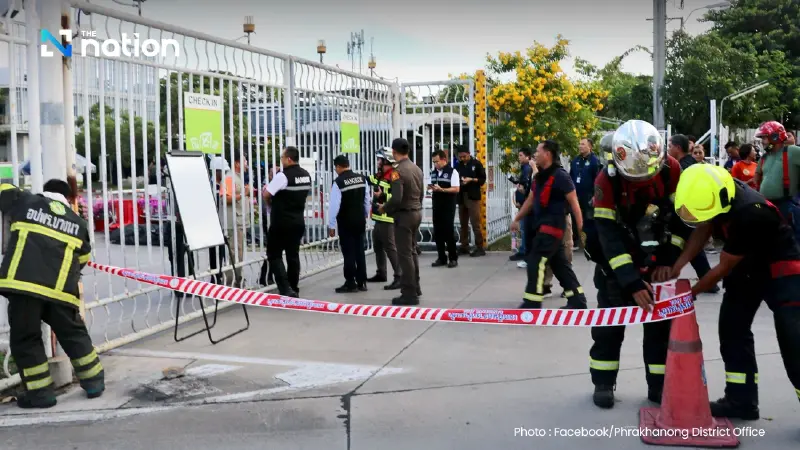


The Bangkok Metropolitan Administration’s Erawan Center initially reported seven people injured. Four were in the red triage category and three in the yellow category.
- Following a fire at the Bangchak oil refinery, the Thai government has ordered the Pollution Control Department to monitor air quality and wastewater to assess environmental and health impacts.
- Air quality monitoring will focus on downwind areas, utilizing a mobile unit and fixed stations to measure hazardous pollutants like volatile organic compounds (VOCs), carbon monoxide, and PM2.5.
- The investigation includes checking for contamination in local water bodies from wastewater generated during firefighting and refinery operations.
- Authorities will provide continuous updates and health advisories to residents in affected areas based on the monitoring results until the risk is deemed to have passed.
Natural Resources and Environment Minister Suchart Chomklin said on Thursday (November 26, 2026) that Prime Minister Anutin Charnvirakul had expressed concern about the fire at the Bangchak oil refinery, particularly its possible effects on local residents and the environment.
Anutin had instructed him to oversee the environmental checks and direct the Pollution Control Department (PCD) to go to the site immediately to monitor the situation and assess the impact.
Suchart said he had ordered the department to monitor air quality and investigate any wastewater arising from firefighting and refinery operations.
The aim was to assess in full the risk of contamination in local water bodies and the potential impact on nearby residents.
He instructed the department to monitor conditions closely and continuously and coordinate with the relevant local agencies.
If it identified any environmental risks or impacts, it was to take appropriate measures without delay and issue warnings and advice to help residents prevent and reduce health risks.
Suchart stressed that the Ministry of Natural Resources and Environment would not overlook any situation that could affect people’s quality of life and the environment.
Plan to monitor air quality and the effects of the refinery fire on public health in Phra Khanong
1. Areas at risk and forecast conditions
A Windy forecast checked at 3.34pm indicated the following wind conditions.
- From 1pm to 4pm, winds were expected to blow towards the south to south-west at about 6 km/h, with gusts of 15 km/h.
- At 7pm, winds were forecast to continue in the same direction, easing to about 4 km/h.
- At 10pm, winds were likely to shift westwards, at about 4 km/h.
The plan gives Phra Khanong and Bang Na priority for monitoring and calls for checks on whether pollutants spread westwards during the night.
The proposed initial monitoring area extends 5 km from the site, with an emphasis on areas downwind. This radius is for monitoring only and does not define a danger zone or an evacuation area.
- 0–1 km
Give first priority to communities immediately around the refinery.
- 1–3 km
Focus on measuring pollutants in downwind communities, including at schools and in places where vulnerable groups are present.
- 3–5 km
Track the spread of pollutants through the network of monitoring stations.
- Beyond 5 km
Consider extending monitoring according to wind direction, readings and conditions at the fire.
Wind speeds are likely to fall in the evening and at night, and the layer of air in which pollutants mix may become shallower. If the site continues to emit pollutants, they may be diluted more slowly.
2. Immediate measures to protect public health
- People near the site must comply strictly with evacuation orders issued by officials.
- People in downwind areas where no evacuation order is in force should stay indoors and keep doors and windows tightly closed.
- Switch off ventilation systems that draw outdoor air into buildings.
- Suspend outdoor activities and avoid routes affected by smoke.
- Work with district offices to monitor schools, childcare centres, healthcare facilities and communities downwind.
- Take particular care of children, older people, pregnant women and people with heart or respiratory conditions.
- Anyone experiencing stinging eyes, a burning sensation in the nose, coughing, chest tightness, difficulty breathing, dizziness or nausea should avoid further exposure, move to a safe area and seek medical attention. In an emergency, call 1669.
N95 masks can reduce exposure to dust and soot. They offer no protection against toxic gases or chemical vapours.
3. Deployment of a mobile air quality monitoring unit
The plan calls for one six-wheeled mobile unit capable of measuring volatile organic compounds (VOCs) to be made ready.
Proposed primary site
- Wat Bang Na Nok School, Bang Na
Reserve sites
- Bang Na District Office
- Bangchak School (Nak Phuean Uppatham), Phra Khanong
Reasons for the site choices
- The forecast for the afternoon and early evening puts communities south and south-west of the refinery downwind, making them a priority.
- Heat from the fire lifts the smoke plume. The area closest to the source may therefore not have the highest ground-level concentrations of pollutants.
- Measurements should focus on locations downwind where people may be exposed (Downwind Receptor).
4. Pollutants to monitor and associated health risks
If petroleum products burn or leak, they may release pollutants that warrant monitoring.
- VOCs such as benzene, toluene, ethylbenzene and xylene can irritate the eyes and airways and cause headaches, dizziness and nausea.
- Carbon monoxide (CO) reduces the blood’s capacity to carry oxygen. High exposure can be fatal.
- Sulphur dioxide (SO₂) and nitrogen dioxide (NO₂) can irritate the airways and trigger asthma symptoms.
- Hydrogen sulphide (H₂S) can be fatal at high levels of exposure if the gas has leaked or is involved in the affected production process.
- PM2.5, PM10 and black soot can affect the respiratory system, heart and blood vessels.
- Cumulative exposure to some polycyclic aromatic hydrocarbons (PAHs) can increase the risk of cancer.
5. Monitoring station and weather data
AirBKK
- Phra Khanong and Bang Na
Monitor areas near the source and downwind.
- Suan Luang and Vadhana
Use readings for upwind comparisons according to the observed wind direction.
- Khlong Toei
Watch for changes in wind direction.
- Yan Nawa and Rat Burana
Track any subsequent spread of pollutants to the west and south-west.
PCD’s Air4Thai stations
- Thai Meteorological Department station, Bang Na
- Nonsi Witthaya School station, Yan Nawa
- Rat Burana Post Office station
Weather data
- Observed wind direction and speed at the refinery
- Thai Meteorological Department data and models used to forecast wind direction
- KU Tower data, VR and information on temperature inversions to support an overall assessment of atmospheric ventilation and the risk of pollutants building up in the evening and at night
6. Measurements, analysis and risk assessment
- Use fixed-station readings from 12pm onwards to compare conditions before and after the fire began. Use hourly readings, or more frequent readings where instruments allow.
- Compare upwind and downwind readings to assess any increase in pollutant levels.
- Do not use either the 24-hour average for PM2.5 or the total concentration of volatile organic compounds (TVOCs) as the sole basis for confirming that conditions are safe.
- Map the monitoring area and update it according to wind direction and monitoring results.
- Pay particular attention to changes in wind direction and speed between 7pm and 10pm when considering whether to reposition the mobile unit and whether to extend monitoring.
- Report on conditions every 30 minutes and immediately if a risk to public health is identified.
- Once the fire is under control, continue monitoring until both the readings and the risk assessment support ending the checks.
