
Anutin tells governors to act swiftly on foreigner deportations
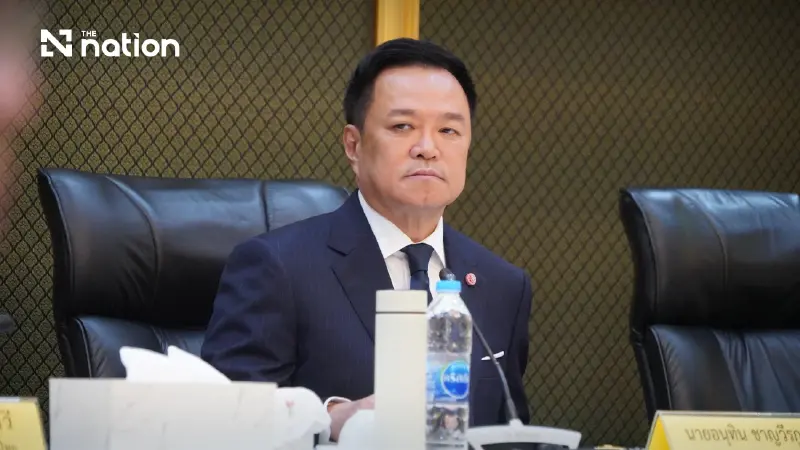


Thai PM Anutin tells governors to act swiftly against foreign lawbreakers, enforce deportation rules and remove signs barring Thai people.
- Prime Minister Anutin Charnvirakul has ordered provincial governors to use their full legal powers to swiftly deport foreigners who exploit, intimidate, or exhibit undesirable conduct towards Thai people.
- Anutin dismissed concerns over deportation costs and appeals as excuses for inaction, assuring officials that expenses would be covered and that the government is prepared to handle legal challenges.
- He argued that deporting offending foreigners is preferable to having them serve prison sentences in Thailand, stating that incarceration consumes national resources like food and water.
- The crackdown targets a range of offenses, including aggressive behavior, illegal business operations like nominee arrangements, and actions deemed disrespectful to Thai culture, such as setting up unauthorized places of worship.
Prime Minister and Interior Minister Anutin Charnvirakul has urged provincial governors to make full use of the law against foreigners who exploit or intimidate Thai people, calling for swift deportation when their conduct meets the relevant criteria.
Speaking about the implementation of Interior Ministry policies on Thursday (September 17, 2026), Anutin praised Deputy Interior Minister Polapee Suwunchwee for taking the lead in legal action and encouraging enforcement teams. He noted that their work had received a strongly positive response.
Foreigners could live alongside Thai people if they earned an honest living and did not exploit others or use their strength, intelligence, financial resources or various systems to take advantage of Thais, he said.
However, Anutin called for full enforcement against those who behaved aggressively, threatened or bullied others, or displayed undesirable conduct. He singled out Phuket and Surat Thani, alongside other provinces experiencing similar problems, and urged governors to exercise their legal powers fully.

Religious premises and private cemeteries
“I do not think you can simply set up a place of worship on your own. These arrangements must also respect Thai society and culture,” Anutin said.
“I have recently learnt that there has even been a request to establish a private cemetery. This is going too far, well beyond the bounds. You should be grateful we have let you come here. Come here to earn an honest living.
“If you are going to die, go and die back home. You do not need to die here. And do not exploit us. Nor is it acceptable to apply for permission to open a restaurant but have a place of worship there.”
Anutin said Thailand was willing to welcome foreigners, but the relationship had to benefit both sides. He recognised that tourism brought spending and investment into the country, but maintained that this did not give anyone the right to exploit others or use investment to conduct illegal activities.
He added that the people involved came from numerous countries, not just one, including countries in Asia, the Middle East, Central Asia, Europe and Africa.
Governors and district chiefs needed to issue firm instructions rather than repeatedly chase individual cases without bringing the wider situation under control, he said. Authorities should use the law to establish clear limits on unacceptable conduct and restore order quickly and effectively.

Deportation costs and appeals
Anutin said he had signed an Interior Ministry notification on deportation, providing officials with mechanisms to take full action. This also signalled to anyone contemplating improper conduct that the government was serious and prepared to deport them.
“Do not come back and ask where the money will come from to pay for the flight when someone is deported. Asking that suggests you have not thought it through, or that you are trying to pass the responsibility to someone else. That is unacceptable,” he told officials.
“Deportation means that once you have taken action, that person must leave the country. I will arrange for the expenses to be covered. Do not use these things as excuses.
“At times, it feels like an insult to our intelligence to say you cannot sign a deportation order because you do not know who will pay for the plane ticket. If there is no money, the province should pay first, and we can work out how it will be reimbursed.
“If I were you, I would pay out of my own pocket. People like this in your province are already a source of misfortune in our own home. Why keep them?”
Anutin continued, “Do not worry about the expenses. If their behaviour meets the criteria, take action immediately.
“If we prosecute these people here, even when they are guilty, and do not deport them, we are wasting our food. They use our food, our water and our accommodation. There is no benefit in keeping them here.
“If their behaviour is undesirable, there is only one option. They must leave. That is all. Do not worry if they appeal. The interior minister signs the deportation order, and they appeal to the prime minister. Let them. You have every advantage in taking full action on this matter.
“Enforce the law strictly. The ministry’s order was issued on your recommendations. Now that it has been issued, use it fully. I ask the deputy interior minister to follow up and work with governors, with support from the Department of Provincial Administration, so that everything proceeds swiftly.”
Anutin added that discussions on Wednesday (September 16) had raised the question of whether some people would have to serve their sentences before being deported. He argued that keeping them in Thailand to serve sentences consumed resources and that it would be better to deport them and leave them to their fate back home.
He therefore urged officials to identify legal avenues that prioritised removing such people from the country because of their inappropriate conduct.
Coordinated enforcement and information leaks
Turning to drugs, Anutin reiterated his instructions for governors to carry out screening in coordination with district chiefs. He said governors had been paired with provincial police commanders to work together and urged them to turn those instructions into action.
He also praised efforts to maintain social order by all deputy interior ministers and the director-general of the Department of Provincial Administration, while calling for closer cooperation among agencies.
Under the previous government, the ministry had had to act on its own because the interior minister did not oversee the police, he explained. Now that he also oversaw the police, he expected cooperation to improve. He cautioned, however, that some operational information had to remain confidential, as discussing too much could lead to leaks.
“Information leaked last week, and things did not go as planned. I want the permanent secretary and the director-general of the Department of Provincial Administration to speak to the national police chief, or the prospective national police chief, and establish a comprehensive framework for working together,” Anutin said.
“Once targets have been identified, intelligence must also be kept under control. Take full action and do not allow leaks.
“I have heard that, during the warrant process, officers use a tactic of shouting loudly across the premises. I will not say where. And that is that. This is a tactic that every governor must be able to spot. Once they shout like that, the establishment closes.”
He continued, “We must see through their tricks. I have worked with you for three years. Nobody becomes a provincial governor by chance or without ability. It is up to you whether you demonstrate that ability fully. Whether you stay in neutral or shift into fifth gear depends on how you work.
“Someone who cannot do the job, who does not know how to work, could never reach the position of governor. I still have confidence in your abilities. Work with confidence and deliver your best.”
Signs excluding Thai people and nominee arrangements
Anutin reiterated that Thailand remained willing to welcome foreigners who came in good faith and respected the country’s laws, customs and culture. He said Thai people and foreigners should be able to live together without discrimination based on race or religion.
He instructed governors who encountered signs barring Thai people from entering premises to remove them personally. He said Thai people should be allowed into such places, with the exception of private homes. Even so, he insisted that a sign declaring Thai people unwelcome should be removed even if it was displayed by the owner of a private home.
Anutin described those responsible as undesirable people and claimed that anyone daring to behave that way must be either mad or drunk. He instructed governors to investigate what offences they might have committed and use the law to remove them from the country.
He also called on governors nationwide to investigate offences involving foreigners seriously, including nominee arrangements and land ownership.
“You can ask the deputy interior minister, who has received training on how nominee networks operate. Apply the laws on nominees, and address dishonest business operations, working without permits and the use of Thailand as a base for committing offences,” Anutin said.
“The Prime Minister’s Office regulation on deportation has already taken effect. Please act fairly, carefully and decisively.”
