
Anutin denies govt link as MPs urge scam probes after 28-name US sanctions request
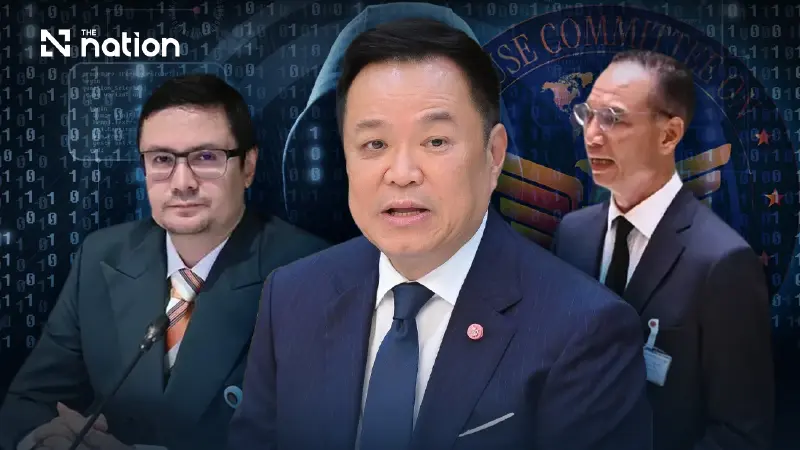


Thai MPs urge faster investigations as Anutin says the matter involving former deputy finance minister Vorapak is not connected to his government.
- Two Thai MPs, Korn Chatikavanij and Rangsiman Rome, have urged Thai authorities to accelerate investigations into scam-linked money laundering.
- The call to action was prompted by a US congressional request to investigate and consider sanctions against 28 individuals and entities, including former deputy finance minister Vorapak Tanyawong.
- The MPs proposed coordinating with US committees to share evidence and re-examining the financial records of those implicated in the US request.
- They warned that a slow investigation in Thailand could damage the country's international reputation and financial credibility, especially if the US acts first.
Democrat Party MP Korn Chatikavanij and People’s Party MP Rangsiman Rome urged Thai authorities on Thursday (September 17, 2026) to accelerate investigations into alleged scam-linked money laundering, following a US congressional request to investigate 28 individuals and entities for possible sanctions, including former deputy finance minister Vorapak Tanyawong.
Speaking at the Interior Ministry, Prime Minister and Interior Minister Anutin Charnvirakul said he had seen Vorapak’s name in the request. Anutin said anyone facing allegations should appoint a lawyer and clear their name, adding that the matter was not connected to his government.
Asked about calls for the Thai government to accelerate investigations, Anutin replied: “Which government? Not this government.”

The US congressional request naming Vorapak among 28 individuals and entities concerns alleged links to scam operations and human trafficking in Southeast Asia. The chairs of two US House committees asked the State and Treasury departments to investigate and consider sanctions if the relevant legal criteria were met; the request itself neither imposes sanctions nor establishes wrongdoing.
Vorapak, who served in Anutin’s first administration, has denied involvement in scam networks, money laundering and human trafficking and said he was ready to cooperate fully with scrutiny.
Vorapak said he had contacted the US Treasury Department’s Office of Foreign Assets Control (OFAC) to establish how to submit facts and documentary evidence. Vorapak was also preparing letters to the two committee chairs to request an opportunity to clarify the allegations and respond directly to their questions.
Korn proposes sharing evidence with US committees
Korn, a Democrat Party deputy leader and party-list MP, said he would propose at the Thai House finance committee’s September 17 meeting that it coordinate with the two US committees and exchange information relevant to the investigations.
Korn argued that US authorities could have access to financial trails unavailable to Thai investigators, while Thai agencies might hold information their US counterparts lacked. Sharing evidence could therefore serve both countries’ interests, he said.
Korn stressed that inclusion in the US request was not proof of guilt. Rather, he said, US lawmakers believed there were sufficient indications to justify deeper investigation and consideration of possible economic sanctions against those concerned.
Scam networks operating from Southeast Asia had harmed victims around the world, including Thailand and the United States, Korn said. In his view, US lawmakers were no longer prepared to wait for what he described as slow enforcement in Thailand and wanted their own authorities to use existing laws to investigate.

Korn maintained that scrutiny should not stop with Vorapak, saying financial transactions could reveal connections to other people. Korn declined to say whether anyone in the current government might be involved, but called for action against anyone found to have participated in defrauding the public or laundering proceeds through Thailand’s capital market, regardless of political affiliation.
Korn questions regulators over alleged money laundering
Korn said the House committee responsible for finance, fiscal affairs, financial institutions and financial markets had previously urged the Securities and Exchange Commission (SEC) and Anti-Money Laundering Office (AMLO) to act swiftly on available evidence concerning alleged scam-linked money laundering.
Korn said he had also raised parliamentary questions with Deputy Prime Minister and Finance Minister Ekniti Nitithanprapas about oversight of the SEC and its structure. Those questions included an investigation into whether the SEC chairman had connections to the same case, according to Korn.
Unresolved questions about the SEC’s leadership and possible political connections could affect confidence in the regulator, whatever the eventual findings, Korn argued. Korn urged the government to explain the facts rather than allow uncertainty to persist.
Korn said concerns about transnational illicit capital remained unresolved despite a decline in public attention. Korn alleged that such networks could use Thailand’s capital market to launder money only with cooperation from people in Thailand, and said foreign authorities were beginning to recognise those connections.
While acknowledging Vorapak’s right to defend himself before the US committees, Korn questioned whether the SEC had contacted the former minister and whether Vorapak had offered an explanation to the Thai regulator. Korn said that, to his knowledge, no such explanation had been provided.
Korn also pointed to Anutin’s appointment of Vorapak to a senior financial post in his first administration. Korn argued that a lack of visible progress could raise questions about political protection, making it more important for the responsible agencies to establish the facts promptly.
Rangsiman calls for financial-trail and asset checks

Speaking at Parliament, Rangsiman, a People’s Party party-list MP, called for financial records and cases involving Vorapak to be re-examined, including the roles of people connected with BIC Bank.
“In Vorapak’s case, the files need to be reviewed, including the financial trails, the various cases and people connected with BIC Bank,” Rangsiman said.
If investigators identified assets connected to alleged offences, Rangsiman said those assets should at least be seized or frozen for examination and to prevent transfers. Rangsiman also called for action involving an oil company he alleged was connected to the matter, adding: “This should not be swept under the carpet.”
Rangsiman questioned which laws, if any, Thai authorities had invoked in Vorapak’s case. Rangsiman warned that a failure to act could fuel perceptions that influence or connections within Anutin’s administration were protecting people from scrutiny.
Rangsiman said Vorapak had previously served on a working group tackling the problem. Rangsiman criticised the government for what he characterised as allowing people facing allegations to examine matters involving themselves, and said Finance Minister Ekniti had an important role in resolving the issue.
Rangsiman also questioned why an arrest warrant had not been issued for Hun To, a nephew of Cambodian Senate President Hun Sen. Rangsiman asked whether deference to influential figures was delaying enforcement and called on Anutin to explain why action had not progressed.
Thai MPs warn of risks to financial confidence
Korn warned that if US authorities moved ahead while Thai investigations remained slow, foreign observers could question Thailand’s ability to protect both Thai citizens and foreigners. Korn said Thailand had direct responsibility and access to more domestic information, making delays potentially damaging to the country’s international standing and confidence in its financial system.
Korn argued that Thai laws already covered the conduct in question and that the responsible agencies were clearly identified. The problems, in his assessment, were delays, insufficient seriousness and a lack of clear progress rather than an absence of legal powers.
The 180-day period cited in the debate relates to the US committees’ request for US authorities to determine whether those named meet the criteria for sanctions. It is not a deadline imposed on Thailand to complete an investigation.
Korn contrasted that timetable with what he described as a lack of progress in Thailand. Korn warned that foreign authorities acting first could damage perceptions of Thai law enforcement and urged the responsible agencies to meet public expectations.
Rangsiman argued that the 180-day period also had implications for the Thai government’s credibility. Rangsiman alleged that political figures and a large oil company had connections to the matter and said the government was best placed to know the relevant details.
Rangsiman warned that allowing foreign governments to act while Thai authorities remained inactive could have wider consequences for confidence in Thailand, including reputational damage to legitimate businesses.
