
Thailand enacts political amnesty excluding Section 112
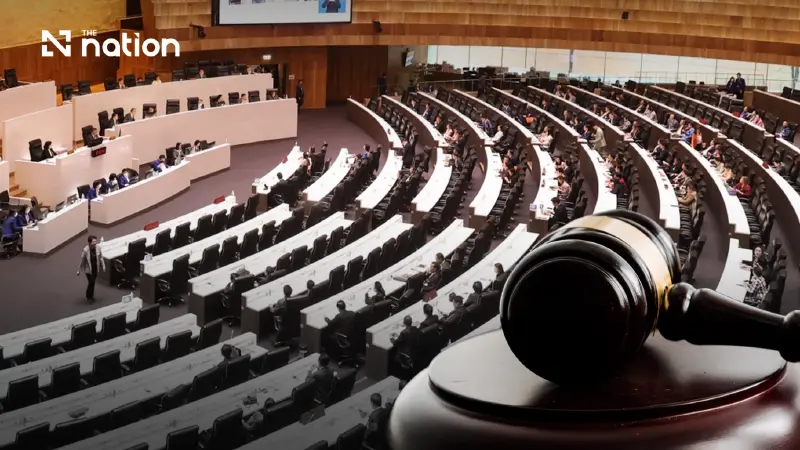


Thailand’s new law covers politically motivated acts from 2005 to 2025, while excluding Section 112, corruption and serious violence.
The Royal Gazette on Sunday (August 23, 2026) published the Act on Promoting a Peaceful Society B.E. 2569 (2026), creating an amnesty for qualifying offences arising from political demonstrations or political expression over a period of more than 20 years.
The law was published in Volume 143, Part 50 Kor, beginning on page 1, and will take effect on Monday, the day after its publication.
Promulgated with the advice and consent of Parliament, the Act is intended to address prolonged political conflict by granting amnesty to people whose participation in political gatherings or political expression arose from political conflict or political motivation.
It covers eligible acts committed from January 1, 2005, to July 16, 2025.
Amnesty covers political acts over 20 years
The law applies to qualifying offences listed in an annex to the Act, together with related offences, where the conduct arose from participation in political demonstrations or political expression motivated by political conflict.
Qualifying acts are treated as no longer constituting offences. Those covered are relieved of criminal and regulatory-penalty liability, provided this does not conflict with Thailand’s obligations under international law.
Related civil proceedings brought by state agencies or state enterprises are also terminated. However, the law does not extinguish liabilities owed directly to private individuals or specific private groups.
The legislation is intended to ease the effects of political prosecutions accumulated over more than two decades and support national reconciliation.
Section 112 and serious offences excluded
The Act expressly excludes several categories of conduct from the amnesty:
- Corruption or misconduct offences
- Offences under Section 112 of the Criminal Code
- Acts causing another person’s death
- Acts causing serious bodily harm under Section 297 of the Criminal Code
- Compoundable offences
- Acts creating direct liability to a private individual or specific private group rather than a state agency
These exclusions are set out in Section 3 of the final text.
Section 112 cases are excluded in all circumstances. A provision allowing rehabilitative measures for people who were under 18 when an offence was committed also does not apply to Section 112.
Nine-member committee to rule on eligibility
The law establishes a nine-member Committee on Promoting a Peaceful Society to determine who qualifies for amnesty and exemption from liability.
The committee will comprise:
- The prime minister, or a deputy prime minister designated by the prime minister, as chair
- The justice minister as deputy chair
- The permanent secretary for justice
- The secretary-general of the National Human Rights Commission of Thailand
- One legal, human-rights or criminal-justice expert approved by the House of Representatives Coordinating Committee
- One expert in the same fields approved by the opposition parties’ coordinating committee
- One expert approved by the Council of University Presidents of Thailand
- One civil-society expert in conflict management and the administration of justice, nominated by the House speaker
- The permanent secretary of the Prime Minister’s Office as a member and secretary
The four appointed experts must not have an interest in any matter covered by the Act.
The committee must hold its first meeting within 30 days of the law taking effect.
It will have the authority to decide eligibility for amnesty, receive applications from interested parties, request documents or testimony, appoint subcommittees and issue recommendations concerning the promotion of a peaceful society.
Its rulings will be final and binding on state agencies involved in the justice system.
The committee must complete its work within 180 days of its first meeting. The deadline may be extended no more than twice, with each extension limited to 90 days.
