
Yodchanan lifts Pheu Thai, Bhumjaithai loses ground
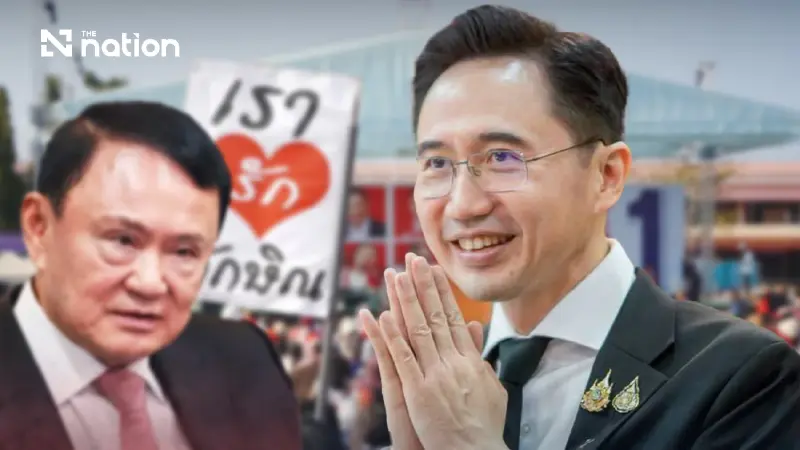


Two provincial election victories and Yodchanan Wongsawat’s flood response are feeding Pheu Thai’s recovery narrative as its coalition partner struggles
- Pheu Thai is showing signs of political recovery, strengthened by recent victories in provincial elections in Kalasin and Roi Et.
- Deputy Prime Minister Yodchanan Wongsawat's public profile is rising, boosting the party's image through his effective handling of the Nan floods and active campaigning, creating a "Shane comeback" narrative.
- In contrast, coalition leader Bhumjaithai is described as politically weakening, with its popularity declining due to an investigation into alleged Senate election collusion and questions over its government's performance.
Pheu Thai’s victories in the provincial elections in Kalasin and Roi Et, coupled with Deputy Prime Minister Yodchanan Wongsawat’s increasingly prominent public role, have strengthened suggestions that the party is beginning to recover politically.
A Bangkokbiznews News political analysis described the two local victories as small but significant gains for the red camp at a time when prominent members of the Shinawatra family have maintained relatively low profiles.
The results have also helped build what the analysis called a “Shane comeback” narrative around Yodchanan, whose political profile has grown through his work in government and on the campaign trail.
By contrast, the analysis portrayed coalition leader Bhumjaithai as politically “close to a coma”, with Prime Minister Anutin Charnvirakul’s second government facing questions over its performance after little more than four months in office.
It linked the fall in Anutin’s and Bhumjaithai’s popularity to the investigation into alleged collusion in the Senate election, saying the issue had also weakened public confidence in the Election Commission.
Despite those pressures, the coalition remains politically stable. Pheu Thai has shown no sign that it intends to withdraw and pursue a rumoured alternative agreement between the red and green political camps.
Local victories strengthen Pheu Thai’s base
Pheu Thai retained the leadership of the Provincial Administrative Organisations in Kalasin and Roi Et, demonstrating that its local support networks in the two northeastern provinces remain strong.

Chalermkwan Lortrakul secured 306,674 votes in Kalasin, while Seksit Wainiyompong received 330,708 votes in Roi Et.
Yodchanan, who is also minister of higher education, science, research and innovation and an adviser to Pheu Thai, joined the party’s MPs in campaigning for Chalermkwan during the final stage of the Kalasin contest.
The two victories have provided Pheu Thai with an opportunity to rebuild support in the Northeast. The analysis argued that the party was gradually regaining ground as the nationalist sentiment that had previously benefited Bhumjaithai began to fade amid successive political controversies.
Nan response raises Yodchanan’s profile
Yodchanan has attracted further attention through his role in the government’s response to flooding in Nan.

After being instructed by Anutin to oversee the situation, he travelled from Surat Thani to Nan and coordinated government departments, operational units and local authorities involved in public safety and emergency assistance.
The analysis credited him with acting quickly and effectively during the disaster, presenting the former academic as a younger political leader capable of handling work on the ground.
His presence also carried political significance for Pheu Thai. Nan had been a stronghold of Thaksin Shinawatra and parties associated with him for more than two decades.
Since 2005, parliamentary seats in the province had been held by members of the Srikaew, Ramsut and Supriyasilp families, who represented Thai Rak Thai, the People Power Party and later Pheu Thai.
That dominance ended in the general election early in 2026. Chonnan Srikaew, Songyot Ramsut and Nattapong Supriyasilp were defeated, with the People’s Party winning two seats and the Klatham Party taking one.
Pheu Thai ministers and former Nan MPs have since continued visiting the province. The analysis presented the flood response as both a government responsibility and an opportunity for the party to reconnect with voters in a former stronghold.
The story behind the comeback phrase
Political commentators have increasingly discussed Yodchanan in positive terms, according to the analysis. Although he comes from the Shinawatra family network, it argued that his political character differs from relatives who entered politics before him.

His understated manner, humility and down-to-earth image were identified as political strengths, along with what the analysis described as an ability to understand both traditional and contemporary politics.
Former prime minister Somchai Wongsawat has said his son’s nickname, Shane, was inspired by the Western film Shane, which was released in 1953 and was popular with the older generation of the family.
The line “Shane, come back” later became a familiar expression and has periodically been applied in Thai politics to politicians or parties seeking to recover after a decline.
Thaksin takes a quieter role
The analysis also identified former prime minister Thaksin Shinawatra as an important figure in Pheu Thai’s attempt to combine established politicians with a younger generation.
Since regaining his freedom, it said, Thaksin has worked discreetly from his Ban Chan Song La residence. Rather than becoming a political lightning rod, as he did during the Srettha Thavisin and Paetongtarn Shinawatra governments, he has maintained a lower profile.
Political figures remain unconvinced that Thaksin intends to retire and spend his time with his grandchildren, despite comments he made while living in Dubai before returning to Thailand in mid-2023.
On August 18, 2026, he delivered a keynote address on security challenges in the modern world, technology and international cooperation at the 30th-anniversary celebration of Somapa Information Technology Public Company Limited at the Dusit Thani hotel.
The analysis presented that appearance as evidence that Thaksin had not withdrawn from Thai politics but had shifted from being an exceptional political player to an observer waiting for an appropriate moment to act.
Pheu Thai is also building a younger professional team, particularly among younger voters and Generation Z. Many have no direct connection with Thaksin’s period of political dominance and know him primarily as a former prime minister, the father of former prime minister Paetongtarn and a political figure who recently returned to Thailand.
The emerging structure combines younger figures—including the children, grandchildren and friends of established politicians—with Thaksin’s longstanding network of political allies.
The analysis suggested that Thaksin could strengthen the party’s internal operation and connect its older and younger MPs. His influence could also discourage senior MPs who missed out on ministerial positions from defecting to Bhumjaithai or Klatham.
Pheu Thai’s central electoral challenge is whether it can improve on the 74 parliamentary seats it secured at the next general election.
More immediately, the investigation into alleged Senate election collusion has created a confrontation between the blue political camp and opposing orange and light-blue groups alongside iLaw.
The analysis said the relationship between the red and blue camps, under what it described as the influence of the “deep state”, could still shift during the remaining four months of the parliamentary session.
