
Thailand orders cemetery checks over nationwide licence validity
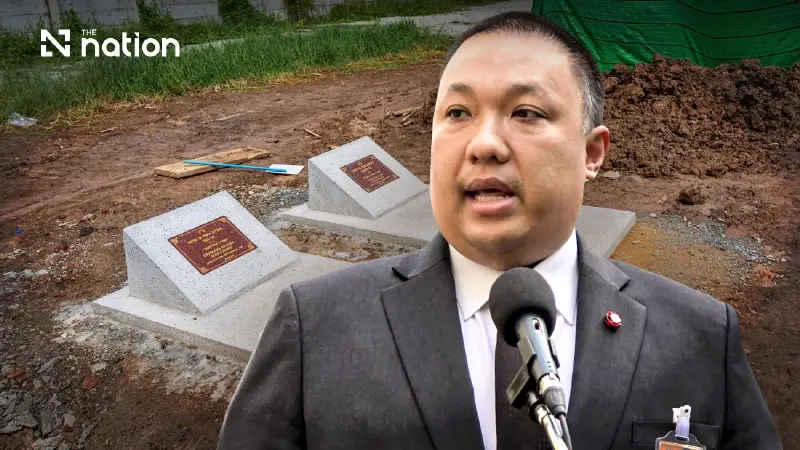


Four bodies were moved from a Chachoengsao Jewish cemetery to Chonburi as officials compile a nationwide cemetery list and examine nominee arrangements.
- A nationwide inspection was prompted by the investigation and license revocation of a Jewish cemetery in Chachoengsao, which will serve as a "model" for future actions.
- The Department of Provincial Administration (DOPA) has been ordered to compile a complete list of all cemeteries and cremation facilities across the country within three days.
- Following the count, authorities will systematically check every site on the list to ensure it holds a valid operating license.
- Any cemetery or facility found to be operating with an invalid license will face revocation and related legal proceedings.
Deputy Interior Minister Polpee Suwannachavee reported progress at Government House at 9.40am in the revocation process involving a Jewish cemetery in Chachoengsao.
He said a team from Gan Chabad Co Ltd had moved all four bodies at 5am to a cemetery in Chonburi.
Chachoengsao province had been notified, while Chonburi province was also to be informed.
Polpee said he had instructed local Department of Provincial Administration (DOPA) officials to observe the operation because he wanted to verify whether there had been any change and whether the bodies were in fact being relocated.
He added that the wife of one of the deceased had previously wanted to take the body away for a ceremony.
As the body had already been buried, he said he did not understand what ceremony was intended and had therefore assigned local authorities in both provinces to oversee the matter.
Polpee said the Interior Ministry’s ad hoc committee on social order had met on Monday (September 14) to discuss cemeteries nationwide.
DOPA had been instructed to complete a count of cemeteries and cremation facilities across the country within three days and submit a report.
Once the complete list was available, the authorities would check whether the sites held valid licences.
If any were found to be invalid, the ministry would apply the “Chachoengsao model”, including revocation and related legal proceedings.
Polpee said his retrospective examination of the Gan Chabad cemetery in Chachoengsao had raised questions about the process dating to 2021, and he believed the original application to establish the cemetery had lacked supporting evidence.
He said Google Earth imagery of the site clearly showed the road and that a water source had already existed there.
The provincial governor had appointed a committee to investigate approval documents signed by the president of the subdistrict administrative organisation and some officials, with the inquiry to be completed within 15 days.
Any extension would be considered later if the inquiry was not completed by the deadline.
Polpee said he believed the approval was improper and that legal action would be taken against any civil servants or local administrators found to have been involved.
Polpee said an informal meeting that afternoon would bring together Deputy Prime Minister and Commerce Minister Suphajee Suthumpun, Justice Minister Pol Lt Gen Rutthapol Naowarat, the Royal Thai Police (RTP), the Anti-Money Laundering Office (AMLO), DOPA and the Interior Ministry.
The discussion would cover nominees, nationality, visas and all related work conducted over the previous 30 to 40 days, which he said had yet to complete the full coordination cycle.
When Interior Ministry officials made arrests, the cases had to be referred to police.
If police did not proceed, the ministry would need to be informed so that it could pursue the investigation.
Polpee planned to discuss with Rutthapol what he described as an Israeli company with a network spanning dozens of companies.
He also wanted closer cooperation with the Department of Special Investigation (DSI), which was already working on the matter, so that information could be transferred more quickly and possible alternatives to routine bureaucratic procedures could be considered.
DOPA would discuss company registration and information sharing with Suphajee.
According to Polpee, nominees were holding land in Thailand through around 2,000 corporate entities, while more than 10,000 additional companies were considered suspicious.
The value cited in connection with these companies exceeded THB80 billion.
The information would be compiled and discussed that day before being submitted to the prime minister following the Vietnam trip.
Polpee said no appeals against the deportation of the Israeli and French nationals had yet been filed and that immigration police were holding them in custody.
If no appeal was lodged within seven days, they would be removed from the country.
He said the evidence and grounds for deportation would first need to be reviewed under the relevant law.
For other offences involving foreign nationals, the authorities were more likely to pursue visa revocation.
He cited the arrest of a group at 577 Club in Huai Khwang, where procedures were under way to revoke the visas of five foreign nationals.
