
Japan launches disaster agency to strengthen public readiness


Residents are asked to store food and water for at least three days, preferably a week, while government preparedness will be reviewed at year-end.
- Japan has launched a new National Disaster Management Agency with the goal of making the country the "world's most disaster-resilient nation."
- The agency's first action was to ask residents to prepare for major disasters by stockpiling at least three days of food and water, securing furniture, and locating evacuation shelters.
- Replacing a smaller office with 60% more staff, the new body is designed to act as a "strong control tower" to coordinate disaster response, recovery, and reconstruction across government ministries.
- The agency has also tasked local governments with improving evacuation centers and instructed ministries to ensure companies are implementing effective disaster prevention plans.
Japan’s National Disaster Management Agency began work on November 2 with an “emergency request” asking residents to prepare for major disasters before they occur.
Similar requests went to central government ministries and agencies, as well as local governments.
A minimum of three days’ food and water was recommended, with a week’s supply preferred.
Residents were also asked to fasten furniture to walls and check where evacuation shelters are located.
Making Japan “the world’s most disaster-resilient nation” is the goal set out by the agency’s first chief, Goshi Hosono.
He pledged stronger preparations for large-scale disasters, including a possible megaquake in the Nankai Trough, off the Pacific coast of central to south-western Japan.
According to the Cabinet Office, 20 of Japan’s 47 prefectures are expected to experience shaking of upper 6 or above if a Nankai Trough megaquake occurs.
Upper 6 ranks second highest on the Japanese seismic intensity scale.
Four prefectures may face similarly severe shaking from an earthquake in the Chishima and Japan trenches, off the Pacific coast of northern to eastern Japan, the Cabinet Office indicated.
Central and local governments cannot do everything when a massive disaster strikes, Hosono told a press conference.
“I hope that you all take proper action,” he said.
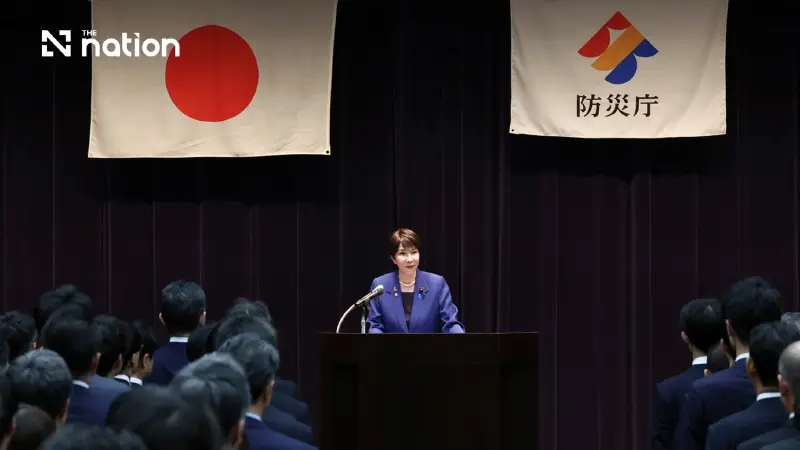
“Protecting the lives and livelihoods of the people is one of the nation’s most important responsibilities,” Prime Minister Sanae Takaichi said at the inauguration ceremony.
She instructed ministries and agencies to overcome bureaucratic divisions so the new organisation could act as a “strong control tower”.
The agency replaces the Cabinet Office’s disaster management section, with staffing expanded by 60% to 352.
Its remit covers the first response to a disaster, recovery and reconstruction.
The launch was also marked by the installation of an office signboard.
Ministries and agencies were asked to review their plans for maintaining operations during disasters and ensure companies were putting effective disaster prevention measures into practice.
Local governments received requests to improve conditions in evacuation centres and strengthen measures for commuters stranded during a disaster.
Progress will be assessed by the agency at the end of the year.
It may also make recommendations and request changes to budgets if necessary.
A proposed disaster prevention bureau had attracted interest from 49 organisations across Japan wishing to host it as of the end of October.
The government is expected to choose a location by summer 2027 for the local organisation, which would implement measures in response to major earthquakes.


[Copyright The Jiji Press, Ltd.]
