
Thailand to hold talks with Myanmar over pollution in border rivers
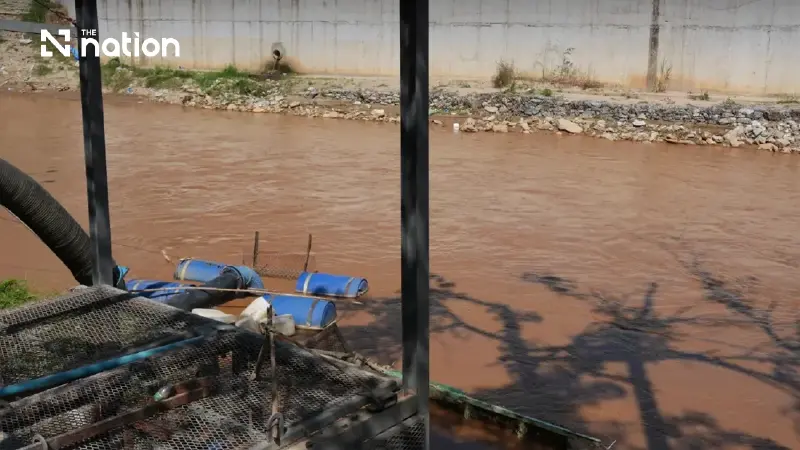


Political developments and trade barriers are also on the agenda, while Thai agencies have been ordered to test water, soil and aquatic animals.
- Thailand's Foreign Minister is scheduled to hold talks in Myanmar to address severe pollution, including arsenic and heavy metals, in the shared Kok and Sai rivers.
- The pollution is believed to originate from mining activities in Myanmar's Shan State, and the discussions will urge Myanmar to examine and address conditions on its side of the border.
- The talks will build on a prior agreement to establish a Joint Working Group on Water Quality, which will meet soon to finalize a framework for managing the transboundary issue.
Foreign Minister Sihasak Phuangketkeow will discuss border security, river pollution, political developments and trade barriers during a visit to Nay Pyi Taw, Myanmar, on Thursday (November 12, 2026).
Speaking at Government House, Sihasak said he wanted an update on Myanmar’s political situation to share with fellow foreign ministers from the Association of Southeast Asian Nations (ASEAN).
Their meeting would precede the leaders’ talks at the 49th ASEAN Summit in Manila, the Philippines, on November 16–18.
He would reiterate the longstanding understanding that Myanmar’s military operations must not affect Thai territory or civilians, following concerns over cross-border gunfire and bombing.
Both Thailand and ASEAN wanted violence in Myanmar reduced, which Thailand believed would help create conditions for reconciliation.
On trade, Thailand wanted to resolve obstacles involving import licences to improve the flow of goods across the border.
Sihasak also described pollution in the Kok and Sai rivers as quite severe, citing the latest report from the Ministry of Natural Resources and Environment.
He said conditions on the Myanmar side, including mining activity, needed to be examined.
Addressing concerns over pollution linked to mines in Shan State and Myanmar’s ability to engage with the state, Sihasak said its government would need to address mining within its own territory.
The longstanding problem had affected Thai communities, and water quality was now poor.
Restoring contaminated water was difficult, making urgent discussions necessary.
Natural Resources and Environment Minister Suchart Chomklin, speaking on November 10, described arsenic and heavy metals above standard limits in Chiang Rai’s Sai River as a transboundary pollution problem.
Thailand shared the Sai, Kok and Ruak rivers with Shan State in Myanmar, where mining was known to take place, he said.
Sihasak recalled earlier discussions and an agreement with Myanmar President Senior General Min Aung Hlaing to establish a joint working group on water quality.
Suchart said terms of reference (TOR) had been drawn up between Thailand’s permanent secretary for natural resources and environment and the permanent secretary of Myanmar’s ministry responsible for the environment when Min Aung Hlaing met the Thai prime minister.
The Joint Working Group on Water Quality Management in Boundary and Transboundary Rivers would hold its first meeting in late November to finalise the TOR framework, with representatives from Myanmar and Shan State attending.
Thailand would raise concerns for people in Myanmar who used the water for drinking and other purposes and consumed local aquatic animals.
Plans included testing water and soil, highlighting the effects on Myanmar’s population, sharing knowledge and installing equipment in the country.
Suchart described action on two levels, with national-level cooperation involving the Ministry of Foreign Affairs and all relevant sectors.
Within Thailand, the prime minister had instructed all relevant agencies to act.
The Department of Fisheries was to check whether aquatic animals were safe to eat, while the Land Development Department was to test agricultural soil for contamination above standard limits.
The Ministry of Natural Resources and Environment was to test water and send results to relevant agencies, including the Ministry of Public Health.
The public health minister had sent a team to advise residents.
The response also involved coordination with the Chiang Rai governor and water testing to determine whether the Provincial Waterworks Authority could use the river water to produce tap water.
If the water could not be used, the government and the Provincial Waterworks Authority would need to find alternative sources for residents.
The authority would lead that work, with support available from the Ministry of Natural Resources and Environment if it could not do so.
The Pollution Control Department had established seven water monitoring stations this year and was seeking a site for a local laboratory.
This would allow heavy metals to be tested as quickly as possible without sending samples to Bangkok.
The Office of the National Water Resources was also involved in the response.
Suchart stressed that the government was taking the problem seriously but needed to address it systematically, while the agencies concerned had to explain their work to the public.
