
Thailand Ranks Third Worldwide for In-Store Payment Apps as PromptPay Drives Boom
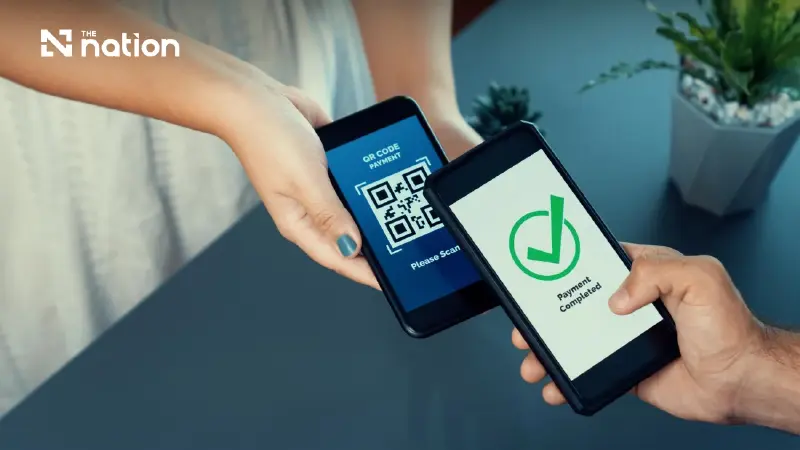


A global report says Thailand’s e-commerce will hit US$60 billion by 2030, as PromptPay-led bank transfers near half of all online spending
- Thailand ranks third globally for in-store payment app usage, with 56% of spending conducted this way, behind only China (89%) and India (65%).
- The trend is driven by the national instant payment system, PromptPay, which facilitates account-to-account (A2A) transfers via QR codes, making them the most popular payment method.
- The rise of payment apps has caused cash's share of in-store spending to fall dramatically from 68% in 2019 to 30% in 2025.
- Account-to-account payments are projected to grow further, expected to comprise 51% of all in-store spending by 2030.
A global report says Thailand’s e-commerce will hit US$60 billion by 2030, as PromptPay-led bank transfers near half of all online spending.
Thai shoppers pay by bank transfer at a rate few countries can match, and the habit is set to deepen by 2030, according to the 11th edition of the Global Payments Report (GPR). These payments are known as account-to-account, or A2A.
Money moves straight from one bank account to another, usually when a customer scans a QR code in a banking or wallet app. In Thailand, A2A is already the most popular way to pay.
Bank transfers lead Thai spending as cash fades
A2A made up 44% of online spending and 43% of in-store spending in 2025. By 2030, the report expects this to rise to 49% online and 51% in stores. That would put bank transfers above half of all in-store spending.
Payment apps, which include digital wallets and banking apps, accounted for 56% of in-store spending in 2025.
Among the 42 markets studied, only China (89%) and India (65%) scored higher. The global average is 37%. The report credits PromptPay, the Bank of Thailand’s national instant payment system.
The number of PromptPay transactions rose 10% between January and August 2025. Cash’s share of spending fell from 68% in 2019 to 30% in 2025. Digital wallets play a smaller role but are growing. They made up 25% of online and 13% of in-store spending in 2025.
The report forecasts 27% and 14% by 2030. TrueMoney and ShopeePay are the wallets Thai consumers mention most, and most wallet spending is funded straight from bank accounts.

Cards have a smaller share. Credit cards accounted for 10% of online and 9% of in-store spending and are expected to slip to 9% and 7%. Of Thailand’s cards, 67% are Visa and 28% are Mastercard, based on 2024 data, the latest available. Buy now, pay later is about 1% of online spending.
The market is also growing fast. Online shopping was worth US$35 billion in 2025 and is forecast to reach US$60 billion by 2030, a rise of 12% a year.
In-store spending was US$209 billion and is forecast to reach US$262 billion, growing 5% a year. Cash has not gone away. It still accounted for 30% of in-store spending in 2025, and cash on delivery made up 15% of online spending, among the highest rates in the world.
Cash use is highest in rural and suburban areas and continues to fall in cities such as Bangkok. By 2030 the report expects cash to fall to 25% in stores and cash on delivery to 11% online.
Thailand links up with Asia, but selling abroad remains a hurdle
Thai regulators are using PromptPay’s domestic success to build links with other countries. They are working to connect it with India’s Unified Payments Interface (UPI).
They are also taking part in Project Nexus, an effort to link instant payment systems in India, Malaysia, the Philippines, Singapore and Thailand. For Thailand’s tourism-heavy economy, this matters.
Chanunpak Kaewchambang, country manager for Thailand at Global Payments, said visitors from places such as Hong Kong can often pay by scanning a Thai QR code with their home banking app. They do not need to exchange cash or open a Thai bank account.
Challenges remain for Thai merchants targeting overseas buyers. PromptPay QR codes are accepted almost everywhere at home, but foreign consumers mostly rely on cards or their own local digital wallets.

Win Vareekasem, co-founder and chief executive of Beam, a Thai payments platform, said partnering with Global Payments gives Beam a broader product suite to support larger merchants.
Chanunpak said the aim is for Thai brands to expand into markets such as Singapore, Malaysia or the United States without finding a new payment provider for each one.
Asia races ahead on payment apps while Europe sticks to cards
Thailand’s rise reflects a wider trend across Asia-Pacific, where QR codes have helped markets skip past card-based systems. In 2025, payment apps made up 89% of in-store spending in China and 65% in India. Thailand (56%), Hong Kong (54%) and Vietnam (52%) followed. European shoppers, by contrast, still rely on cards.
Digital wallets made up just 18% of in-store spending in 2025. That may change.
Apple has opened its iPhone contactless technology to rival providers, and players such as Wero, PayPal and Klarna are expanding.
Europe is also the world’s biggest user of buy now, pay later, at 9% of online spending. Globally, payment apps made up 37% of in-store spending in 2025.
The report forecasts this will reach 46%, or US$15.6 trillion, by 2030. Cryptocurrency is still rarely used to pay directly. Cash has also fallen fast in other Asian markets.
In India it dropped from 71% of in-store spending in 2019 to 14% in 2025. In Indonesia it fell from 77% to 36%, and in Malaysia from 64% to 22%.

Local payment methods go global, and providers must keep up
The report describes a world where local payment systems are going global. Many fast-growing payment methods were built for domestic use, not for travellers or overseas shoppers. Payment firms and merchants must now support both local favourites and global cards.
Chanunpak said speed, convenience and security are what customers want.
“For merchants, understanding these shifts is essential to delivering the experiences customers expect,” she said.
As instant payments grow, she added, strong fraud monitoring and risk management become more important.
Strong home base, but selling abroad is the next test
Thailand starts from a strong position. Merchants that accept PromptPay QR codes can reach almost every Thai consumer, because most people already have a bank account.
The next test is helping Thai sellers serve overseas customers, who expect to pay in their own currency and, in many countries, by card.
The report does not set out a to-do list, but its comparisons suggest several lessons.
Push cash use down further. India and Indonesia cut cash use quickly after fast-payment systems took hold. Thailand’s remaining cash is concentrated in rural areas and cash on delivery, which gives policymakers and online sellers clear targets.
Take home-grown systems abroad. Even Europe is now trying to join up its separate national systems through Wero. Thailand’s work with India and Project Nexus is a step in the same direction.
Add more to wallets. In China, wallets combine bank transfers, instalments, cards and loyalty points in one app. Thai wallets are still mostly funded straight from bank accounts, which leaves room to add features.
Keep cards in the mix. In card-led markets such as Australia, the UK and the US, even wallet spending is mostly funded by cards. Thai merchants hoping to sell there will still need to accept them.
The Global Payments Report (GPR) is published by Global Payments following its merger with Worldpay in January 2026. This 11th edition covers 42 markets — adding Portugal and Switzerland this year — drawing on a survey of 63,000 consumers alongside proprietary modelling.
