
Bangkok Gen Z rally demands education reform and youth participation
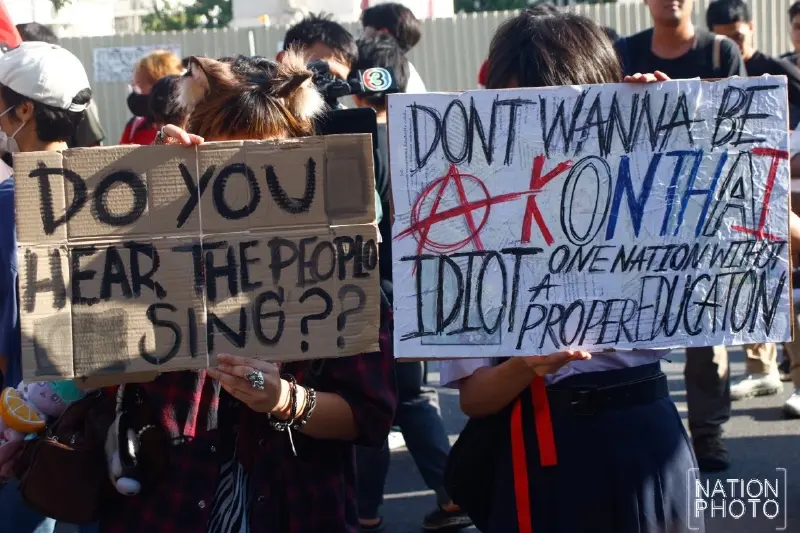


Gen Z students wearing cat ears rallied at Bangkok’s Democracy Monument on World Children’s Day to demand education reform and youth participation while denying party backing.
- Young activists and students, part of Generation Z, held a rally at Bangkok's Democracy Monument to demand significant education reform and a greater role for youth in policymaking.
- The protesters' key demands for education included equal access to quality schooling, more democracy within schools, and a shift away from a system that primarily serves commercial interests.
- Demonstrators called for meaningful youth participation in decision-making processes and urged Prime Minister Anutin Charnvirakul's government to address their concerns.
- The rally, organised by student networks to coincide with World Children’s Day, was declared to be independent of any political parties.
Students and young activists gathered at Bangkok’s Democracy Monument on Friday (November 20), demanding education reform, greater youth participation in policymaking and action from Prime Minister Anutin Charnvirakul’s government.
Organisers insisted the demonstration was independent of political parties.
The rally, organised by student networks including Studem Network and Free Thai Youth, coincided with World Children’s Day and was held under the theme “Wear Cat Ears to Chase Out Noo”.
The slogan plays on the nickname of Prime Minister Anutin Charnvirakul, who is widely known as “Noo”, meaning mouse or rat in Thai.
Protesters began gathering at around 3pm, with some wearing school or university uniforms and cat-ear headbands as a symbolic gesture.
Participants set up a cordoned-off speaking area near McDonald’s on Ratchadamnoen Avenue, where speakers criticised Thailand’s education system and the government’s performance. Demonstrators also created placards highlighting educational inequality and other social concerns.

Students demand fairer education and a say in policymaking
Teerapat, a representative of the student and youth network, explained that the demonstration was inspired by World Children’s Day and the growing wave of Gen Z-led protests worldwide.
He argued that Thailand’s education system remained deeply unequal, with access to quality secondary and university education often dependent on financial circumstances.
Many young people, he noted, were forced to take out student loans before entering the workforce, despite uncertain employment prospects after graduation.
He also criticised the limited opportunities for students to influence school policies and questioned the drafting of the proposed National Education Act, raising concerns about the involvement of individuals who had also helped draft the 2017 Constitution.
Beyond education, protesters called for an end to compulsory military conscription and discrimination based on race or nationality.
Teerapat criticised nationalist sentiment surrounding the Thai-Cambodian conflict, arguing that tensions had caused economic and social harm rather than benefiting either country.
He stressed that migrant workers contributed to Thailand and should not be treated as threats to the country.

Four key demands for education reform
In its statement, Studem Network outlined four key demands aimed at transforming Thailand’s education system:
- Equal access to quality education: Address structural inequalities and ensure that all students have access to quality education, regardless of their economic or social background.
- Greater democracy in schools: Restore students’ rights and freedoms, and give them a meaningful say in shaping school rules and policies.
- Meaningful youth participation: Recognise young people as active participants in decision-making, empowering them to shape their own futures rather than simply accept decisions made on their behalf.
- Education beyond capitalism: Challenge an education system focused primarily on producing workers to serve commercial interests, and promote critical thinking, individual empowerment and freedom from exploitation.
“We do not simply want an education that teaches us to compete and survive within the existing system. We want an education that allows us to criticise, question and collectively transform the social structures that oppress us,” the network stated.
“Education should not produce people to serve capitalism; it should empower individuals to shape their own lives and build a fairer society.”

Protesters deny political party backing
Addressing accusations that political parties were orchestrating the demonstration, Teerapat firmly rejected claims of outside political control.
“We are not slaves to political parties. Political parties are supposed to serve the people,” he declared.
He urged the public not to undermine the struggles of young activists or other groups, including farmers and ordinary citizens, by assuming their grievances were politically manufactured.
People who joined demonstrations, he argued, were exercising their rights in response to genuine hardship.
Teerapat emphasised that the gathering was peaceful and had no single leader, with participants working towards shared objectives rather than following instructions from any political organisation.
He also urged critics to focus on the protesters’ demands instead of questioning their political affiliations.

Government urged to act or step aside
Turning to Prime Minister Anutin’s administration and the Bhumjaithai Party, Teerapat expressed little confidence that the government would respond to the protesters’ concerns.
However, he insisted that the movement was not simply seeking to remove the government.
The priority, he explained, was to secure meaningful solutions to the country’s problems. If the administration was unable to deliver, it should step aside.
“We are the country’s present, and together we will help shape its future,” he stressed.
Asked whether demonstrations could intensify, Teerapat declined to make any commitments, noting that the problems extended well beyond the capital.
“Bangkok is not the whole of Thailand,” he remarked, explaining that any broader mobilisation would depend on people elsewhere in the country who were experiencing similar difficulties.
He also emphasised that education and politics were inseparable because education policy directly affected people’s lives.

Police oversee peaceful rally as protesters disperse
Pol Maj Gen Worasak Pisitbannakorn, commander of Metropolitan Police Division 1, confirmed that officers from Chana Songkhram and Samran Rat police stations had been deployed alongside traffic police to maintain order and monitor surrounding roads.
Additional officers were stationed nearby to prevent disturbances. At the time of his briefing, he reported that Ratchadamnoen Road had not been closed to traffic.
The police commander confirmed that organisers had submitted the required notification for a gathering scheduled to continue until 8pm.
Under Thailand’s Public Assembly Act 2015, protesters were required to avoid obstructing traffic or causing unnecessary disruption to the public.
At approximately 7.25pm, organisers announced the end of the demonstration and encouraged participants to collect rubbish before leaving.
The crowd then gradually dispersed, bringing the World Children’s Day protest to a peaceful conclusion.


