
Thai Tiew Thai Plus set for October 1 launch



Tourism Minister Surasak expects talks with the Finance Ministry to produce a clear conclusion this week ahead of Cabinet review in September.
The government expects to conclude discussions with the Finance Ministry on the Thai Tiew Thai Plus domestic tourism stimulus during the week beginning August 24 and plans to launch the programme on October 1, Tourism and Sports Minister Surasak Phancharoenworakul said.
The proposal is being prepared for submission to Cabinet in September, with the remaining talks covering the scheme’s operating model and funding arrangements.
Surasak’s confirmation of the launch timetable comes as the government seeks to maintain domestic travel spending while revenue from foreign tourists risks falling short of its 2-trillion-baht target for 2026.
Thailand expects about 33 million international arrivals this year, but high-spending markets, particularly in East Asia, have not yet fully recovered. Total tourism revenue is forecast to remain close to the 2.7 trillion baht recorded in 2025.
Airfare subsidy may require central-budget funding
A proposed airfare subsidy under Thai Tiew Thai Plus may face legal restrictions preventing the government from financing it with borrowed money.
The government may therefore have to consider using the fiscal 2027 central budget, which would become available after the new financial year begins on October 1.
The Tourism and Sports Ministry has previously said the broader programme is intended to support spending across tourism businesses and distribute revenue among accommodation providers, restaurants and other service operators.
Surasak said the government expected a clear conclusion on the scheme within the current week so that preparations could be completed before the Cabinet submission and October launch.

Domestic travel to offset weaker foreign revenue
The government is placing greater emphasis on domestic tourism to help offset the slower recovery in international visitor spending.
Although the number of foreign arrivals is expected to reach 33 million, Surasak acknowledged that the 2-trillion-baht international tourism revenue target might not be achieved this year.
The principal weakness is among high-spending travellers, particularly those from East Asian markets, which have not returned to their previous strength.
Domestic tourism will therefore be used to maintain momentum and provide a temporary balance between local and international revenue.
Surasak expects foreign tourism receipts to return to growth and reach 2 trillion baht in 2027. Total tourism revenue is forecast to expand by at least 5% next year.
Government targets 3tn baht within four years
The government has set a longer-term objective of raising Thailand’s total tourism revenue to 3 trillion baht within its four-year term.
Surasak said it was difficult to predict when the industry would return to earlier levels because several important factors were beyond the government’s control.
These included geopolitical changes, the energy crisis, the global economic slowdown and stronger competition from other destinations in the region.
The government would nevertheless seek to increase tourism revenue each year until the previous target level was restored, he said.
Southern unrest not expected to deter Malaysian visitors
The government does not expect the latest unrest in Thailand’s southern border provinces to have a severe psychological impact on Malaysian tourists overall.
Surasak said Malaysian visitors understood that the violence was concentrated in limited areas where security incidents had occurred previously. The attacks were not directed at tourists and did not take place in the country’s main tourism destinations, he added.
Major destinations remained safe and continued to retain visitor confidence, according to the government’s assessment.
Security agencies were coordinating protective measures, although Surasak acknowledged the difficulty of preventing every incident across an extensive area.
Foreign lawbreakers could face visa revocation
Surasak also addressed symbolic political activities connected with external conflicts, including anti-Israel actions reported in major tourism areas such as Koh Samui and Phuket.
He said Thailand remained geopolitically neutral and welcomed visitors from all countries equally, but foreign nationals were required to respect Thai law and culture.
The government was prepared to revoke the visas of foreigners who caused a public nuisance or violated Thai law, he said.
Thailand would not be allowed to become a venue for disruptive symbolic activities or for conflicts from overseas to be brought into the country, according to the minister.
TAT told to shift from volume to value
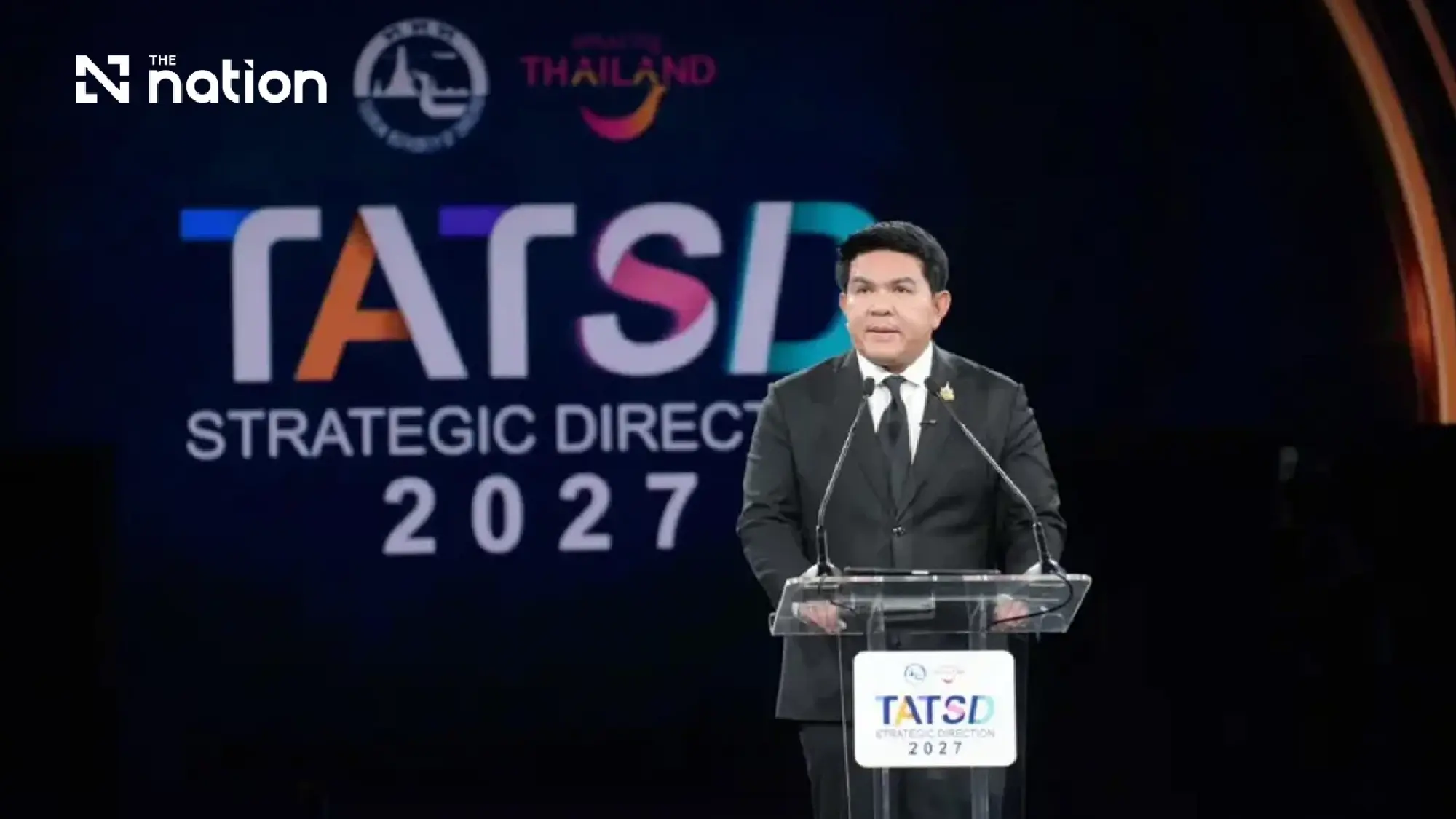
Surasak later set out the government’s tourism direction at the Tourism Authority of Thailand’s presentation of its 2027 marketing plans, following an annual action-planning meeting held in July.
The government is restructuring the management of tourism and culture as it seeks to position Thailand as a major regional destination and develop tourism into an industry capable of generating long-term value.
The strategy represents a shift away from measuring performance mainly through visitor numbers towards attracting higher-value travellers and increasing economic returns from each trip.
The Tourism and Sports Ministry has also been instructed to establish a joint public-private committee to coordinate tourism development.
Its responsibilities will include promoting Thailand as a year-round destination, developing domestic travel measures and improving destinations, safety, convenience, hygiene and visitor confidence.
Three priorities set for TAT in 2027
The government has given TAT three principal policy directions for its 2027 action plan.
1. Develop Thailand as a high-value experiential destination
TAT has been instructed to focus on the quality and value of tourism rather than simply increasing the number of travellers.
Products and services should be developed for higher-value visitors, with emphasis on health and wellness, culture, food, sport and creative tourism.
The objective is to raise spending per visitor while improving the distribution of tourism revenue.
2. Use data, technology and innovation
TAT is expected to strengthen its collection and analysis of traveller insights and consumer behaviour.
Artificial intelligence will be applied to marketing communications, planning and policy decisions as the agency develops into a more data-driven organisation.
3. Build long-term competitiveness and sustainability
Public and private bodies will be expected to coordinate policies that balance economic, social and environmental considerations with local identity.
The government wants tourism to support economic activity while contributing to the quality of life of communities across Thailand.
Surasak said tourism was not the responsibility of any single agency. The public sector, private businesses, communities and citizens would need to work together under a “Team Thailand” approach to develop a stable, balanced and sustainable tourism industry.
