
US-Iran talks begin as Hormuz closure claim strains fragile ceasefire
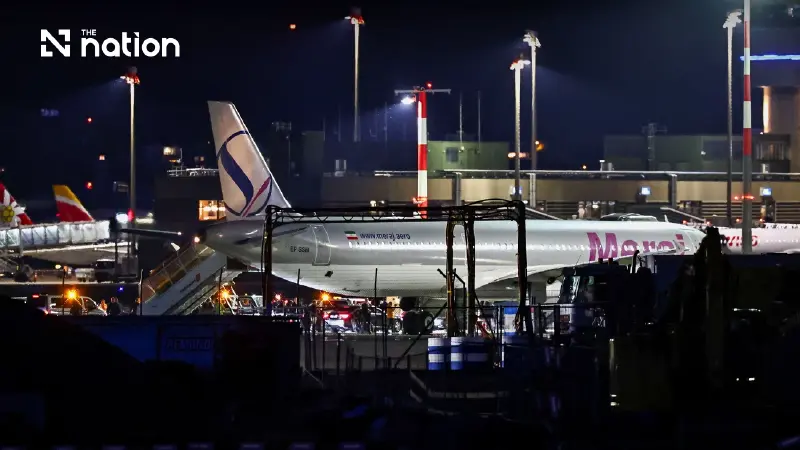


Negotiators meet in Switzerland under a 60-day ceasefire, as Washington disputes Tehran’s claim that the Strait of Hormuz has been closed.
- US and Iranian delegations have begun peace talks in Switzerland to advance an interim agreement aimed at ending their recent war.
- The talks are immediately strained by conflicting claims over the Strait of Hormuz, with Iran's Revolutionary Guard stating it is closed while the US military insists commercial shipping continues.
- The fragile 60-day ceasefire, a precondition for the talks, is further threatened by continued fighting between Israel and Hezbollah in Lebanon, which Iran accuses the US of failing to stop.
US and Iranian negotiators were due to begin peace talks in Switzerland on Sunday (June 21), even as Washington disputed Tehran’s claim that it had closed the Strait of Hormuz, a key route for global oil and gas supplies.
Iranian state media said a high-level delegation had arrived in Switzerland, while US Vice President JD Vance left Washington for talks that Pakistan said would begin on Sunday.
The meetings are aimed at advancing an interim agreement brokered by Pakistan and signed on Wednesday by US President Donald Trump and Iranian President Masoud Pezeshkian to end their almost four-month war.
The diplomatic push comes despite new tension over the Strait of Hormuz.
The US and Iran had agreed to a 60-day ceasefire while negotiations take place, but Tehran’s Islamic Revolutionary Guard Corps said on Saturday that the strait had been shut.
US Central Command rejected that account, saying commercial shipping was still moving through the waterway.
The IRGC warned that ships would be at risk if they approached the strait, citing what it called Israeli “crimes” in Lebanon and accusing Washington of violating commitments to establish a ceasefire.
US Central Command said 55 merchant ships had transited the strait on Saturday, carrying more than 17 million barrels of oil to global markets, and added that US forces would ensure commercial traffic continued.
Trump wrote on social media on Saturday that no toll would be charged for passage through the strait during or after the 60-day ceasefire, unless the US imposed one if peace talks failed.
He left open the possibility of a US toll “for services rendered as the Guardian Angel to the countries of the Middle East” if a peace deal is not completed.

Mohammad Mokhber, an adviser to Iranian Supreme Leader Ayatollah Mojtaba Khamenei, accused the US on X of failing to implement the first clause of the 14-point interim deal with Iran, which includes a ceasefire “on all fronts”, including Lebanon.
He said that as long as the agreement remained only on paper, the flow of Middle East energy would remain halted.
The Iranian delegation was led by chief negotiator Mohammad Baqer Qalibaf and included Foreign Minister Abbas Araqchi, as well as senior security, central bank and oil officials, Iranian media said.
The US team includes Vance, envoys Steve Witkoff and Jared Kushner, Trump’s son-in-law.
Iranian Foreign Ministry spokesperson Esmaeil Baghaei said Iran would press in Switzerland for the other side to fulfil its commitments, citing what he described as past failures by the other side to honour agreements.
Vance told Fox News he was confident the ceasefire would hold and said he had seen no evidence that the Strait of Hormuz was closed.
Vance left for Switzerland shortly after 4 pm ET, or 2100 GMT, on Saturday.
Speaking to reporters before boarding a plane at Joint Base Andrews in Maryland, he said negotiators would probably hold a “couple days of talks”.
“I think we’re going to hopefully make progress on the nuclear issue, make progress on the Lebanon ceasefire issue,” he said.
A halt to fighting in Lebanon was one of the conditions for launching 60 days of US-Iranian talks on Tehran’s nuclear programme and other issues.
However, Lebanese Civil Defence said 20 people were killed by Israeli strikes in Lebanon on Saturday, hours after a truce there took effect.
Israel said it was responding to attacks from Hezbollah, while the Iran-backed group said it would not allow Israel “freedom of movement” in Lebanon.


Israel, which was left out of the US-Iran talks, has said it is not a party to the deal and will keep its forces in the Lebanese territory it occupies.
Israeli broadcaster Channel 12 reported that the prime minister and defence minister had instructed the military to hold fire in Lebanon, but that it would not withdraw from areas it had captured.
A poll conducted by the Israeli Hebrew University and shared exclusively with Reuters found that about 92% of Israelis believed Iran benefited more than Israel from the joint Israeli-US military campaign.
In comparison, only about 8% believed Israel emerged victorious.
Almost 90% said the goals of the war had not been met, and more than 70% said they did not believe Netanyahu’s claims of major achievements.
Lebanon’s state news agency NNA said Israeli warplanes and drones struck locations across southern Lebanon and the Bekaa Valley on Saturday, both Hezbollah strongholds.
An Israeli military official said Hezbollah fired more than 50 projectiles at Israeli forces in southern Lebanon overnight, and that Israel attacked what it described as Hezbollah targets in response.
An Israeli military statement said Israel was committed to the ceasefire but would continue to act against any threat to Israel or its forces.
Lebanon’s health ministry says 4,057 people have been killed in Israeli attacks since March 2, including medics, women and children, though it does not specify how many of the dead were combatants.
Israeli authorities say at least 32 soldiers and four civilians have been killed in fighting with Hezbollah.

Reuters
