
Indian defence institute chief assesses Japan arms export policy
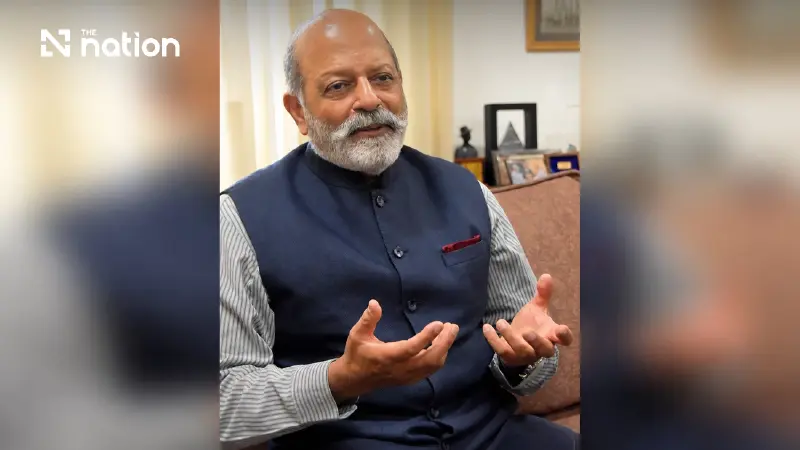


Sujan Chinoy says Japan should work with trusted partners such as India to spread defence production and reduce wartime risks.
- Sujan Chinoy, head of a leading Indian defence institute, has strongly welcomed Japan's decision to ease its arms export restrictions, viewing it as a positive step for Japan's security.
- He believes the policy shift opens the door for deeper defence cooperation with India, including the potential for joint production of warships like the Mogami-class frigate.
- Chinoy suggests that producing military equipment in India would serve as "risk mitigation" for Japan, whose own defence industrial base is geographically vulnerable to attack.
- The former ambassador frames the move as a way for Japan to normalise its defence policy, reduce its over-reliance on the US, and deter regional pressure from countries like China.
The head of a leading Indian defence research institute has welcomed Japan’s move to ease arms export restrictions, arguing that the policy shift could strengthen Tokyo’s security while opening the way for deeper defence equipment cooperation with India, including the possible joint production of warships.
Sujan Chinoy, director-general of the Manohar Parrikar Institute for Defence Studies and Analyses and a former Indian ambassador to Japan from 2015 to 2018, said in an interview that he “greatly” welcomed the decision.
“It is something that is going to help Japan with its future security and defence,” he said.
He pointed to steps being advanced under Prime Minister Sanae Takaichi, who took office last October, including Japan’s proposal to provide decommissioned Abukuma-class destroyers of the Maritime Self-Defence Force to the Philippines and its plan to export an upgraded version of the MSDF’s Mogami-class frigate to Australia.
“I believe [Japan has] been in touch with India about the Mogami-class frigates,” Chinoy said.
Chinoy said Japan should avoid keeping the most advanced parts of its military industrial base within its own territory alone.
“Geographically small countries run a very big danger of trying to keep their front-line sophisticated military industrial complex limited to their own geography,” he said, warning that such sites “can easily be targeted” if war breaks out.
India would be a natural partner for such an approach, he said, adding that Japan could use warships and weapons produced in the South Asian country as an “insurance policy” and a form of “risk mitigation”.
Japan effectively removed its ban on lethal weapons exports in April by revising its three principles on defence equipment transfers and related implementation guidelines.
Chinoy said the shift was viewed favourably by many Indians. “Indians would say it is high time [for Japan to do so],” he said.
He also rejected the idea that a stronger Japanese defence posture would change the country’s basic identity. “Japan is a peace-loving country, [and] that does not change,” he said.
“But to be a peace-loving country does not mean that you allow yourself to be so hamstrung, as...your hands and feet are tied, that you can be bullied by others.”
The former ambassador linked the argument to pressure from China, including the risk of more military exercises and intrusions into areas around the Senkaku Islands in the East China Sea, which are administered by Japan and claimed by China.
A more “proactive” defence policy could help deter such moves, he said.
Chinoy said Japan had depended “for too long” on the United States for defence and security, allowing other countries to take advantage of that reliance.
“What Japan’s policies were earlier was quite different. They were not normal,” he said. “Now it is becoming normal.”
He dismissed concerns that Japanese arms exported to India could be transferred onwards to third countries.
There was “no basis” for such apprehension, he said, noting that India buys military equipment from countries including the United States and France but has never passed it on to others.

[Copyright The Jiji Press, Ltd.]
