
Thai Chinese descendant’s journey to China revives a family legacy
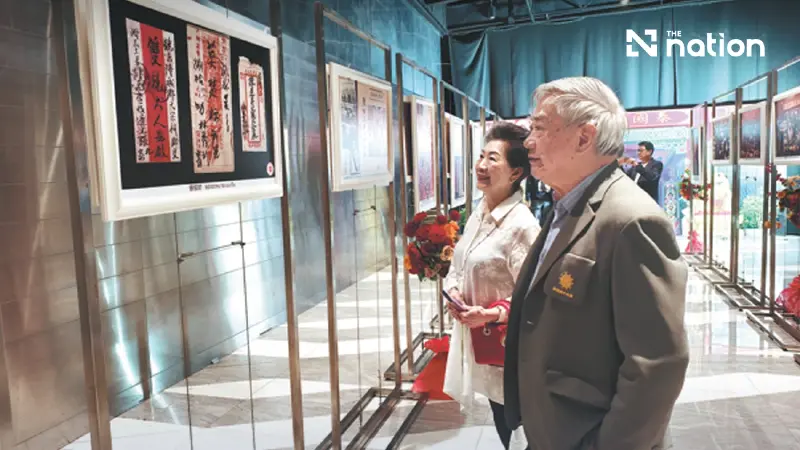


A Thai man of Chinese descent traces his grandfather’s roots in Guangdong, uncovering preserved letters, family ties and a renewed sense of belonging.
- A Thai man of Chinese descent, Pravit, was inspired by a movie to travel to his grandfather's hometown in China to fulfill his ancestor's unrealized wish to "return home in glory."
- During his journey, he reconnected with long-lost relatives and discovered his grandfather's legacy through preserved letters and financial remittances (qiaopi) sent from Thailand.
- Pravit's connection to his heritage was solidified when he learned of his grandfather's contributions to the village and had his own name officially added to the family genealogy.
In Thailand, roughly half of the 10 people you meet may have Chinese ancestry somewhere in their family history. While the exact number of people of Chinese descent is difficult to determine, official estimates put it at about 9.8 million, or more than 10 percent of the population.
Perhaps that helps explain why Thailand became the setting for Dear You, a Chinese movie that has resonated with audiences in the Southeast Asian country.
My 41-year-old Thai friend, Pravit, is a descendant of Chinese immigrants. His grandfather came from Raoping in South China's Guangdong province. Although Thailand's identity cards allow only Thai names, Pravit was also given a Chinese name at birth: Tang Haiyuan.
When Dear You premiered in Bangkok last month, Pravit was among those who went to see it. A line from the male lead struck a chord, "Returning home in glory."
"The character Zheng Musheng never got the chance to return home in glory," Pravit said. "My grandfather had that regret, too. I want to fulfill it for him. I want my grandfather to return home in glory."
Pravit's grandfather died relatively young after living in Thailand for more than 10 years. None of his children had ever returned to his hometown in China.
With help from the Raoping Natives Association in Thailand, Pravit eventually contacted people in his grandfather's village. When relatives heard that a descendant of the Tang family was returning to find them, word quickly spread through the family.
Among them was an aunt in her 80s who was living in Shenzhen, nearly 400 kilometers from Raoping. Learning that Pravit was returning to fulfill his grandfather's wish, she made the long journey back to Raoping to meet him. Only after their reunion did Pravit learn that, during his grandfather's time in Thailand, he had sent many letters and remittances, known as qiaopi, back home. His relatives had preserved them all.
"They told me that the money my grandfather sent to my great-grandmother was also used to help many poor people in the village," Pravit said. The relatives also showed him a thick family genealogy.
"I asked if my name could be added. They said: 'Of course. You are a descendant of our family,'" the nearly 1.9-meter-tall Thai man recalled through tears.
For many third- and fourth-generation Chinese descendants in Thailand, their ancestral hometowns have become distant memories — places that belonged to their grandparents rather than to them.
Pravit, however, has found another way to keep that connection alive.
He often introduces China to Thai audiences through social media. As more followers have grown curious about the country, he has organized trips to China so they can experience its landscapes, culture and history.
For decades, the story of overseas Chinese communities has often been told through migration, hardship and survival: people leaving home with little more than they could carry, building new lives in unfamiliar lands, sending money and letters back across the sea, and raising children who would eventually become more Thai, Malaysian, Indonesian or American than Chinese.
But migration does not necessarily erase memory. Sometimes, it simply reshapes the way memory travels.
Pravit's story made me think that, for many overseas Chinese, reconnecting with China today is no longer simply about finding an ancestral village. It can also mean encountering a country that has changed dramatically since their grandparents' departure.
That encounter can create a different kind of cultural recognition — one based not only on ancestry, but also on discovering how fragments of an old homeland have remained alive abroad while the homeland itself has continued to evolve.
According to incomplete statistics, an estimated 50 million to 60 million overseas Chinese live across nearly 200 countries and regions.
They are scattered across the world like dandelion seeds, taking root wherever the wind carried them. They built families, businesses and communities far from where their ancestors began, adapting to new societies while carrying fragments of an older identity with them.
Perhaps that is why the journey to find one's roots can still be so emotional.
The roots may have grown thinner with each generation, the language may have faded, and memories may have blurred. But sometimes, all it takes is a name, a gravestone, an old letter — or a journey back — to make those roots visible again.
And when overseas Chinese return to China today, they may find more than the place their ancestors once left. They find a country that has moved forward while carrying its past with it.
In that meeting between memory and change, between an old homeland and a changing China, cultural identity becomes more than an inheritance. It becomes recognition.
And sometimes, recognition feels very much like coming home.
The author is chief correspondent at China Daily Asia-Pacific Bureau based in Bangkok.
By Yang Wanli
Source: China Daily
