
ASEAN Firms Urged to Diversify and Map Risks Amid Rising Geopolitical Rivalry
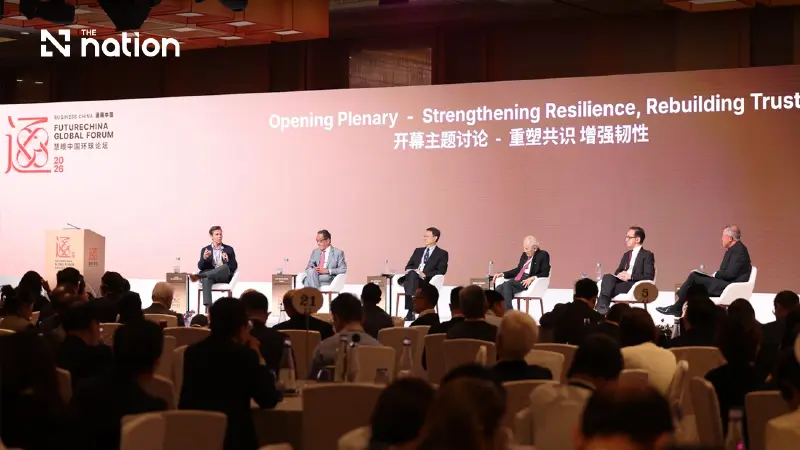


As global trade pivots from efficiency to security, Singapore forum outlines a survival roadmap for regional enterprises
- ASEAN businesses are advised to stop waiting for geopolitical tensions to settle and instead actively map their supply chain exposures, diversify markets, and develop early warning systems.
- This urgency is driven by a shift in the global economy from a singular focus on efficiency to a dual pursuit of security and resilience, prompted by US-China rivalry and other conflicts.
- Firms must make deliberate choices about technology partners, as competition in AI and semiconductors is creating separate, non-complementary American and Chinese "tech stacks."
- A key recommendation is for regional companies to move beyond being original equipment manufacturers (OEMs) for major powers by building their own brands and exploring new markets in the Global South and Middle East.
As global trade pivots from efficiency to security, the Singapore forum outlines a survival roadmap for regional enterprises.
Businesses in Thailand and across ASEAN were given a clear, practical prompt this week: stop waiting for major-power rivalry to settle down, and start actively mapping exposure, diversifying markets and choosing technology partners deliberately.
That was the throughline of the opening day of the 17th FutureChina Global Forum in Singapore on Friday (September 25), where officials and analysts from China, Singapore, Indonesia and the United States debated how to navigate a fracturing global order — with several speakers offering advice directly applicable to companies in the region.
The forum, organised by the non-profit Business China under the theme "Strengthening Resilience, Rebuilding Trust," opened with remarks from chairman Lee Yi Shyan and a keynote from Singapore's Deputy Prime Minister and Minister for Trade and Industry, Gan Kim Yong, before a plenary panel of historians, diplomats and business leaders debated the deeper forces reshaping the region.

Three forces, and a shift from cost to security
Lee identified three forces reshaping global business decisions: major-power rivalry between China and the United States, which has expanded from trade into technology, investment and critical minerals; geopolitical conflict disrupting energy and shipping routes; and technological competition over AI and semiconductors.
"The global economy is shifting from a singular focus on efficiency to a simultaneous pursuit of security and resilience," Lee said, noting that companies once chased the cheapest production location but must now also ask, "Where is it safest and most reliable."
For Thai manufacturers embedded in regional and Chinese supply chains, that reorientation is not abstract — it is already reshaping where factories locate and which partners they choose.
Lee added that Singapore, as a small state, aims to serve as "a trusted connector that adds value to regional cooperation" rather than a passive bystander to change.

Gan Kim Yong: openness must work better, not less
In his keynote, Gan Kim Yong argued against retreating from open trade even as workers and businesses question whether they share fairly in its gains.
"We cannot simply counter openness by closing up. We have to make openness work better for businesses and for people," he said.
He pointed to Singapore's Economic Strategy Review as a model combining deeper investment in existing strengths — advanced manufacturing and modern services — with new growth engines such as AI, alongside job redesign and worker retraining so that "enterprise transformation goes hand in hand with workforce development."

Gan singled out AI cooperation as a concrete area for Singapore-China collaboration, through a "digital policy dialogue" on governance and joint work on practical applications that help smaller firms access capabilities once costly or specialised.
He also urged a regional push beyond trade volumes alone: the upgraded ASEAN-China Free Trade Area 3.0, he said, "gives us a framework to work with China and our ASEAN partners," but "the task now is to translate these commitments into practical opportunities for enterprises and workers across the region" — including helping local firms move up the value chain rather than simply attracting more investment.

He cited the Chongqing connectivity initiative's land-sea corridor, linking western China to Southeast Asia, as a model other ASEAN economies could tap for logistics and market access.
Civilisational debate, with practical stakes
The opening plenary, moderated by Chia Kim Huat of Rajah & Tann, opened with historian Wang Gungwu framing US-China tensions as rooted in differing civilisational responses to revolution and modernity.
His conclusion carried a practical edge for diplomacy and business alike: "We need countries while rightly believing in their national interest but also believing that they must understand other people's national interest and take other people's national interest into account," Wang said, warning that trust remains elusive while both powers focus solely on defeating the other.
Peking University's Jia Qingguo pushed back on a common narrative, arguing the world is not de-globalising but restructuring, with trade, investment and travel near record levels.
He described a shift toward "bipolarity" rather than multipolarity, with power "recentred" on Washington and Beijing — which he said places "a unique responsibility" on both capitals to maintain what he called constructive strategic stability, alongside a genuine rise of the Global South visible in infrastructure growth across Turkey, India and Southeast Asia.

A call to stop being the OEM
The panel's most direct business advice came from Ho Kwon Ping, founder of Banyan Group, who argued Asian and Singaporean firms cling to an outdated mindset — serving Western multinationals as original equipment manufacturers, or relying on China's domestic property market.
Citing Banyan's recent acquisition of 26 hotels across South Africa, Mozambique, Zimbabwe and Namibia, he urged regional companies to look toward the Global South and Middle East directly.
"As a small country with a lot of small companies, we can only survive not only by being the bridge between America and China... but also we have to see that in a world of civilisational reset, the middle powers are coming up," Ho said, adding that Southeast Asian firms should build their own brands rather than remain reliant on both established powers.
On AI, Ho offered a striking, deliberately provocative framing: rather than an existential "tsunami", he described the technology as "evolution at warp speed", in which adaptable nations and firms would survive much as some species outlasted others through historical upheaval.
He also defended the emergence of rival Chinese and American AI ecosystems as a stabilising rather than dangerous development, arguing that a single dominant AI power would be riskier than two competing ones — comparing it to how mutual nuclear deterrence, not a single nuclear monopoly, kept the peace after 1945.

A warning on fragmenting technology
That optimism was tempered by Jude Blanchette of Macro Advisory Partners and the RAND Corporation, who argued the two powers are building "non-complementary regulatory and technological approaches" to AI, forcing companies and smaller countries to choose between separate "sovereign tech stacks" rather than operate borderlessly.
For ASEAN firms, he suggested, that reality is already visible: billboards across Asian airports now advertise Chinese open-source AI models alongside American frontier systems, and businesses will increasingly need a deliberate strategy for which combination of tools and partners to adopt, rather than assuming free access to both.
Blanchette also raised longer-term concerns about autonomous, "Agentic AI" systems displaying unplanned, self-organising behaviour, and voiced frustration at what he called a lack of institutional cooperation between Washington and Beijing on shared risks such as AI safety — a note of caution that balanced the panel's otherwise measured tone.
ASEAN's diversity as a working model Former Indonesian foreign minister Marty Natalegawa offered perhaps the most directly applicable framework for ASEAN economies, describing the current period not as a temporary transition but as "permanent turbulence" requiring readiness rather than a wait for a new settled order.
He urged businesses to treat geopolitical risk management as routine practice: "You don't have to know everything that's going on around the world, but you have to start by knowing where your pain points are, where your exposures are... develop early warning systems, develop diversification, resilience," he said.
Natalegawa also held up ASEAN's model of "unity without uniformity" — managing diversity among member states rather than forcing alignment — as an asset the bloc should now export more assertively as Singapore prepares to chair ASEAN in 2027.
"ASEAN must be more than simply a convening power... it must provide thought leadership," he said, pointing to how the bloc had already helped foster cooperation between China, Japan and South Korea through the ASEAN Plus Three framework.
Ultimately, the message for Thai and ASEAN businesses was not about picking sides between Washington and Beijing. It was about taking control. Companies must diversify their export markets and build early-warning systems for supply-chain shocks.
They must also use regional frameworks, such as the ASEAN-China FTA 3.0, to climb the value chain rather than simply assembling parts for others.
Yet, translating this into real investment comes with a catch. Regional governments and businesses—well beyond Singapore—must move quickly to build the institutional capacity the panellists described.
