
France reports 1,200 arrests during protests over rising living costs
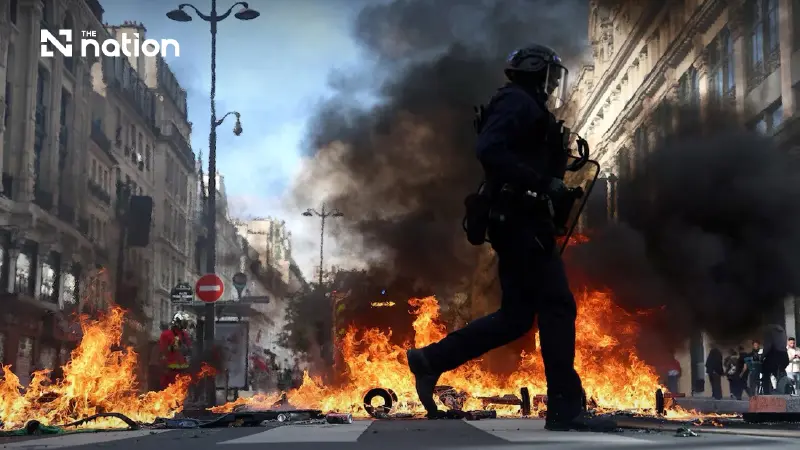


Hundreds of thousands marched over public services and living costs as attackers burned public buildings and looted shops in French cities.
- French authorities reported approximately 1,200 arrests and over 150 police officers injured during nationwide protests.
- The demonstrations, involving hundreds of thousands of people, were sparked by the rising cost of living, high fuel prices, and declining public services.
- While most demonstrations were peaceful, significant violence occurred, including looting, arson, and attacks on police and public buildings by fringe groups.
- The unrest also resulted in protester injuries, including a teenager who lost a hand, raising questions about police tactics.
Prime Minister Sébastien Lecornu reported about 1,200 arrests and more than 150 police officers injured during demonstrations over rising living costs and declining public services in France on Saturday (October 17).
Most of the hundreds of thousands who took to the streets demonstrated peacefully.
Interior Minister Laurent Nuñez estimated that 550,000 people joined marches in scores of cities, while the CGT trade union gave Reuters a higher figure of 800,000.
The movement began a month earlier among secondary school pupils in the working-class northern suburbs of Paris.
Their complaints about missing teachers and poor school facilities subsequently widened into a campaign concerning inequality, public spending and living standards.
“We are fighting because the cost of living is too harsh, because the price of fuel is too high, because high school pupils are being violently attacked and hurt all over the country just for trying to protest and ask for more teachers and decent learning conditions,” said Lola, a 19-year-old protester in Paris.
Participants stressed that peaceful demonstrators made up the majority, blaming much of the destruction on troublemakers intent on damaging property and confronting police.
Many carried placards denouncing the police, President Emmanuel Macron and the wealthy.
Street blockades by people wearing high-visibility vests brought back images of the Yellow Vest protests during Macron’s previous term.
Nationwide participation surpassed the peak of that movement, although it fell well short of the turnout against his pension overhaul in 2023.


Macron now faces mounting economic pressure and a fragmented political landscape as his presidency approaches its end.
Attempts to reduce France’s public debt have not restored investor confidence, and government borrowing costs have climbed to levels unseen in more than two decades.
The violence accompanying the marches was among the worst France had witnessed in decades.
Fringe groups attacked police officers and their vehicles, ransacked luxury shops and supermarkets, and damaged public buildings.
Fire struck both Limoges city hall and Lyon’s tourist office.
In Marseille, protesters dressed in black forced their way into city hall and marked the building with anarchic graffiti.
Although most marches got under way around midday, some began ahead of their official starting times.
Parts of Paris saw officers fire tear gas while falling back before largely young crowds, many dressed in black and wearing hoodies, masks and goggles to protect themselves from the gas.
Banks in the capital were smashed up and boutiques, including a Lacoste shop, were ransacked.
An SFR mobile phone shop was looted, and rioters attempted to break into Galeries Lafayette department store.
Numerous cars were among the objects set ablaze throughout the day.
During evening visits to affected sites, Lecornu blamed criminals and the “ultra-left” for the unrest.
With only months remaining before next year’s presidential election, he insisted that violence would not intimidate the government.
“To those who clearly want to use this violence as a ‘warm-up’ before the presidential election, I say clearly: We will not let ourselves be intimidated. No one will impose their political agenda through violence,” he wrote on X.


Macron promised prosecution and punishment for those behind the attacks.
“We will all stand united against the sowers of chaos, who only seek to undermine our institutions and prevent those who peacefully express their demands from doing so,” he wrote on X.
Injuries to demonstrators have meanwhile raised questions about police tactics.
A teenager lost a hand after picking up a stun grenade, and the police watchdog is investigating at least two dozen allegations of police violence.
Nuñez confirmed that a person had a hand torn off during Saturday’s clashes.
French media reported that he had tried to pick up a stun grenade.
Lecornu did not state whether any demonstrators had been hurt when giving the number of injured officers.
For the UNSA Police union, footage of crowds attacking police vans with clubs and bricks at several locations illustrated the pressure facing officers.
Posting the video on X, the union warned that police forces were at breaking point.
“Today again, in every corner of France, our colleagues are being used as punching bags. Pelted with stones, injured, trapped in real ambushes,” it stated.
“Let everyone take responsibility: this cannot go on indefinitely. The rope is stretched to its maximum.”
Beyond France, rising living costs also brought smaller-scale demonstrations in Belgium, Portugal and Italy.
Albania saw further protests over perceived government corruption, a lack of jobs and poor education standards.
Tens of thousands marched in Lisbon against housing expenses and other living costs following days of unrest.
House prices in Portugal have doubled since 2017, fuelling an affordability crisis that ranks among Europe’s worst.
In Belgium, several hundred people, most of them young, gathered in Brussels for protests partly inspired by the French demonstrations. Some clashed with police.
Student groups have identified rising education costs and fears that reforms could make higher education less accessible as reasons for their protests.
Italian police cleared Milan’s central cathedral square with tear gas after disorder broke out during a march against high living costs.
Another protest turned violent in Bologna, where officers used water cannons in an attempt to disperse crowds and arrested seven people, the ANSA news agency reported.
Albanian students continued mass demonstrations for a fifth day, demanding the resignation of Prime Minister Edi Rama.
Police fired what appeared to be rubber bullets at protesters.
Source: Reuters
