
Trump, Xi and Putin issue four-point peace pledge on 19 Nov
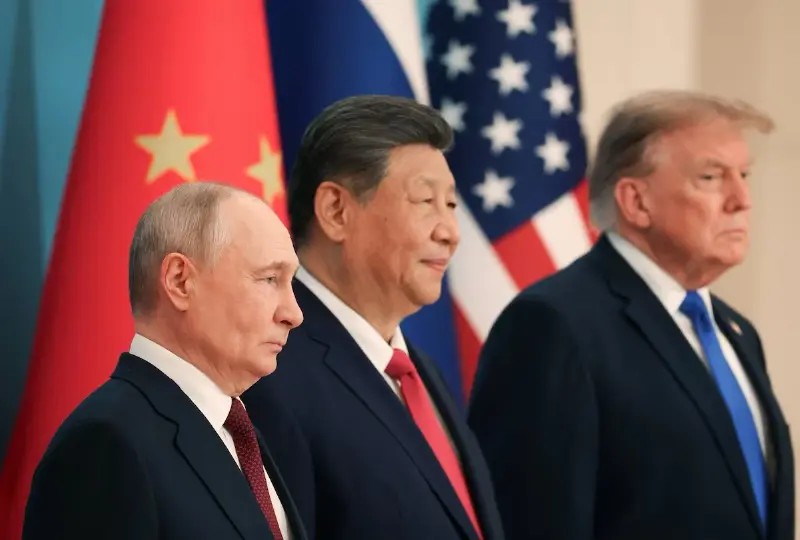


The Shenzhen declaration promises talks on nuclear risks but sets no timetable for them and makes no mention of the wars in Ukraine or Iran.
- On November 19 in Shenzhen, US President Trump, Chinese President Xi, and Russian President Putin agreed to a four-point peace declaration aimed at reducing the risk of nuclear war.
- The four points include reforming the UN, ensuring global energy supplies, upholding the immunity of state officials from international courts, and reaffirming that a nuclear war cannot be won.
- The declaration does not set a date for future talks or include any commitment from the leaders to negotiate cuts to their nuclear arsenals.
US President Donald Trump, Chinese President Xi Jinping and Russian President Vladimir Putin agreed in Shenzhen on 19 November 2026 to discuss how to reduce the risk of nuclear war. Their four-point peace declaration set no date for those talks and made no commitment to negotiate cuts to their arsenals.
Xi hosted the first three-way summit of the US, Chinese and Russian presidents at a lakeside villa in the wooded hills of Shenzhen. The afternoon meeting, held alongside the Asia-Pacific Economic Cooperation summit, concluded Trump’s three-day tour of Asia.

What did the three nuclear powers agree in Shenzhen?
The Shenzhen declaration sets out four commitments by the leaders of the countries with the world’s largest nuclear arsenals.
1. Reform the United Nations so it can respond more effectively to threats to international peace and security.
2. Increase production and supply of refined petroleum products and keep energy supplies flowing to all countries.
3. Uphold the principle of state consent and respect for the immunity of state officials. The leaders said the International Criminal Court and similar bodies must act within their jurisdiction.
4. Reaffirm that a nuclear war cannot be won and must never be fought, and open a dialogue on reducing nuclear risks and preventing the spread of nuclear weapons.
Trump has sought a three-way arms reduction treaty since his first term. Beijing has resisted, arguing that China has far fewer nuclear weapons than either Russia or the United States. Trump acknowledged at the start of the summit how difficult it would be to give them up.
Daryl Kimball, executive director of the US-based Arms Control Association, welcomed the leaders’ reaffirmation on nuclear war but called for negotiations. “We need action on disarmament diplomacy,” he said.
Europe challenges its exclusion from Ukraine diplomacy
Ukraine’s European allies met in Berlin on 19 November to back Kyiv and objected to the prospect of a settlement negotiated without them. The Shenzhen declaration mentioned neither Russia’s war in Ukraine nor the US conflict with Iran. Putin said afterwards that the declaration’s aims were modest and no country would be compelled to comply.
German Chancellor Friedrich Merz invoked the 1945 Yalta conference, where Soviet, US and British leaders helped shape post-war Europe. “A Yalta format will not bring peace,” Merz said. Putin defended the earlier conference, arguing that it had recognised the balance of power at the time and that any settlement today would also have to reflect conditions on the ground.
Ukrainian Foreign Minister Andriy Sybiha rejected the idea that Shenzhen had given Putin a new Yalta. Referring to damage to the bridge linking Russia with occupied Crimea, Sybiha said on X that Moscow had all but lost its route to Yalta itself. He urged Putin to end the war. Putin said the three powers shared an interest in resolving the conflict.
The declaration’s passage on immunity touches directly on Putin. In March 2023, the International Criminal Court issued arrest warrants for Putin and Russia’s children’s rights commissioner over the alleged unlawful deportation and transfer of Ukrainian children from occupied territory. Moscow rejects the allegations.
Jonathan Eyal, international director at London’s Royal United Services Institute, saw the challenge to international courts as the summit’s most significant outcome. “The big powers dictate, the small powers suffer,” he said. Eyal said Putin had gained international standing while Trump had gained little from the photographs. Russia’s economy is roughly a tenth the size of China’s, and Western sanctions restrict most Russian companies’ trade with the West.

Xi warns Trump over Taiwan
Xi told Trump in a separate meeting that Washington’s handling of Taiwan could set back relations with Beijing. Trump, who met Xi and Putin individually and called both men friends, told NBC News that he and Xi also saw merit in safeguards for artificial intelligence.
Xi had greeted Trump at Shenzhen airport on 18 November and the two briefly embraced. It was the first time as president that Xi had gone to an airport to welcome a visiting leader, returning a courtesy Trump had extended in the United States in September. Putin received a quieter welcome. Japanese Prime Minister Sanae Takaichi arrived without a ceremony.
China’s relations with Japan have deteriorated since Takaichi said in 2025 that Japan could deploy its military if Chinese action against Taiwan also threatened Japanese territory.
Trump rates Shenzhen summit 12 out of 10
Trump told NBC News he would give the meeting 12 out of 10 and praised the personal ties it had built. At the opening, Trump had argued that making peace required leaders to meet. Xi said the rest of the world benefited when major powers got along and suffered when they clashed.
Chinese Foreign Minister Wang Yi said the leaders had explained their intentions to one another in person and established a new way for their countries to work together. Officials from all three governments would remain in contact, he said.
US Senate Democratic leader Chuck Schumer called the summit a “historic embarrassment” and accused Trump of giving US adversaries a photo opportunity at America’s expense. Analysts quoted by Reuters said Trump had hoped the trip would strengthen his standing after Republicans lost control of Congress in November’s midterm elections.
Trump said on Truth Social that he would hold a news conference in Washington at noon local time on Friday, 20 November. Trump is expected to meet Xi again at the Group of 20 summit at his Florida golf resort in December. Putin said he had discussed the invitation with Trump and would take events in Russia into account before deciding whether to attend.
