
Bayer, GIZ and BCIU collaboration for sustainable and low-carbon rice systems
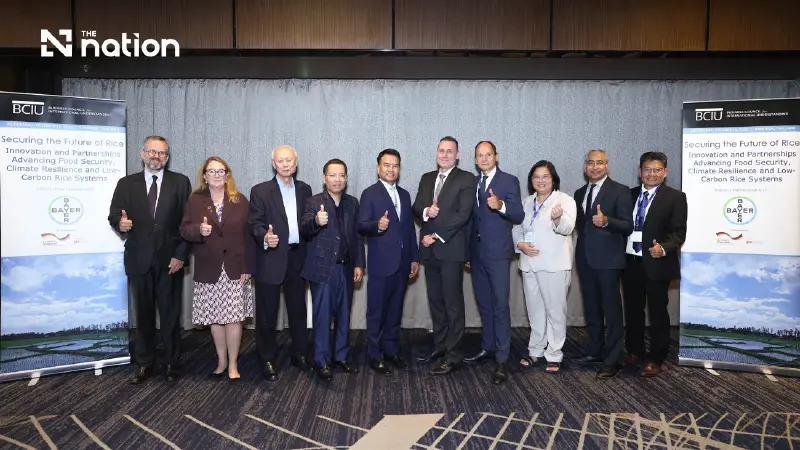


Bayer, in cooperation with the Deutsche Gesellschaft für International Zusammenarbeit (GIZ) GmbH, and together with the Business Council for International Understanding (BCIU), hosted the event "Securing the Future of Rice: Innovation and Partnerships Advancing Food Security, Climate Resilience and Low-Carbon Rice Systems" in Bangkok.
On the sidelines of the World Bank and IMF fall meetings, this flagship event brought together government, industry and development partners to discuss the future of rice production in Asia.

Rice is essential to global food security and the livelihoods of millions of farmers, yet rice systems face growing climate and sustainability challenges. The event brought together senior voices from the public, multilateral, research, finance and private sectors to explore how low-carbon rice systems can be scaled across the region. Participants exchanged perspectives that the challenge is no longer innovation alone, but what is needed is a smart combination of approaches into locally adapted systems that farmers can use confidently and profitably.

The panel highlighted practical approaches, demonstrating how food security, farmer prosperity and climate goals can advance together, building on climate-smart finance, sustainable farming practices and stronger value-chain partnerships. Examples included sustainable intensification, alternate wetting and drying, direct-seeded rice, mechanization, integrated pest and residue management, and digital advisory.
The event opened with keynote on next-generation rice for food security, climate resilience and sustainable development by Anup Jagwani, Director, Farming and Agribusiness, World Bank Group.

The program featured distinguished speakers including Matthias Berninger, Executive Vice President, Head of Public Affairs, Sustainability and Safety, Bayer AG; Ingrid-Gabriela Hoven, Managing Director of Deutsche Gesellschaft für International Zusammenarbeit (GIZ) GmbH; Dr. Pham Quang Minh, Head of Food, Agriculture and Forestry Division, ASEAN Secretariat; Dr. Chitnucha Buddhaboon, Advisor, Rice Department, Ministry of Agriculture and Cooperatives, Kingdom of Thailand; Dr. Huynh Kim Dinh, Deputy Director General, National Agricultural Extension Center, Ministry of Agriculture and Environment, Socialist Republic of Vietnam; Beau Damen, Natural Resources Officer, Climate Change and Climate Finance, Regional Office for Asia and the Pacific, Food and Agriculture Organization; Prof. Dr. Paul Teng, Executive Director, IRRI Fund Singapore; Simon Thorsten Wiebusch, Vice Chairman, Managing Director & Chief Executive Officer of Bayer CropScience Limited, India; Ampawa Sylanont, Head of Component- Climate Finance of Thai Rice Green Climate Fund, GIZ and Paul Nicholson, Vice President and Head of Rice Research and Sustainability at Olam Agri.

The discussions covered two key areas:
- The Global Context, Innovation and Partnership of Rice, Food Security and Climate Resilience session, moderated by Adrien Viller, Director of Member Relations at BCIU, explored how innovation and partnerships can help address food security and climate challenges and support more resilient and sustainable rice systems.
- Public-Private Partnership in Sustainable Rice and Low-Carbon Transformation in Asia session, moderated by Noopur Desai, Senior Manager, Food Initiatives, at the World Economic Forum (WEF), focused on how collaboration across sectors can strengthen farmer adoption and help scale sustainable and low-carbon rice practices across Asia.

Transforming rice systems requires more than solutions alone. It requires coordinated policies, accessible finance, effective extension and cooperatives, market incentives, and long-term and strong partnerships that enable farmers to adopt solutions confidently and profitably.
The forum underscored the role of governments, financial institutions, public and private partners as well as the importance of collaboration across sectors to strengthen food security, support farmer resilience and advance more sustainable rice systems in Asia.
