
Blending hydrogen with natural gas to transform power generation towards net zero
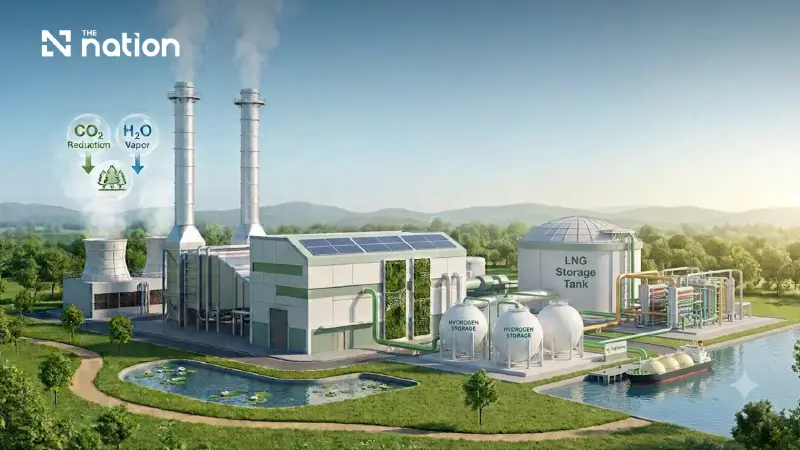


As the world accelerates efforts to cut carbon emissions, electricity demand continues to rise with economic growth and technological development. The central question is therefore not simply “How much clean energy can we use?”, but “How can we move from conventional energy to cleaner alternatives without compromising the security of the national electricity system?”
Thailand currently relies on natural gas for approximately 50-60% of its electricity generation, providing baseload power to maintain system stability. Replacing natural gas entirely with renewable energy remains challenging because of limitations in supply reliability and the readiness of the electricity grid.
Blending hydrogen with natural gas for electricity generation, known as hydrogen co-firing, is therefore emerging as a promising option. The approach involves gradually increasing the hydrogen content and reducing natural gas consumption as technology and costs allow.
How can hydrogen help reduce carbon emissions?
Hydrogen (H₂) is a colourless, odourless gas with a higher calorific value than fuel oil or natural gas. It contains no carbon and therefore produces no carbon dioxide (CO₂) when burned.
Blending hydrogen with natural gas for power generation can consequently reduce CO₂ emissions as the fuel mix changes. Hydrogen is therefore regarded as one of the key technologies supporting the transition to clean energy.
However, hydrogen remains considerably more expensive than natural gas. Introducing it too rapidly could increase electricity costs, while current hydrogen supplies and infrastructure are not yet sufficient to support widespread use.

From the laboratory to commercial deployment
Takasago Hydrogen Park, operated by Mitsubishi Heavy Industries, Ltd. (MHI) in Hyogo Prefecture, Japan, is regarded as the world’s first integrated hydrogen technology validation centre. Its activities cover the entire process, from hydrogen production and storage to its use in electricity generation.
MHI has developed advanced combustor technology that enables hydrogen to be burned alongside natural gas while maintaining stable combustion and low nitrogen oxide (NOₓ) emissions.
In 2023, MHI achieved what the source describes as the world’s first demonstration of co-firing a 30% hydrogen blend with natural gas, using five JAC (J-Series Air-Cooled) gas turbines at T-Point 2. The grid-connected, 566-megawatt gas turbine combined-cycle (GTCC) test facility is located at Takasago Hydrogen Park. The demonstration reduced CO₂ emissions by 10%.

During 2024-2025, MHI subsequently tested combustion using 100% hydrogen in its medium-sized H-25 gas turbine, with a capacity of 40 megawatts, in preparation for commercial deployment. The company aims to enable its large gas turbines to operate on 100% hydrogen after 2030.
Thailand advances hydrogen research
Thailand’s Ministry of Energy has identified hydrogen as one of the energy technologies of the future. It is expected to play a role in the country’s electricity system after 2040, reflecting continuing limitations in cost and commercial readiness.
Meanwhile, the Electricity Generating Authority of Thailand (EGAT) has been studying the feasibility of blending 5% hydrogen with natural gas for electricity generation at six of its power plants: North Bangkok, South Bangkok, Wang Noi, Bang Pakong, Nam Phong and Chana.
The studies are intended to prepare the facilities while awaiting clearer policy direction under Thailand’s new Power Development Plan.
Japan’s progress in using hydrogen for commercial power generation, even at a relatively limited proportion, demonstrates the potential to modify existing natural gas power plants rather than build new facilities, potentially saving substantial investment.
The approach illustrates an energy transition in which natural gas, renewables and hydrogen complement one another, helping the electricity system maintain security and flexibility while reducing carbon emissions.
