
Developers welcome proposed land and construction tax law


Play
Urge govt to grasp nettle and also reform other property taxes, such as transfer, mortgage fees
Residential property companies have welcomed the proposed land and construction tax bill, which if passed will open up business opportunities to develop unused land currently owned by private landlords.
Meanwhile, they suggest that the government should take the opportunity to reform all tax packages related to land and construction, such as transfer fees and mortgage fees.
“If the Finance Ministry wants a law governing land and construction tax, it has to revise other fees and taxes that landowners, property developers and home-buyers currently have to pay. That would ensure fairness for all parties,” said Thai Condominium Association president Prasert Taedullayasatit, who is also managing director for condominiums at Pruksa Real Estate.
At present, when people buy a home, they have to pay a transfer fee of 2 per cent of the asset’s appraised value and a 1-per-cent mortgage fee, while property companies have to pay a 3.3-per-cent special business tax.
Meanwhile, when people sell a home they have owned for less than five years, they also have to pay the special business tax of 3.3 per cent, and must add the revenue from the sale to their personal income for tax purposes.
If they have owned the home for more than five years, they can avoid the special business tax, but still must declare the sale revenue as personal income.
Prasert argues that if a land and construction tax were to be added to these existing costs, it would be unfair to home-owners.
His association is, therefore, urging that the transfer and mortgage fees be reduced if the new tax becomes a reality.
It also wants either a cut in the special business tax or adjustments to the requirement for home-sale revenue to be included as personal income for tax purposes.
This would reduce costs for both home-buyers and home-owners. It would also help drive the property market, for both new and resale housing, in a sustainable way, he said.
Housing Business Association president Atip Bichanond, who is also director of property developer Supalai, said his group was proposing exemption from the land and construction tax for homes with an appraised asset value of no more than Bt1 million, or land covering an area of no more than 50 square wah (200 square metres), as this would be fair for low-income people.
“We don’t know if the draft of this Act has such an exemption, but we will propose it again anyway,” he said.
Kittipol Pramote na Ayudhya, director of the Thai Real Estate Association, said the proposed land and construction tax could result in greater fairness within society.
However, the tax has to be fair for lower-income people and also have a clear system for considering who has to pay it and who does not.
Tax reform a priority
This past Monday, Finance Minister Sommai Phasi said tax reform was one of his first priority tasks, and that inheritance tax and land and construction taxation were the two most “tangible” ideas on the table.
However, it is still not definite that the ministry will introduce and implement both at the same time, he said.
According to Revenue Department draft proposals, the land and construction tax would be assessed on land and improvements at a rate ranging from 0.05-2 per cent.
This means vacant land appraised at Bt10 million would incur a tax bill of Bt5,000 at the tax rate of 0.05 per cent for the first year. As the idle land is held longer, the liability would rise to Bt200,000 a year at a rate of 2 per cent.
The owners of residences appraised at Bt1,000,001 would pay a real-estate tax of Bt1,000.001 a year. For every Bt1 million in appraised value, the tax would amount to Bt1,000 a year.
Ananda Development president and CEO Chanond Ruangkritya said that if the National Legislative Assembly approved the bill for land and construction tax, it would not impact on property developers, as they buy land and develop it for sale, and do not hold undeveloped land for long periods.
“We think it will be better for property business, because firms will have more land for residential development for people than in the current situation [of too much land lying idle],” he said.
Kanda Group CEO Issara Boonyoung said the proposed land and construction tax would open up business opportunities for property firms to buy land from private holders seeking to shed some or all of their undeveloped real estate after the law became effective.
Landlords would have to pay to leave their land unused, and would therefore have to develop it themselves or sell to developers for the construction of residential or commercial buildings, or for agricultural purposes, he said.
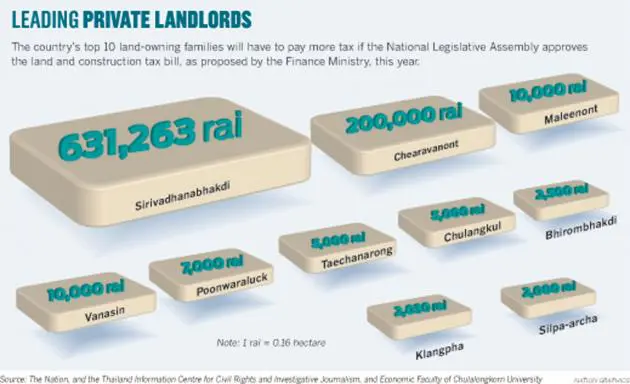
According to research by Prof Dr Phasuk Pongpichit, a lecturer in the Economics Faculty of Chulalongkorn University, land worth Bt10.87 billion is currently owned by just 134 people around the country.
Beverage tycoon Charoen Sirivadhanabhakdi and his family are the biggest private landowners with 631,263 rai (101,000 hectares), followed by the Chearavanont family, which holds 200,000 rai. (See graphic for other leading land-owning families.)
The research also shows that a total of 837 Thais each hold more than 1,000 rai, which means that a very large part of the country’s land is privately owned by less than 1 per cent of the Kingdom’s population of around 62 million.
Phasuk’s research supports the case for a land and construction tax law in order to distribute the nation’s land more equitably, which in turn would generate more value than is currently the case with much of it lying idle in the hands of a relatively small number of people.
