
Sumet urges action as sustainability challenges intensify
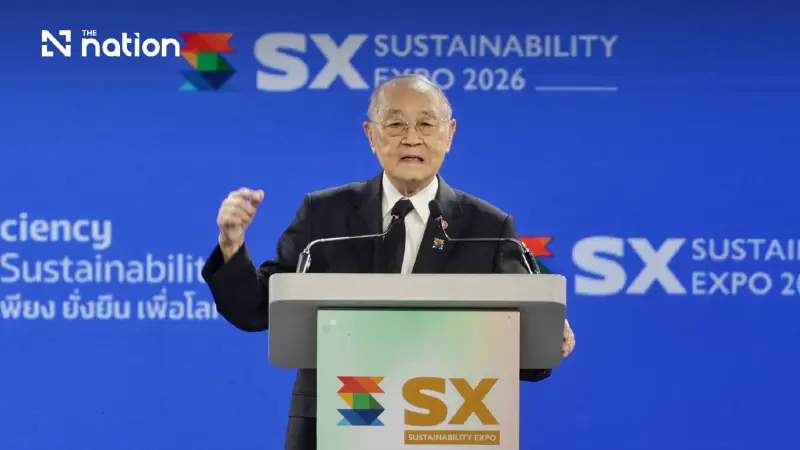


At Sustainability Expo 2026 in Bangkok, Sumet Tantivejkul urged organisations to put solutions into practice, adapt to change and involve younger generations.
- Sumet Tantivejkul has urged organisations to put environmental solutions into practice, stating that current efforts to protect the planet are insufficient as destructive activities continue.
- He called for greater cooperation and preparedness for environmental upheaval, suggesting societies must adapt to threats like flooding through careful planning and practical solutions.
- He advocated for the wider practical application of the Sufficiency Economy Philosophy's principles of moderation and resilience to tackle environmental and economic uncertainty.
- Sumet stressed that sustainability efforts must be passed on to younger generations to ensure the work continues, arguing that the task is never truly finished.
Sumet Tantivejkul, a board member and senior special adviser to the Chaipattana Foundation, urged organisations to put environmental solutions into practice and ensure sustainability efforts continued across generations.
Speaking at the opening of Sustainability Expo 2026 (SX2026) at the Queen Sirikit National Convention Centre in Bangkok on Monday (November 9), he stressed that efforts to protect the planet remained insufficient.
He also called for wider cooperation and greater preparedness for social, economic and environmental upheaval. Although conservation efforts were gaining support, he argued that destructive activities continued to threaten natural resources and that the work towards sustainability could never be considered complete.

More partners, greater responsibility
Reflecting on the expo's first edition, Sumet recalled two hopes he had expressed at the time: that more organisations and communities would become involved in sustainability efforts, and that discussions would progress from identifying problems to finding practical solutions.
He recalled that the inaugural expo had featured around 10 booths and noted that approximately 300 organisations were participating this year.
Despite that growth, Sumet cautioned that efforts to restore the planet were being undermined by the continued destruction of natural resources.
"Many people around the world are putting their efforts into protecting and restoring the planet. Sadly, others are still destroying the world, harming one another and using up the resources we have left," he remarked.
He pointed to disappearing forests and the degradation of land, water and other essential resources as reasons that sustainability initiatives must continue.
Recalling a personal encounter with the late King Bhumibol Adulyadej (Rama IX), Sumet repeated the monarch's message to him: "The work is not yet finished."
"What we have done is good, but it is not enough. We must keep going until we achieve a world that is sustainable and leave future generations the conditions they need to live," he emphasised.
Adapting to environmental threats
Sumet also asked the audience to consider how societies should respond to changes beyond their control.
He observed that continued development could bring increasingly complex challenges, including waste, water pollution, forest loss and disasters caused by both natural forces and human activities.
Using the threat of flooding in Bangkok and other coastal cities as an example, he outlined three possible responses: holding back floodwater, moving people away from danger or adapting communities to live with water.
He argued that each approach required careful planning and consideration of its impact on affected residents.
He questioned whether sufficient preparations were in place to relocate large numbers of people and provide essential supplies if communities had to move.
As an example of adapting to recurring floods, he recalled traditional approaches in Phetchaburi, where residents had adjusted their homes and daily routines to seasonal flooding.
"If we cannot fight the problem, what are we going to do? If we neither fight nor flee, and choose to live with it, then we must adapt. We must change how we live," he argued.
For Sumet, adaptation meant finding practical solutions suited to local conditions and people's needs.

Sufficiency Economy Philosophy remains relevant
Turning to the Sufficiency Economy Philosophy championed by King Rama IX, Sumet highlighted its continuing relevance amid rapid and unpredictable change.
He noted that the philosophy's formulation in 1999 repeatedly emphasised the need to prepare for change.
He argued that its principles of moderation, reasonableness, knowledge, careful judgement and resilience remained particularly relevant amid environmental degradation, natural disasters, economic uncertainty and changing energy conditions.
Sumet stressed that these principles should guide practical decisions and actions rather than remain theoretical ideas.
He also highlighted Thai Industrial Standard (TIS) 9999, introduced in 2013 as guidance for industrial organisations seeking to apply the Sufficiency Economy Philosophy.
More than a decade later, he expressed disappointment that its guidance had not been applied more widely, despite its potential to improve organisational management and support sustainable development.
"If we genuinely put these principles into practice, we can solve the problems. We can still solve them in time," he told the audience.

Passing sustainability efforts to younger generations
Sumet also stressed that sustainability initiatives must outlast individual projects, exhibitions and awards.
Innovation should deliver lasting benefits, he argued, with successful projects developed further rather than considered complete after their initial achievements.
Referring to the Chaipattana Foundation's activities involving young people in water and forest conservation, Sumet stressed the importance of helping children understand why natural resources matter to everyday life.
He encouraged organisations to involve successive generations, allowing younger participants to build on existing initiatives and develop new approaches suited to changing circumstances.
"We have to pass this work on from generation to generation. It cannot simply stop when one group finishes its activities, because the work itself is never finished," he emphasised.
