
Thailand and US Eye Concrete SMR Partnership as 2037 Nuclear Goal Nears


US funding, a legal framework and a skills push give Thai-US SMR cooperation fresh momentum, as experts name the ‘human gap’ as the biggest hurdle to 2037
- The US-Thailand partnership on Small Modular Reactors (SMRs) is being solidified through a legal framework ("123 Agreement"), US-funded feasibility studies, and Thailand's participation in the US FIRST programme for workforce and infrastructure development.
- Thailand's draft Power Development Plan sets a target to have its first SMR operational by 2037 to help meet rising electricity demand, declining gas output, and net-zero commitments.
- Experts identify the "human gap", or a shortage of skilled personnel such as regulators and operators, as the biggest hurdle to achieving the 2037 goal, estimating it will take a decade to develop the necessary workforce.
- To address the skills shortage, Thailand has outlined a phased plan that includes establishing a national nuclear organisation, training regulators, selecting a technology, and recruiting and training thousands of workers before 2037.
US funding, a legal framework and a skills push give Thai-US SMR cooperation fresh momentum, as experts name the ‘human gap’ as the biggest hurdle to 2037.
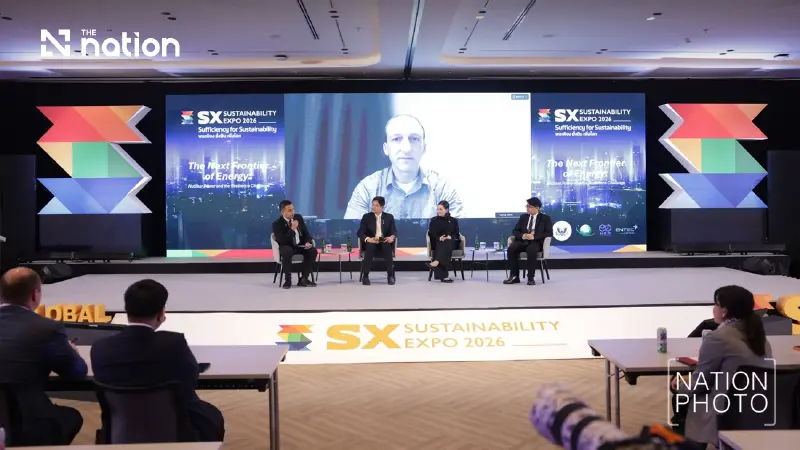
Thailand and the United States are moving from principle to practice on small modular reactors (SMRs), with US-funded feasibility work, a new legal framework and a joint push on skills pointing to an increasingly concrete nuclear partnership between the two countries, speakers said at a panel in Bangkok on Monday (November 9).
The discussion, “The Next Frontier of Energy: Nuclear Power and the Resilience Challenge”, was held as part of the SX Global Forum at Sustainability Expo 2026. It was organised by the US Embassy Bangkok with support from the Thailand Institute of Nuclear Technology (TINT), the National Science Museum and the National Energy Technology Center (ENTEC).
Building blocks already in place
Rebekah Vermillion, an economic officer at the US Embassy, said the bilateral “123 Agreement” (the U.S.–Thailand Civil Nuclear Cooperation Agreement), which came into force last year, supplies the legal foundation for civil nuclear cooperation.
On top of it, the US Trade and Development Agency (USTDA) is funding a pre-feasibility study for the Electricity Generating Authority of Thailand (EGAT).
“Basically we’re paying for engineers to evaluate all the different SMR technology proposals,” she said, adding that the work should help Thai engineers weigh technology options, sites and deployment models.

Thailand is also taking part in the US State Department’s flagship FIRST programme (Foundational Infrastructure for Responsible Use of Small Modular Reactor Technology).
It offers advice on feasibility studies, siting, financing, licensing, regulatory infrastructure, workforce development and technology selection.
Thailand’s draft Power Development Plan 2026 targets a first SMR by 2037, about 11 years away, and 9,000 megawatts of nuclear capacity by 2050, according to moderator Dr Kampanart Silva of ENTEC.

“Not like buying a barrel of oil”
Vermillion argued that nuclear power demands far more than hardware. “It’s not like buying a barrel of oil,” she said. A buyer needs a full ecosystem covering workforce, regulation, waste management and public engagement, she said.
She contrasted Washington’s approach with that of unnamed competitors offering a “buy-in-a-box” model. Such packages may be cheaper upfront, she said, but they hand over operations without giving the host country visibility, local capacity or genuine energy security. She called that approach fundamentally flawed.
On resilience, she pointed to the long relationship between the two countries and noted that reactors can operate for a century, so a buyer should choose a partner with proven staying power.
She also said US partners regard Thailand’s phased timeline as “realistic” and credible, which makes it a more attractive place to invest than a country with a shorter, more ambitious schedule.
Adopting nuclear power, she said, is “not a sprint”.

People are the biggest gap
Asked where Thailand’s biggest shortfall lies, Dr Wasin Vechgama of TINT, who also manages the Hub of Talents for Nuclear Energy Technology (HOTNET), was unequivocal: people.
Regulation and infrastructure both depend on skilled staff, and a decade is needed to develop them. He sketched three phases to 2037. Next year, once the power plan is settled, Thailand would set up a national ‘Nuclear Energy Programme Implementing Organisation’ (NEPIO), bringing several ministries together, and begin training more than 50 regulators able to review SMR safety analysis reports.
From 2029 to 2032, it would select a technology and train the operators who will run it. From 2032 to 2036, it would recruit an estimated 2,000 construction workers and about 500 permanent plant staff, figures he said were based on international guidance for a first SMR.
The hardest task, he said, is training regulators to assess a specific SMR design.
He suggested US experience, including that of NuScale Power and other companies working with the US Department of Energy, could help, and called for owners to build up engineering, procurement and construction know-how and to work closely with technical support organisations (TSOs) such as TINT.

Why SMRs, and why now
Dr Thawatchai Onjun, director of the National Science Museum, said rising electricity demand, a decline in Gulf of Thailand gas output and volatile oil and gas prices linked to conflicts in Ukraine and the Middle East had left Thailand with few options.
Net-zero commitments add pressure, he said, and reaching them without nuclear power would be “really difficult”. Industry is strongly supportive, he said, partly because it wants green energy to compete in global markets.
The public is open to nuclear power, he added, but still has questions about how Thailand will do it and how risk will be managed.
He said attitudes have shifted since the Fukushima accident that halted an earlier push because of the energy context and major safety advances after Fukushima and Chernobyl.
Professor Michael Short of the Massachusetts Institute of Technology (MIT), speaking online, said SMRs pair well with Thai industry, particularly where process heat and steam are needed.
He cited a hypothetical pulp and paper company, adding that chemicals, oil and gas, and data centres also fit well.
On finance, he said a gigawatt-scale plant in the US has recently cost more than US$10 billion, putting it within reach only of governments and the largest companies. Because SMRs are smaller, he argued, payback could come in four or five years rather than about 20, opening the market to mid-sized firms.

Safety, security and the machines
On natural hazards, Prof Short said SMRs face the same rules as large plants, which must shut down safely even in “beyond design basis” events.
He recalled a magnitude 7.1 earthquake at a Japanese plant that he barely felt and noted that the Onagawa plant survived the tsunami that struck Fukushima.
He claimed that nuclear power is statistically as safe as solar and that SMRs should be safer per megawatt because a smaller amount of power is easier to control.
Addressing cyber threats, Dr Thawatchai noted that Thailand’s research reactor, which has operated for more than 60 years, uses isolated control systems. Meanwhile, Vermillion stated that US Cyber Command is rolling out cybersecurity support for partner countries’ energy sectors, covering oil and gas alongside SMRs.
On artificial intelligence, Dr Wasin said human supervision remains essential because automated systems can multiply errors.
Prof Short said it would be “a long, long, long time” before AI could run a reactor, as there is little data on accidents, “and I hope there never is”. He put the horizon at perhaps 50 years.

Winning public trust
Prof Short said US communities warm to nearby plants through public tours and legally required public hearings. He described asking MIT students to burn 1,000 bananas, which contain naturally radioactive potassium, and measure the result.
Trust arrives in drops and is lost in buckets, he said, and building it takes years of one-to-one listening. Dr Thawatchai said Thailand could learn from such outreach and use it as a shortcut.
Regional ambitions and next steps
Dr Wasin noted that Southeast Asia is not starting from zero: Malaysia has established a nuclear energy body and approached vendors, Singapore is finding experts to assess technologies, and Vietnam is reviewing its infrastructure.
Thailand could use the Asian Network on Nuclear Power Safety Research and TSO networks to share knowledge with regulators, he said.
Asked for priorities over the next 12 months, the panellists converged on skills. Dr Thawatchai called for training seminars and research exchanges.
Dr Wasin proposed that experts from EGAT, TINT and other agencies work alongside US counterparts on the USTDA project and that FIRST be used to develop SMR courses for operators and experts.
Prof Short urged joint educational partnerships, with immersion programmes and exchanges of young experts and students, which he said could begin within weeks rather than months.
“It’s hard to spin up technology right away,” he said, “but the one thing as an educator, we can spin up person-to-person interaction immediately.”
